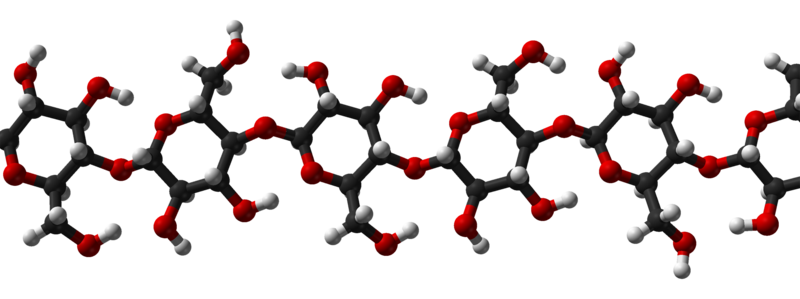
File:Cellulose-Ibeta-from-xtal-2002-3D-balls.png · Wikimedia Commons · See Wikimedia Commons
polysaccharide
Sign in to saveAlso known as polysaccharides
thumb|upright=1.5|3D structure of cellulose, a [[beta-glucan polysaccharide]] thumb|class=skin-invert-image|upright=1.5|Amylose is a linear [[polymer of glucose mainly linked with α(1→4) bonds. It can be made of several thousands of glucose units. It is one of the two components of starch, the other being amylopectin.]]
A polysaccharide is a large molecule made up of many sugar units linked together in a chain, with examples including cellulose (found in plants) and starch (a storage carbohydrate in many organisms). Polysaccharides are important because they serve as key structural materials and energy sources—cellulose provides plant cell structure, while starch stores energy that organisms can access when needed.
AI-generated from the Wikipedia summary — may contain errors.
Research
755,281 papers- Astragalus polysaccharide: a review of its immunomodulatory effect.ReviewArchives of pharmacal research · 2022Li CX, Liu Y, Zhang YZ et al.DOI: 10.1007/s12272-022-01393-3
- Polysaccharide nanoparticles: from fabrication to applications.ReviewJournal of materials chemistry. B · 2021Plucinski A, Lyu Z, Schmidt BVKJDOI: 10.1039/d1tb00628b
- Biological activities and pharmaceutical applications of polysaccharide from natural resources: A review.ReviewCarbohydrate polymers · 2018Yu Y, Shen M, Song Q et al.DOI: 10.1016/j.carbpol.2017.12.009
- Extracellular polysaccharide biosynthesis in Cordyceps.ReviewCritical reviews in microbiology · 2020Yang S, Yang X, Zhang HDOI: 10.1080/1040841X.2020.1794788
- Polysaccharide-Based Biomaterials in Tissue Engineering: A Review.ReviewTissue engineering. Part B, Reviews · 2021Jin M, Shi J, Zhu W et al.DOI: 10.1089/ten.TEB.2020.0208
- Polysaccharide lyases.ReviewApplied biochemistry and biotechnology · 1986Linhardt RJ, Galliher PM, Cooney CLDOI: 10.1007/BF02798420
- Plant polysaccharide degradation-related enzymes in Aspergillus oryzae.ReviewBioscience, biotechnology, and biochemistry · 2024Matsuzawa TDOI: 10.1093/bbb/zbad177
- Polysaccharide-based hydrogels: New insights and futuristic prospects in wound healing.ReviewInternational journal of biological macromolecules · 2022Raina N, Pahwa R, Thakur VK et al.DOI: 10.1016/j.ijbiomac.2022.11.115
via PubMed
Wikidata facts
- Subclass of
- biopolymer
- Has part
- oxygen
Show 5 more facts
- Commons category
- Polysaccharides
- topic's main category
- Category:Polysaccharides
- opposite of
- oligosaccharide
- on focus list of Wikimedia project
- Wikipedia:Vital articles/Level/4
- polymer of
- monosaccharide
via Wikidata · CC0
~17 min read
Encyclopedic overview
20 sectionsContents
- Cellulose and dietary fiber
- Structure
- Storage polysaccharides
- Starch
- Glycogen
- Galactogen
- Inulin
- Structural polysaccharides
- Arabinoxylans
- Cellulose
- Chitin
- Pectins
- Acidic polysaccharides
- Bacterial polysaccharides
- Chemical identification tests for polysaccharides
- Periodic acid-Schiff stain (PAS)
- Derivatives
- See also
- References
- External links
thumb|upright=1.5|3D structure of cellulose, a [[beta-glucan polysaccharide]] thumb|class=skin-invert-image|upright=1.5|Amylose is a linear [[polymer of glucose mainly linked with α(1→4) bonds. It can be made of several thousands of glucose units. It is one of the two components of starch, the other being amylopectin.]]
Polysaccharides (; ) are "Compounds consisting of a large number of monosaccharides linked glycosidically". They are the most abundant carbohydrates in food. Their structures range from linear to highly branched polymers. Examples include storage polysaccharides such as starch, glycogen, and galactogen and structural polysaccharides such as hemicellulose and chitin. The term "glycan" is synonymous with polysaccharide, but often glycans are discussed in the context of glycoconjugates, i.e. hybrids of polysaccharides and proteins or lipids.
Excerpted from Wikipedia’s “polysaccharide” article, available under the CC BY-SA 4.0 licence.
Gallery (11)
Available in 75 languages
- Español
- Français
- Deutsch
- 中文
- 日本語
- Русский
- Português
- Italiano
- العربية
- हिन्दी
- Albanian
- Armenian
- Asturian
- azb
- Azerbaijani
- Bahasa Indonesia
- Bangla
- Basque
Show 56 more
- be_x_old
- Belarusian
- Bosnian
- Bulgarian
- Catalan
- Croatian
- Czech
- Danish
- Esperanto
- Estonian
- Finnish
- Galician
- Georgian
- Greek
- Hebrew
- Hungarian
- Icelandic
- Ido
- Irish
- Javanese
- Kazakh
- Kyrgyz
- Latvian
- Limburgish
- Lithuanian
- Macedonian
- Malay
- Nederlands
- Norwegian
- Norwegian Nynorsk
- Occitan
- Polski
- Romanian
- Scottish Gaelic
- Serbian
- Serbian (Latin)
- simple
- Slovak
- Slovenian
- Sundanese
- Svenska
- Tajik
- Tamil
- Telugu
- Tiếng Việt
- Türkçe
- Ukrainian
- Uzbek
- Waray
- Welsh
- Wu Chinese
- zh_min_nan
- zh_yue
- فارسی
- ไทย
- 한국어
via Wikidata sitelinks · CC0