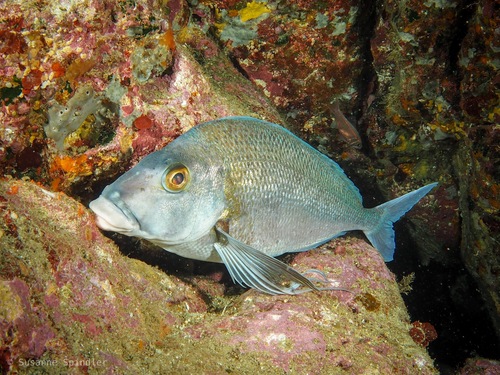
(c) Susanne Spindler, some rights reserved (CC BY-NC-ND), uploaded by Susanne Spindler · cc-by-nc-nd
Porae
Sign in to saveAlso known as Nemadactylus douglasii, Rubberlip perch, Douglas morwong
The porae (Nemadactylus douglasii), the grey morwong, blue morwong, butterfish, '''Douglas' morwong, Eastern blue morwong, great perch, queen snapper, rubberlip morwong or silver morwong''', is a species of marine ray-finned fish, traditionally regarded as belonging to the family Cheilodactylidae, the members of which are commonly known as morwongs. It is found around south eastern Australia and the north eastern coast of the North Island of New Zealand at depths of about 10 to 100 metres, on sandy and rocky coasts.
Species
Grey Morwong
Species
- PhylumChordata
- ClassTeleostei
- OrderCentrarchiformes
- FamilyCheilodactylidae
via
Wikidata facts
- Instance of
- taxon
- Parent taxon
- Nemadactylus
- Image
- Nemadactylus douglasii (Porae).jpg
Show 4 more facts
- Commons category
- Nemadactylus douglasii
- taxon rank
- species
- taxon name
- Nemadactylus douglasii
- Commons gallery
- Nemadactylus douglasii
Sources (1)
via Wikidata · CC0
~5 min read
Encyclopedic overview
6 sectionsContents
- Taxonomy
- Description
- Distribution and habitat
- Biology
- Fisheries
- References
The porae (Nemadactylus douglasii), the grey morwong, blue morwong, butterfish, '''Douglas' morwong, Eastern blue morwong, great perch, queen snapper, rubberlip morwong or silver morwong', is a species of marine ray-finned fish, traditionally regarded as belonging to the family Cheilodactylidae, the members of which are commonly known as morwongs. It is found around south eastern Australia and the north eastern coast of the North Island of New Zealand at depths of about 10 to 100 metres, on sandy and rocky coasts.
==Taxonomy== The porae was first formally described as Cheilodactylus douglasii 1875 by the Scottish-born New Zealand geologist, naturalist and surgeon James Hector with the type localities given as Ngunguru Bay, north of Whangārei and Bay of Islands, Auckland, New Zealand. The specific name honours Sir Robert Andrews Mackenzie Douglas, 3rd Baronet of Douglas of Glenbervie, a former officer in the British Army and New Zealand politician who provided Hector with “kind hospitality” on a “pleasant fishing excursion” at Ngunguru Bay during which he collected some "fine" new specimens. Genetic and morphological analyses strongly support the placement of Nemadactylus in the family Latridae, alongside almost all of the other species formerly classified in the Cheilodactylidae.
Excerpted from Wikipedia’s “Porae” article, available under the CC BY-SA 4.0 licence.