Pyrularia · Kew POWO · Kew Plants of the World Online
Pyrularia
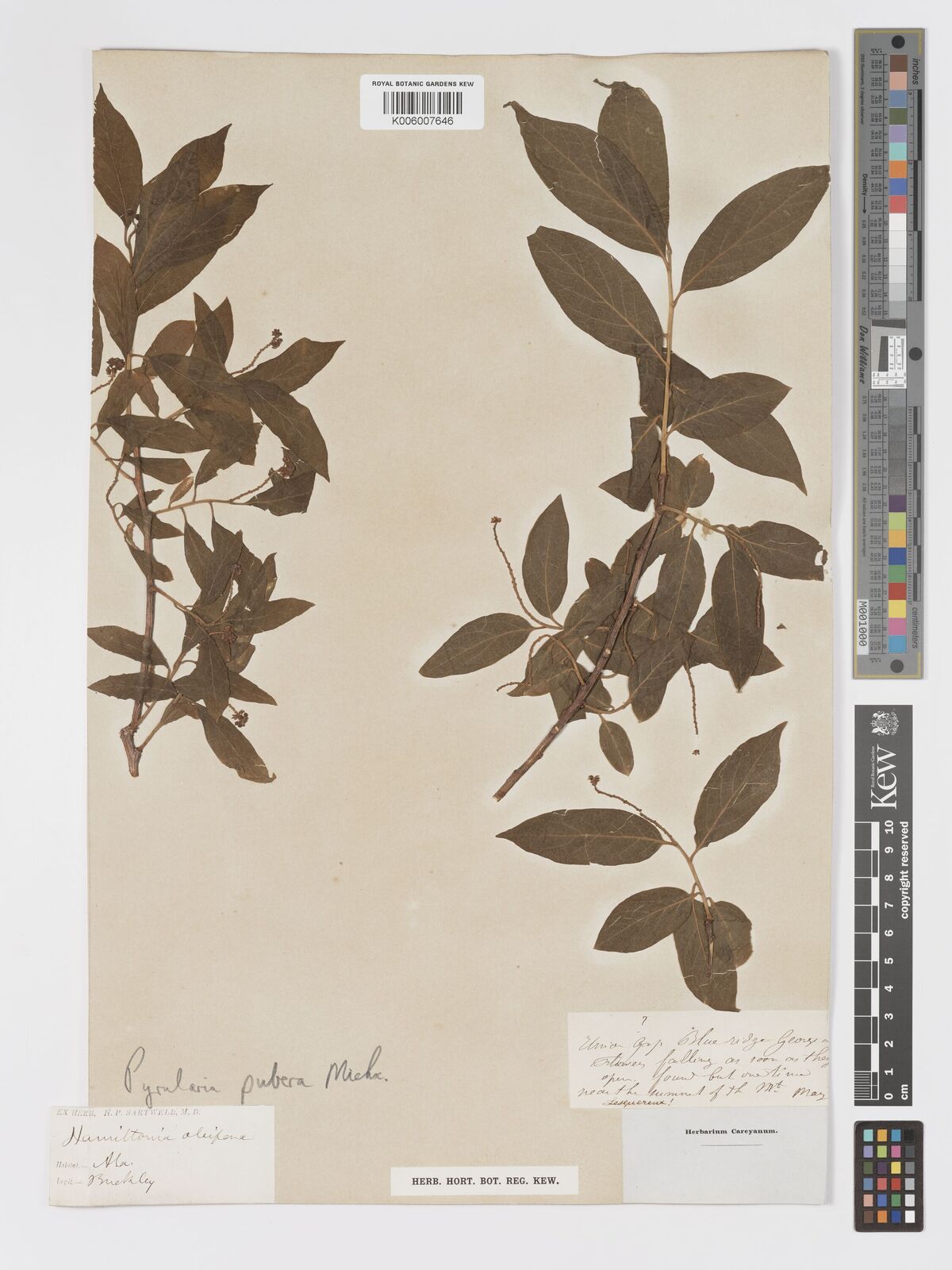
Sign in to savePyrularia is a small genus of shrubs or small trees in the sandalwood family (Santalaceae) which contains two species, Pyrularia pubera and Pyrularia edulis. P. pubera grows in the eastern United States and P. edulis grows in Bhutan, China, India, Myanmar, and Nepal. Both species are parasitic plants, specifically hemiparasites, which while still photosynthetic, will also parasitize the roots of other plants around them.
In the Vinony graph
Within Vinony's link graph, Pyrularia is referenced by 6 other articles, and connects out to André Michaux, plant and Pyrus.
Vinony files it under Santalaceae, Santalaceae genera and Taxa described in 1803.
Its subject is documented across 8 Wikipedia language editions.
Species
GENUS
- KingdomPlantae
- PhylumTracheophyta
- ClassMagnoliopsida
- OrderSantalales
- FamilyCervantesiaceae
via GBIF · Kew POWO
Museum specimens
- Specimen records
- 70
- With media
- 67
- Family
- Cervantesiaceae
- Collections
- CAS, ANSP, CDA, MU, MO, NO
- Recorded in
- United States, China, South Africa, Korea, Democratic Peoples Republic Of, [Etats-Unis]
Research
38 papers- Pyrularia thionin. Physical properties, binding to phospholipid bilayers and cellular responses.Advances in experimental medicine and biology · 1996
- Pyrularia thionin increases arachidonate liberation and prolactin and growth hormone release from anterior pituitary cells.Toxicon : official journal of the International Society on Toxinology · 1992
- Cellular responses to Pyrularia thionin are mediated by Ca2+ influx and phospholipase A2 activation and are inhibited by thionin tyrosine iodination.Proceedings of the National Academy of Sciences of the United States of America · 1989
- Modification of phospholipid membrane structure by the plant toxic peptide Pyrularia thionin.Archives of biochemistry and biophysics · 1993
- Phospholipase activation in the cytotoxic mechanism of thionin purified from nuts of Pyrularia pubera.Toxicon : official journal of the International Society on Toxinology · 1990
via PubMed
Wikidata facts
- Instance of
- taxon
- Parent taxon
- Santalaceae
- Image
- Pyrularia pubera NRCS-2.jpg
Show 6 more facts
- Commons category
- Pyrularia
- taxon name
- Pyrularia
- taxon rank
- genus
- taxon common name
- 檀梨属
- topic's main category
- Category:Pyrularia
Sources (2)
via Wikidata · CC0
~1 min read
Encyclopedic overview
2 sectionsContents
- Taxonomy
- References
Pyrularia is a small genus of shrubs or small trees in the sandalwood family (Santalaceae) which contains two species, Pyrularia pubera and Pyrularia edulis. P. pubera grows in the eastern United States and P. edulis grows in Bhutan, China, India, Myanmar, and Nepal. Both species are parasitic plants, specifically hemiparasites, which while still photosynthetic, will also parasitize the roots of other plants around them.
==Taxonomy== The genus was first formally named in 1803 by French botanist André Michaux. The name Pyrularia derives from the Latin pyrus meaning "pear" and aria meaning "connecting" — this relates to the shape of the fruit.
Excerpted from Wikipedia’s “Pyrularia” article, available under the CC BY-SA 4.0 licence.