File:Quark_structure_proton.svg · Wikimedia Commons · See Wikimedia Commons
Quark
Sign in to saveElementarteilchen, aus denen Hadronen im Standardmodell der Teilchenphysik bestehen
A quark is one of the tiniest building blocks of matter that combines with other quarks to form protons and neutrons, which make up the nuclei of atoms. Quarks are important because understanding them helps us explain what all ordinary matter around us is fundamentally made of, though they can never be observed by themselves—they only exist bound together inside larger particles.
AI-generated from the Wikipedia summary — may contain errors.
Key facts
- Particle.alt
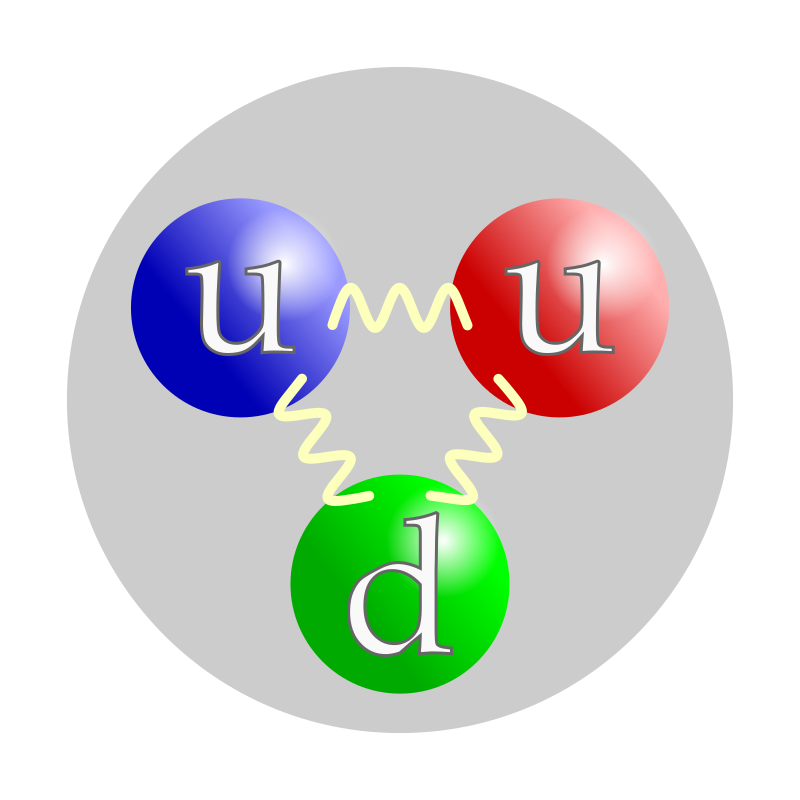
- Three colored balls (symbolizing quarks) connected pairwise by springs (symbolizing gluons), all inside a gray circle (symbolizing a proton). The colors of the balls are red, green, and blue, to parallel each quark's color charge. The red and blue balls are labeled "u" (for "up" quark) and the green one is labeled "d" (for "down" quark).
- Particle.caption
- A proton is composed of two up quarks, one down quark, and the gluons that mediate the forces "binding" them together. The color assignment of individual quarks is arbitrary, but all three colors must be present; red, blue and green are used as an analogy to the primary colors that together produce a white color.
- Particle.num_types
- 6 (up, down, strange, charm, bottom, and top)
- Particle.composition
- elementary particle
- Particle.statistics
- fermionic
- Particle.generation
- 1st, 2nd, 3rd
- Particle.interaction
- strong, weak, electromagnetic, gravitation
- Particle.antiparticle
- antiquark ()
- Particle.discovered
- SLAC ()
- Particle.electric_charge
- + e, − e
- Particle.color_charge
- yes
- Particle.spin
- ħ
- Particle.name
- Quark
- Particle.image
- Quark structure proton.svg
- Particle.image_size
- 225px
via Wikipedia infobox
Wikidata facts
- Subclass of
- charged particle
- Part of
- hadron
- Followed by
- diquark
- Image
- Quark.svg
Show 10 more facts
- interaction
- electromagnetic interaction
- Commons category
- Quarks
- topic's main category
- Category:Quarks
- antiparticle
- antiquark
- Commons gallery
- Quark
- spin quantum number
- 0.5
- has superpartner
- squark
- has characteristic
- electric charge
- Stack Exchange tag
- physics.stackexchange.com/tags/quarks
- on focus list of Wikimedia project
- Wikipedia:Vital articles/Level/4
Sources (9)
via Wikidata · CC0
Article · Deutsch
Quarks (kwɔrks, kwɑːks oder kwɑrks) sind Elementarteilchen und fundamentale Bestandteile der Materie. Quarks verbinden sich zu zusammengesetzten Teilchen, die Hadronen genannt werden. Hierzu gehören die Protonen und Neutronen, die Bestandteile der Atomkerne. Aufgrund eines Phänomens, das als Confinement bekannt ist, werden Quarks nie isoliert gefunden, sondern nur gebunden in Hadronen oder in Quark-Gluon-Plasmen. Quarks sind die einzigen Elementarteilchen im Standardmodell der Teilchenphysik, die allen vier fundamentalen Wechselwirkungen (starke Wechselwirkung, Elektromagnetismus, schwache Wechselwirkung, Gravitation) unterliegen, sowie die einzigen Teilchen, deren elektrische Ladungen keine ganzzahligen Vielfachen der Elementarladung sind. Es gibt sechs Arten von Quarks, die als „Flavours“ bezeichnet werden: up, down, charm, strange, top und bottom. Protonen und Neutronen sind aus Up- und Down-Quarks zusammengesetzt, den Quarks mit der mit Abstand geringsten Masse. Die schwereren Quarks treten nur in sehr kurzlebigen Hadronen auf, die bei hochenergetischen Kollisionen (z. B. mit kosmischer Strahlung und in Teilchenbeschleunigern) entstehen und durch die Schwache Wechselwirkung zerfallen. Zu jedem Quark-Flavour gibt es das entsprechende Antiteilchen (Antiquark), dessen elektrische Ladung und andere Quantenzahlen entgegengesetzte Vorzeichen haben.
Abstract from DBpedia / Wikipedia · CC BY-SA
Gallery (31)
Available in 106 languages
- Español
- Français
- Deutsch
- 中文
- 日本語
- Русский
- Português
- Italiano
- العربية
- हिन्दी
- Afrikaans
- Albanian
- Albanian
- Angika
- Armenian
- Asturian
- azb
- Azerbaijani
Show 87 more
- Bahasa Indonesia
- Bangla
- Basque
- be_x_old
- Belarusian
- Bosnian
- Bulgarian
- Burmese
- Catalan
- Central Kurdish
- Chuvash
- Croatian
- Czech
- Danish
- Esperanto
- Estonian
- Filipino
- Finnish
- Galician
- Georgian
- Greek
- Haitian Creole
- Hebrew
- Hungarian
- Icelandic
- Ido
- Interlingua
- Irish
- Kazakh
- Kurdish
- Kyrgyz
- Lao
- Latin
- Latvian
- Limburgish
- Lingua Franca Nova
- Lithuanian
- lld
- Low German
- Luxembourgish
- Macedonian
- Malay
- Malayalam
- Maltese
- Marathi
- Mongolian
- Moroccan Arabic
- Nederlands
- Nepali
- Norwegian
- Norwegian Nynorsk
- Occitan
- Oromo
- Pashto
- Polski
- Punjabi
- Romanian
- Scots
- Serbian
- Serbian (Latin)
- Sicilian
- simple
- Slovak
- Slovenian
- Sundanese
- Svenska
- Tajik
- Tamil
- Tatar
- Telugu
- Tiếng Việt
- Toki Pona
- Türkçe
- Ukrainian
- Urdu
- Uzbek
- Venetian
- Waray
- Welsh
- Western Panjabi
- Wu Chinese
- zh_classical
- zh_yue
- Zulu
- فارسی
- ไทย
- 한국어
via Wikidata sitelinks · CC0