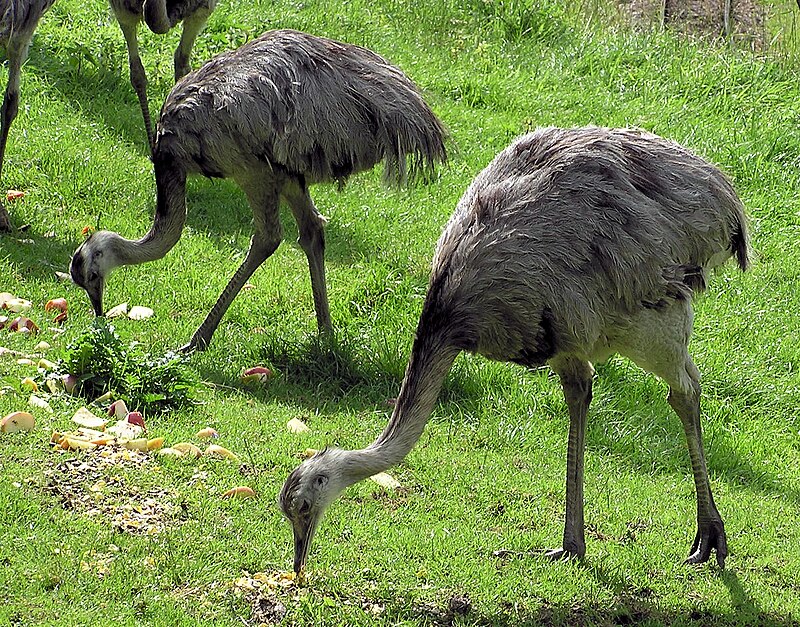
File:Greater_rhea_pair_arp.jpg · Wikimedia Commons · See Wikimedia Commons
OverviewAI-generated
Rhea is a genus of birds within the family Rheidae, order Rheiformes, and class Aves. The taxon was described by Brisson in 1760 and is named after Rhea. It belongs to the phylum Chordata and kingdom Animalia. Members of this genus are oviparous and move via bipedalism. The genus has existed since the Pleistocene, with a start time of about 126 thousand years ago.
Rhea is endemic to South America. The species is not extinct and holds a conservation status of near threatened. Biological records indicate an egg incubation period of 6 and a litter size of 27.5. Occurrence data from various sources includes 68,952 records, while iNaturalist lists 4,842 observations. Institutional records are held by MSB, JSNM, CUMV, FMNH, and UMNH, with collections from the United States, Argentina, and Xx.
Synthesized by Vinony from 46 facts across 7 sources: Wikidata, GBIF, iNaturalist, Gbif Occ, WoRMS, iDigBio, Vinony graph. Generated from structured data (not the Wikipedia text) and checked against those facts — may still contain errors.
Species
Greater Rhea
Rhea
GENUS
- KingdomAnimalia
- PhylumChordata
- ClassAves
- OrderRheiformes
- FamilyRheidae
鶆䴈(學名Rhea)是南美洲的一屬鴕鳥。其下有兩個現存物種,包括美洲鴕及達爾文鶆䴈。由於此種鳥類無法飛行而只能在地上走的特性,因此德國動物學家保羅‧莫寧(英语:Paul Möhring)(Paul Möhring)將其屬名以希臘文的瑞亞(Rhea, "地面")來命名。[來源請求]
via GBIF
Museum specimens
- Specimen records
- 52
- With media
- 1
- Family
- Rheidae
- Collections
- MSB, JSNM, CUMV, FMNH, UMNH, NHMUK
- Recorded in
- United States, Argentina, Xx
Wikidata facts
Show 12 more facts
- taxon name
- Rhea
- taxon rank
- genus
- Commons category
- Rheidae
- topic's main category
- Category:Rhea (genus)
- means of locomotion
- bipedalism
- start time
- 126000-00-
- endemic to
- South America
- egg incubation period
- 6
- litter size
- 27.5
- on focus list of Wikimedia project
- Wikipedia:Vital articles/Level/4
- has characteristic
- oviparity
- temporal range start
- Pleistocene
Sources (2)
via Wikidata · CC0
~11 min read
Encyclopedic overview
The rhea (/ˈriːə/ REE-ə), also known as the ñandú (/njænˈduː/ nyan-DOO) or South American ostrich, is a South American ratite (flightless bird without a keel on the sternum bone) of the order Rheiformes. Rheas are distantly related to the two African ostriches and Australia's emu (the largest, second-largest and third-largest living ratites, respectively), with rheas placing just behind the emu in height and overall size.
Most taxonomic authorities recognize two extant species: the greater, or American, rhea (Rhea americana); and the lesser, or Darwin's, rhea (Rhea pennata). The International Union for Conservation of Nature (IUCN) classifies the puna rhea as another species instead of a subspecies of the lesser rhea. The IUCN currently rates the greater and puna rheas as near-threatened in their native ranges, while Darwin's rhea is of least concern, having recovered from past threats to its survival. In addition, the feral population of the greater rhea in Germany appears to be growing. However, control efforts are underway and seem to succeed in controlling the birds' population growth. Similarly to ostriches and emus, rheas are fairly popular livestock and pets, regularly kept and bred on farms, ranches, private parks, and by aviculturists, mainly in North and South America and Europe.
Excerpted from Wikipedia’s “Rhea” article, available under the CC BY-SA 4.0 licence.
Gallery (15)
Available in 74 languages
- Español
- Français
- Deutsch
- 中文
- 日本語
- Русский
- Português
- Italiano
- العربية
- Armenian
- Asturian
- Aymara
- Azerbaijani
- Bahasa Indonesia
- Balinese
- Bangla
- Basque
- be_x_old
Show 55 more
- Belarusian
- Breton
- Bulgarian
- Catalan
- Cebuano
- Cherokee
- Chuvash
- Croatian
- Czech
- Danish
- Egyptian Arabic
- Esperanto
- Finnish
- Galician
- Georgian
- Greek
- Guarani
- Hebrew
- Hungarian
- Irish
- Kannada
- Kazakh
- Kotava
- Kyrgyz
- Latin
- Latvian
- Limburgish
- Lithuanian
- Low German
- Malay
- Malayalam
- Nederlands
- Northern Frisian
- Norwegian
- Norwegian Nynorsk
- Pashto
- Polski
- Quechua
- Romanian
- Serbian
- Serbian (Latin)
- simple
- Slovenian
- Svenska
- Tiếng Việt
- Türkçe
- Ukrainian
- Uzbek
- Western Frisian
- Western Mari
- Wu Chinese
- Zeelandic
- zh_yue
- فارسی
- 한국어
via Wikidata sitelinks · CC0