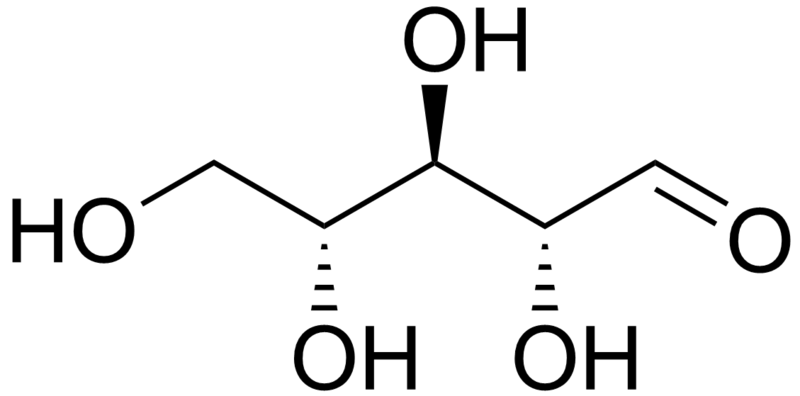
File:D-Ribose.png · Wikimedia Commons · See Wikimedia Commons
ribose
Sign in to savealt=|thumb|class=skin-invert-image| Fischer Projection Ribose is a simple sugar and carbohydrate with molecular formula C5H10O5 and the linear-form composition H−(C=O)−(CHOH)4−H. The naturally occurring form, , is a component of the ribonucleotides from which RNA is built, and so this compound is necessary for coding, decoding, regulation and expression of genes. It has a structural analog, deoxyribose, which is a similarly essential component of DNA. is an unnatural sugar that was first prepared by Emil Fischer and Oscar Piloty in 1891. It was not until 1909 that Phoebus Levene and Walter Jac
Ribose is a simple sugar with the molecular formula C5H10O5 that serves as a key building block of RNA, the molecule responsible for coding, decoding, and expressing genes. Because RNA is essential for how cells read and use genetic information, ribose is fundamental to all living organisms.
AI-generated from the Wikipedia summary — may contain errors.
Research
51,770 papers- D-ribose metabolic disorder and diabetes mellitus.ReviewMolecular biology reports · 2024Tai Y, Zhang Z, Liu Z et al.DOI: 10.1007/s11033-023-09076-y
- Ribose Intake as Food Integrator: Is It a Really Convenient Practice?ReviewBiomolecules · 2022Moschini R, Balestri F, Cappiello M et al.DOI: 10.3390/biom12121775
- RNA ribose methylation (2'-O-methylation): Occurrence, biosynthesis and biological functions.ReviewBiochimica et biophysica acta. Gene regulatory mechanisms · 2019Ayadi L, Galvanin A, Pichot F et al.DOI: 10.1016/j.bbagrm.2018.11.009
- An Update on Poly(ADP-ribose) Polymerase I-A Brief Review.ReviewMini reviews in medicinal chemistry · 2023Negi P, Lakshmanan K, Patel PK et al.DOI: 10.2174/1389557523666230221145844
- Biosynthesis of Ribose-5-Phosphate-Metabolic Regulator of Escherichia coli Viability.ReviewCells · 2025Seregina TA, Shakulov RS, Petrushanko IY et al.DOI: 10.3390/cells14221775
- Prebiotic Pathway from Ribose to RNA Formation.ReviewInternational journal of molecular sciences · 2021Banfalvi GDOI: 10.3390/ijms22083857
- Microbial and enzymatic strategies for the production of L-ribose.ReviewApplied microbiology and biotechnology · 2020Chen M, Wu H, Zhang W et al.DOI: 10.1007/s00253-020-10471-9
- The furanosidic scaffold of d-ribose: a milestone for cell life.ReviewBiochemical Society transactions · 2019Del-Corso A, Cappiello M, Moschini R et al.DOI: 10.1042/BST20190749
via PubMed
Wikidata facts
Show 3 more facts
- described by source
- Armenian Soviet Encyclopedia
- Commons category
- Ribose
- topic's main category
- Category:Ribose
via Wikidata · CC0
~14 min read
Encyclopedic overview
11 sectionsContents
- Synthesis and sources
- Structure
- Functions
- Signaling pathways
- Metabolism
- Nucleotide biosynthesis
- Modifications
- Modifications in nature
- Synthetic modifications
- Medical uses
- References
alt=|thumb|class=skin-invert-image| Fischer Projection Ribose is a simple sugar and carbohydrate with molecular formula C5H10O5 and the linear-form composition H−(C=O)−(CHOH)4−H. The naturally occurring form, , is a component of the ribonucleotides from which RNA is built, and so this compound is necessary for coding, decoding, regulation and expression of genes. It has a structural analog, deoxyribose, which is a similarly essential component of DNA. is an unnatural sugar that was first prepared by Emil Fischer and Oscar Piloty in 1891. It was not until 1909 that Phoebus Levene and Walter Jacobs recognised that was a natural product, the enantiomer of Fischer and Piloty's product, and an essential component of nucleic acids. Fischer chose the name "ribose" as it is a partial rearrangement of the name of another sugar, arabinose, of which ribose is an epimer at the 2' carbon; both names also relate to gum arabic, from which arabinose was first isolated and from which they prepared .
Like most sugars, ribose exists as a mixture of cyclic forms in equilibrium with its linear form, and these readily interconvert especially in aqueous solution. The name "ribose" is used in biochemistry and biology to refer to all of these forms, though more specific names for each are used when required. In its linear form, ribose can be recognised as the pentose sugar with all of its hydroxyl functional groups on the same side in its Fischer projection. has these hydroxyl groups on the right hand side and is associated with the systematic name (2R,3R,4R)-2,3,4,5-tetrahydroxypentanal, whilst has its hydroxyl groups appear on the left hand side in a Fischer projection. Cyclisation of ribose occurs via hemiacetal formation due to attack on the aldehyde by the C4' hydroxyl group to produce a furanose form or by the C5' hydroxyl group to produce a pyranose form. In each case, there are two possible geometric outcomes, named as α- and β- and known as anomers, depending on the stereochemistry at the hemiacetal carbon atom (the "anomeric carbon"). At room temperature, about 76% of is present in pyranose forms (α:β = 1:2) and 24% in the furanose forms (α:β = 1:3), with only about 0.1% of the linear form present.
Excerpted from Wikipedia’s “ribose” article, available under the CC BY-SA 4.0 licence.
Gallery (15)
Available in 68 languages
- Español
- Français
- Deutsch
- 中文
- 日本語
- Русский
- Português
- Italiano
- العربية
- हिन्दी
- Albanian
- Armenian
- azb
- Azerbaijani
- Bahasa Indonesia
- Bangla
- Basque
- be_x_old
Show 49 more
- Belarusian
- Bosnian
- Bulgarian
- Catalan
- Central Kurdish
- Croatian
- Czech
- Danish
- Esperanto
- Estonian
- Finnish
- Galician
- Georgian
- Greek
- Hebrew
- Hungarian
- Irish
- Javanese
- Kazakh
- Latvian
- Lithuanian
- Macedonian
- Malay
- Nederlands
- Norwegian
- Norwegian Nynorsk
- Occitan
- Polski
- Quechua
- Romanian
- Rusyn
- Serbian
- Serbian (Latin)
- simple
- Slovak
- Slovenian
- Svenska
- Tamil
- Tatar
- Tiếng Việt
- Türkçe
- Ukrainian
- Uzbek
- Western Frisian
- Wu Chinese
- zh_min_nan
- فارسی
- ไทย
- 한국어
via Wikidata sitelinks · CC0