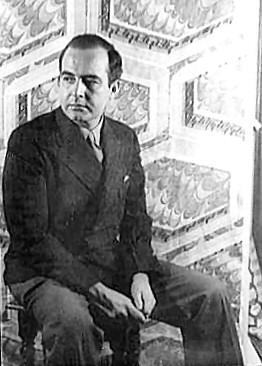
File:Samuel_Barber.jpg · Wikimedia Commons · See Wikimedia Commons
Samuel Barber
Sign in to saveAlso known as Samuel Osborne Barber II, Samuel Osborne Barber
American composer (1910-1981)
OverviewAI-generated
Samuel Barber was an American composer, musicologist, pianist, and conductor. Born Samuel Osmond Barber II on March 9, 1910, in West Chester, Pennsylvania, he began his work period in 1917. He was educated at the Curtis Institute of Music and spoke English. His notable works include the Cello Concerto, Adagio for Strings, Violin Concerto, and the opera Antony and Cleopatra.
Barber was a member of the American Academy of Arts and Sciences and the American Academy of Arts and Letters. His works are held in the collections of the Tate and are recognized in the Pulitzer Prize and American Academy Arts Sciences collections. He died of cancer on January 23, 1981, in Manhattan, New York City, from natural causes.
Synthesized by Vinony from 35 facts across 5 sources: Wikidata, MusicBrainz, Last.fm, TMDb, Vinony collections. Generated from structured data (not the Wikipedia text) and checked against those facts — may still contain errors.
Film & TV
West Chester, Pennsylvania, USA
Known for
- The Opera House — Self (archive footage)2017
- The New Met: Countdown to Curtain — Self1966
- Film Tribute Video Vol.1 — Platoon
via TMDB
Music · MusicBrainz
- Type
- Person
- Gender
- Male
- Origin
- United States
- Active from
- 1910
- Active to
- 1981
Discography
- Knoxville: “Summer of 1915” for Soprano and Orchestra, op. 24 / Four Excursions, op. 201951
- The First Symphony / Dover Beach / Songs From Chamber Music1952
- Barber: Concerto for Piano and Orchestra, op. 38 / Schuman: A Song of Orpheus: Fantasy for Cello and Orchestra1964
- Two Twentieth Century Masterpieces: Violin Concertos1965
- Four Melodic Masterpieces of Samuel Barber1966
- Barber: Adagio for Strings / Ives: Symphony no. 3 / Copland: Quiet City1976
- String Quartet, Op. 11 (Including "Adagio for Strings") / String Quartet No. 2 / Scherzo for String Quartet1976
- Barber: Cello Concerto / Shostakovich: Cello Concerto no. 11983
- Sonata for piano, op. 26 / Nocturne, op. 33 / Ballade for piano, op. 46 / 4 Excursions, op. 201983
- Barber: Summer Music / Hindemith: Kleine Kammermusk / Jolivet: Sérénade / Sæverud: Slåtter og stev fra „Siljustøl”1985
via MusicBrainz · CC0
Listeners · Last.fm
- Listeners
- 666,962
- Total plays
- 3,625,682
Tags
Samuel Osborne Barber (March 9, 1910–January 23, 1981) was an American composer of classical music, best known for his Adagio for Strings. He was born in West Chester, Pennsylvania and began to compose at the age of seven. He studied at the Curtis Institute of Music in Philadelphia before becoming a fellow of the American Academy in Rome in 1935. The following year he wrote his String Quartet in B minor, the second movement of which he would arrange <a href="https://www.last.fm/music/Samuel+Bar
Key facts
- Born
- ( 1910-03-09 ) March 9, 1910, West Chester, Pennsylvania , US
- Died
- January 23, 1981 (1981-01-23) (aged 70), New York City , US
- Occupations
- Composer conductor
- Works
- List of compositions
- Partner
- Gian Carlo Menotti
via Wikipedia infobox
Wikidata facts
- Instance of
- human
- Given name
- Samuel
- Family name
- Barber
- Gender
- male
- Citizenship
- United States
- Place of birth
- West Chester
- Place of death
- Manhattan
- Occupation
- pianist
- Languages spoken
- English language
- Native language
- English language
- Student of
- Rosario Scalero
- Genre
- symphony
- Instrument
- piano
- Image
- Samuel Barber.jpg
Show 16 more facts
- Commons category
- Samuel Barber
- date of birth
- 1910-03-09
- date of death
- 1981-01-23
- member of
- American Academy of Arts and Letters
- cause of death
- cancer
- manner of death
- natural causes
- has works in the collection
- Tate
- start of work period
- 1917-00-00
- birth name
- Samuel Osmond Barber II
- name in native language
- Samuel Barber
- copyright representative
- American Society of Composers, Authors and Publishers
- related category
- Category:Compositions by Samuel Barber
- P8168
- Ramousies
- P12674
- Friedrich Weißler
- unmarried partner
- Gian Carlo Menotti
Sources (7)
via Wikidata · CC0
~30 min read
Encyclopedic overview
Samuel Osmond Barber II (March 9, 1910 – January 23, 1981) was an American composer, pianist, conductor, baritone, and music educator, and one of the most celebrated composers of the mid-20th century. Principally influenced by nine years' composition studies with Rosario Scalero at the Curtis Institute and more than 25 years' study with his uncle, the composer Sidney Homer, Barber's music usually eschewed the experimental trends of musical modernism in favor of traditional 19th-century harmonic language and formal structure embracing lyricism and emotional expression. However, he adopted elements of modernism after 1940 in some of his compositions, such as an increased use of dissonance and chromaticism in the Cello Concerto (1945) and Medea's Dance of Vengeance (1955); and the use of tonal ambiguity and a narrow use of serialism in his Piano Sonata (1949), Prayers of Kierkegaard (1954), and Nocturne (1959).
Barber was adept at both instrumental and vocal music. His works became successful on the international stage and many of his compositions enjoyed rapid adoption into the classical performance canon. In particular, his Adagio for Strings (1936) has earned a permanent place in the orchestral concert repertory, as has that work's adaptation for chorus, Agnus Dei (1967). He received the Pulitzer Prize for Music twice: for his opera Vanessa (1956–1957), and for the Concerto for Piano and Orchestra (1962). Also widely performed is his Knoxville: Summer of 1915 (1947), a setting for soprano and orchestra of a prose text by James Agee. At the time of Barber's death, nearly all of his compositions had been recorded. Many of his compositions were commissioned or first performed by such noted groups and artists as the Boston Symphony Orchestra, the Philadelphia Orchestra, the New York Philharmonic, the Metropolitan Opera, Vladimir Horowitz, Eleanor Steber, Raya Garbousova, John Browning, Leontyne Price, Pierre Bernac, Francis Poulenc, and Dietrich Fischer-Dieskau.
Excerpted from Wikipedia’s “Samuel Barber” article, available under the CC BY-SA 4.0 licence.