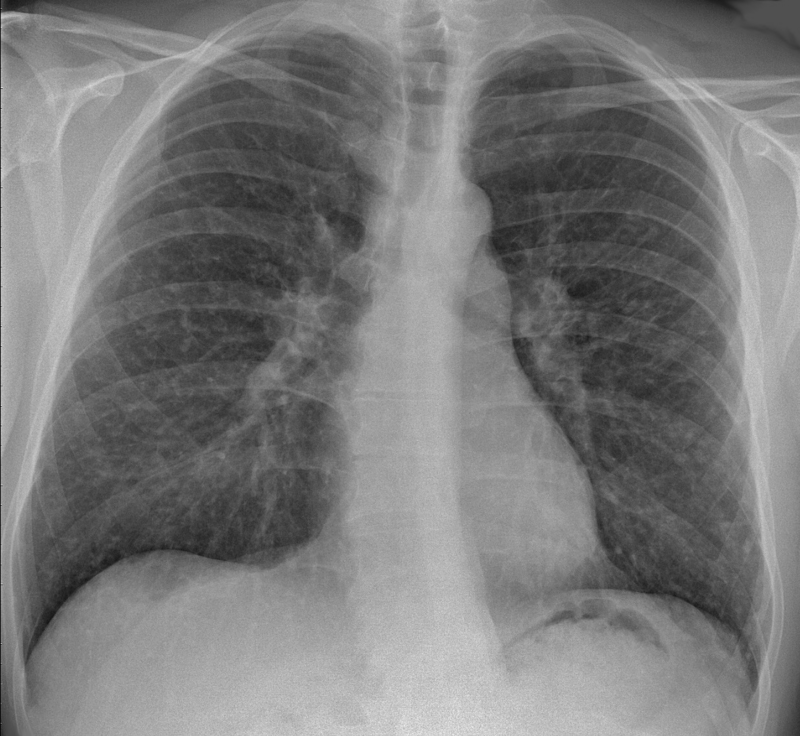
File:Chest_X-ray_of_sarcoidosis_nodules.png · Wikimedia Commons · See Wikimedia Commons
sarcoidosis
Sign in to saveAlso known as Boeck sarcoid, benign lymphogranulomatosis, Besnier-Boeck-Schaumann disease, lymphogranulomatosis
Sarcoidosis, also known as Besnier–Boeck–Schaumann disease, is a non-infectious granulomatous disease involving abnormal collections of inflammatory cells that form lumps known as granulomata. The disease usually begins in the lungs, skin, or lymph nodes. Less commonly affected are the eyes, liver, heart, and brain, though any organ can be affected. The signs and symptoms depend on the organ involved. Often, no symptoms or only mild symptoms are seen. When it affects the lungs, wheezing, coughing, shortness of breath, or chest pain may occur. Some may have Löfgren syndrome, with fever, enlarge
Sarcoidosis is a disease in which inflammatory cells abnormally clump together to form lumps called granulomata, most commonly affecting the lungs, skin, or lymph nodes, though it can involve any organ. The condition is serious because symptoms vary widely depending on which organs are affected—ranging from none at all to breathing problems, chest pain, and other complications—making diagnosis and treatment challenging.
AI-generated from the Wikipedia summary — may contain errors.
Key facts
- Medical condition.name
- Sarcoidosis
- Medical condition.synonyms
- Sarcoïdosis, sarcoid, Besnier–Boeck–Schaumann disease
- Medical condition.image
- Chest X-ray of sarcoidosis nodules.png
- Medical condition.caption
- Chest X-ray showing the typical nodularity of sarcoidosis, predominantly in the hila of the lungs.
- Medical condition.field
- Rheumatology, immunology
- Medical condition.onset
- 20–50 years old More common in women
- Medical condition.duration
- Few years to long term
- Medical condition.causes
- Unknown
- Medical condition.risks
- Family history
- Medical condition.diagnosis
- Based on symptoms and tissue biopsy
- Medical condition.differential
- Tuberculosis, lymphoma, infectious mononucleosis, pulmonary eosinophilia
- Medical condition.treatment
- Ibuprofen, prednisone, methotrexate
- Medical condition.prognosis
- Mortality 1–7%
- Medical condition.frequency
- 1.9 million with interstitial lung disease (2015)
- Medical condition.deaths
- 122,000 with interstitial lung disease (2015)
via Wikipedia infobox
Research
37,709 papers- Ocular Sarcoidosis.ReviewClinics in chest medicine · 2024Rosenbaum JT, Pasadhika SDOI: 10.1016/j.ccm.2023.08.003
- Sarcoidosis.ReviewThe Medical clinics of North America · 2019Llanos O, Hamzeh NDOI: 10.1016/j.mcna.2018.12.011
- [Sarcoidosis].ReviewUgeskrift for laeger · 2018Møller J, Hellmund V, Hilberg O et al.
- Sarcoidosis.ReviewImmunology and allergy clinics of North America · 2012Culver DADOI: 10.1016/j.iac.2012.08.005
- Sarcoidosis.ReviewJournal of the American Academy of Dermatology · 2001English JC 3rd, Patel PJ, Greer KEDOI: 10.1067/mjd.2001.114596
- Sarcoidosis in Post-9/11 Military Veterans.ReviewCutis · 2023Brandon J, Lannan F, Rosenbach MDOI: 10.12788/cutis.0852
- Sarcoidosis and autoimmunity.ReviewCurrent opinion in pulmonary medicine · 2021Song M, Manansala M, Parmar PJ et al.DOI: 10.1097/MCP.0000000000000809
- [Sarcoidosis].Zeitschrift fur Rheumatologie · 2023Bergner RDOI: 10.1007/s00393-023-01338-1
via PubMed
Wikidata facts
- Subclass of
- disease
- Named after
- Ernest Besnier
- Image
- Chest X-ray of sarcoidosis nodules.png
Show 11 more facts
- Commons category
- Sarcoidosis
- NCI Thesaurus ID
- C34995
- health specialty
- ophthalmology
- genetic association
- BTNL2
- exact match
- www.orpha.net/ORDO/Orphanet_797
- ICD-9-CM
- 135
- symptoms and signs
- dyspnea
- possible treatment
- methotrexate
- external data available at URL
- www.nanbyou.or.jp/entry/110
- prevalence
- 0.0016
- on focus list of Wikimedia project
- WikiProject Medicine
Sources (11)
via Wikidata · CC0
~38 min read
Encyclopedic overview
31 sectionsContents
- Signs and symptoms
- Respiratory tract
- Skin
- Bone, joints, and muscles
- Heart
- Eye
- Nervous system
- Endocrine and exocrine
- Gastrointestinal and genitourinary
- Blood
- Cause
- Genetics
- Infectious agents
- Autoimmune
- Pathophysiology
- Histopathology
- Diagnosis
- Classification
- Treatment
- Antimetabolites
- Immunosuppressants
- Specific organ treatments
- Symptoms
- Prognosis
- Epidemiology
- History
- Etymology
- Society and culture
- Pregnancy
- References
- External links
Sarcoidosis, also known as Besnier–Boeck–Schaumann disease, is a non-infectious granulomatous disease involving abnormal collections of inflammatory cells that form lumps known as granulomata. The disease usually begins in the lungs, skin, or lymph nodes. Less commonly affected are the eyes, liver, heart, and brain, though any organ can be affected. The signs and symptoms depend on the organ involved. Often, no symptoms or only mild symptoms are seen. When it affects the lungs, wheezing, coughing, shortness of breath, or chest pain may occur. Some may have Löfgren syndrome, with fever, enlarged hilar lymph nodes, arthritis, and a rash known as erythema nodosum.
The cause of sarcoidosis is unknown. Some believe it may be due to an immune reaction to a trigger such as an infection or chemicals in those who are genetically predisposed. Those with affected family members are at greater risk. Diagnosis is partly based on signs and symptoms, which may be supported by biopsy. Findings that make it likely include large lymph nodes at the root of the lung on both sides, high blood calcium with a normal parathyroid hormone level, or elevated levels of angiotensin-converting enzyme in the blood. The diagnosis should be made only after excluding other possible causes of similar symptoms such as tuberculosis.
Excerpted from Wikipedia’s “sarcoidosis” article, available under the CC BY-SA 4.0 licence.
Gallery (20)
Available in 58 languages
- Español
- Français
- Deutsch
- 中文
- 日本語
- Русский
- Português
- Italiano
- العربية
- हिन्दी
- Albanian
- Armenian
- azb
- Azerbaijani
- Bahasa Indonesia
- Bangla
- Basque
- Bosnian
Show 39 more
- Catalan
- Central Kurdish
- Croatian
- Czech
- Danish
- Esperanto
- Estonian
- Finnish
- Galician
- gpe
- Greek
- Haitian Creole
- Hebrew
- Kannada
- Kazakh
- Latin
- Lingua Franca Nova
- Luxembourgish
- Macedonian
- Malagasy
- Malay
- Nederlands
- Norwegian
- Norwegian Nynorsk
- Odia
- Polski
- Serbian
- Serbian (Latin)
- simple
- Slovenian
- Svenska
- Tatar
- Tiếng Việt
- Tswana
- Türkçe
- Ukrainian
- Uzbek
- فارسی
- 한국어
via Wikidata sitelinks · CC0