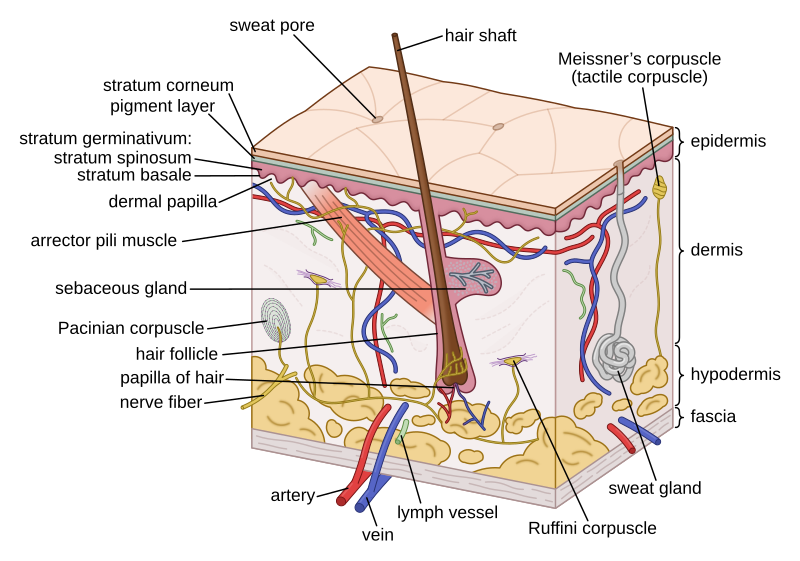
File:Human_skin_structure.svg · Wikimedia Commons · See Wikimedia Commons
sweat gland
Sign in to saveAlso known as sudoriparous glands
small tubular structures of the skin that produce sweat; a type of exocrine gland, which are glands that produce and secrete substances onto an epithelial surface by way of a duct
Key facts
- Precursor
- Ectoderm
- System
- Integumentary
- Nerve
- Eccrine: cholinergic sympathetic nerves , Apocrine: adrenergic nerves
- Latin
- glandula sudorifera
- Mesh
- D013545
- Ta98
- A16.0.00.029
via Wikipedia infobox
Research
13,506 papersvia PubMed
Wikidata facts
- Image
- Gray940 - sweat gland.png
Show 2 more facts
- described by source
- Brockhaus and Efron Encyclopedic Dictionary
- NCI Thesaurus ID
- C33712
Sources (7)
via Wikidata · CC0
~21 min read
Encyclopedic overview
Sweat glands, also known as sudoriferous or sudoriparous glands, from Latin sudor 'sweat', are small tubular structures of the skin that produce sweat. Sweat glands are a type of exocrine gland, which are glands that produce and secrete substances onto an epithelial surface by way of a duct. There are two main types of sweat glands that differ in their structure, function, secretory product, mechanism of excretion, anatomic distribution, and distribution across species:
Eccrine sweat glands are distributed almost all over the human body, in varying densities, with the highest density in palms and soles, then on the head, but much less on the trunk and the extremities. Their water-based secretion represents a primary form of cooling in humans.
Excerpted from Wikipedia’s “sweat gland” article, available under the CC BY-SA 4.0 licence.