File:The_uncivilized_races_of_men_in_all_countries_of_the_world;_being_a_comprehensive_account_of_their_manners_and_customs,_and_of_their_physical,_social,_mental,_moral_and_religious_characteristics._By_(14762645001).jpg · Wikimedia Commons · See Wikimedia Commons
shield
Sign in to saveAlso known as 🛡
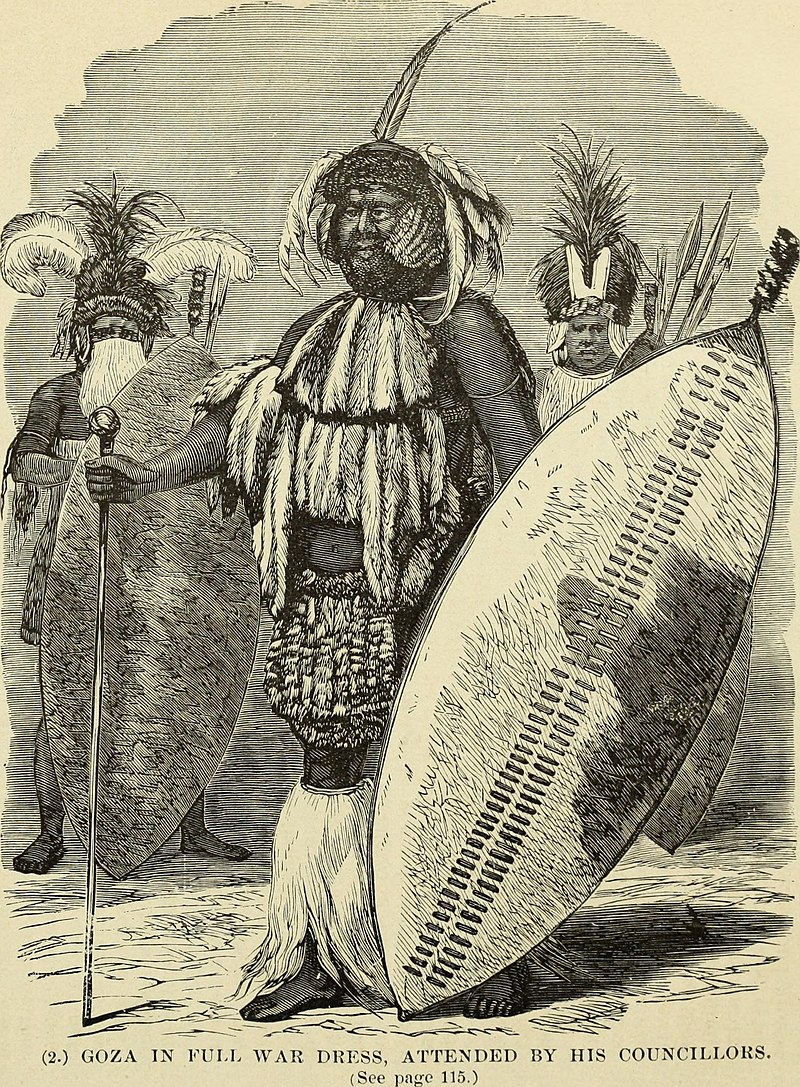
thumb |Zulu people|Zulu chief Goza and two of his councillors in war-dress, all with [[Nguni shields, . The size of the shield on the chief's left arm denotes his status, and the white colour that he is a married man.]] thumb|Wall painting depicting a Mycenaean Greece|Mycenaean Greek "figure eight", 15th century BC, [[National Archaeological Museum, Athens]]
A shield is a protective barrier carried by a person, historically made in various shapes and sizes, that was used in combat to defend against weapons and attacks. Beyond its practical function in warfare, shields often conveyed important social information, such as a person's status or marital condition, making them significant cultural objects in many societies.
AI-generated from the Wikipedia summary — may contain errors.
Wikidata facts
- Image
- Thorsberg Shields.jpg
Show 4 more facts
- Unicode character
- 🛡
- Commons category
- Shields
- topic's main category
- Category:Shields
- on focus list of Wikimedia project
- Wikipedia:Vital articles/Level/4
Sources (2)
via Wikidata · CC0
~19 min read
Encyclopedic overview
16 sectionsContents
- Prehistory
- History
- Ancient
- Post-classical
- Shields of Sub-Saharan Africa
- Shields of Southeast Asia
- Modern
- Law enforcement shields
- Gallery
- Types of shields
- Components
- Tactics
- Heraldry
- References
- Bibliography
- External links
thumb |Zulu people|Zulu chief Goza and two of his councillors in war-dress, all with [[Nguni shields, . The size of the shield on the chief's left arm denotes his status, and the white colour that he is a married man.]] thumb|Wall painting depicting a Mycenaean Greece|Mycenaean Greek "figure eight", 15th century BC, [[National Archaeological Museum, Athens]]
A shield is a piece of personal armour held in the hand, which may or may not be strapped to the wrist or forearm. Shields are used to intercept specific attacks, whether from close-ranged weaponry like spears or long ranged projectiles such as arrows. They function as means of active blocks, as well as to provide passive protection by closing one or more lines of engagement during combat.
Excerpted from Wikipedia’s “shield” article, available under the CC BY-SA 4.0 licence.
Gallery (32)
Available in 91 languages
- Español
- Français
- Deutsch
- 中文
- 日本語
- Русский
- Português
- Italiano
- العربية
- हिन्दी
- Afrikaans
- Albanian
- Armenian
- Asturian
- azb
- Azerbaijani
- Bahasa Indonesia
- Bashkir
Show 72 more
- Basque
- be_x_old
- Belarusian
- Breton
- Bulgarian
- Catalan
- Central Kurdish
- Croatian
- Czech
- Danish
- Erzya
- Esperanto
- Estonian
- Filipino
- Finnish
- Galician
- Georgian
- Greek
- guw
- Hebrew
- Hungarian
- Iban
- Ido
- Interlingua
- Irish
- Javanese
- Kannada
- Kazakh
- Khmer
- Kurdish
- Kyrgyz
- Latin
- Latvian
- Lingala
- Lithuanian
- Macedonian
- Malay
- Manipuri
- Marathi
- Nederlands
- Norwegian
- Norwegian Nynorsk
- Occitan
- Old English
- Piedmontese
- Polski
- Punjabi
- Quechua
- Romanian
- Serbian
- Serbian (Latin)
- Shona
- simple
- Sinhala
- Slovak
- Slovenian
- Sundanese
- Svenska
- Swahili
- Tajik
- Tamil
- Tiếng Việt
- Türkçe
- Tyap
- Ukrainian
- Uzbek
- Wu Chinese
- zh_min_nan
- zh_yue
- فارسی
- ไทย
- 한국어
via Wikidata sitelinks · CC0