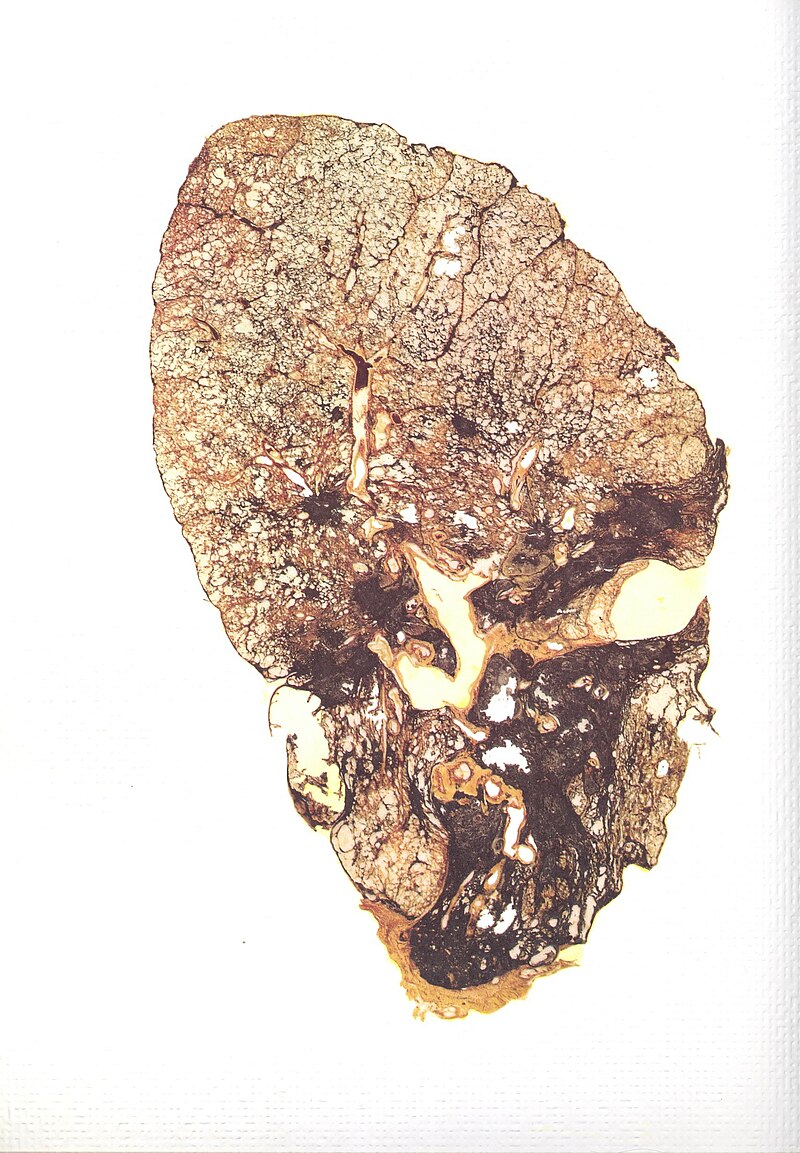
File:Coupe_de_poumon_atteint_de_silicose.jpg · Wikimedia Commons · See Wikimedia Commons
silicosis
Sign in to saveAlso known as Pneumoconiosis due to other silica or silicates, Pneumoconiosis due to silica (disorder), Pneumoconiosis due to silicates (disorder), Silica pneumoconiosis NOS (disorder), Silicotic fibrosis of lung, silicotuberculosis, Pneumoconiosis due to silicates, Silica pneumoconiosis
Silicosis is an occupational lung disease caused by the inhalation of respirable crystalline silica dust. It is characterized by lung inflammation and fibrosis that most commonly affects the upper lobes and is classified as a form of pneumoconiosis. The disease occurs in chronic (simple and progressive massive fibrosis), accelerated, or acute forms, depending on the intensity and duration of exposure.
Key facts
- Medical condition (new).name
- Silicosis
- Medical condition (new).synonyms
- Miner's phthisis; grinder's asthma; potter's rot
- Medical condition (new).image
- Coupe de poumon atteint de silicose.jpg
- Medical condition (new).caption
- Slice of a lung affected by silicosis
- Medical condition (new).field
- Pulmonology
- Medical condition (new).types
- Chronic (simple and progressive massive fibrosis); accelerated; acute
- Medical condition (new).causes
- Inhalation of crystalline silica dust
- Medical condition (new).differential
- Pulmonary talcosis, coal workers' pneumoconiosis
via Wikipedia infobox
Research
10,187 papers- Silicosis: An Update and Guide for Clinicians.Clinics in chest medicine · 2020
- Update on Silicosis.Surgical pathology clinics · 2024
- Early Identification, Accurate Diagnosis, and Treatment of Silicosis.Canadian respiratory journal · 2022
- Silicosis and tuberculosis: A systematic review and meta-analysis.Pulmonology · 2025
- Silicosis.Clinics in chest medicine · 1992
via PubMed
Wikidata facts
- Instance of
- symptom or sign
- Subclass of
- disease
Show 8 more facts
- Commons category
- Silicosis
- NCI Thesaurus ID
- C3369
- health specialty
- pulmonology
- described by source
- Armenian Soviet Encyclopedia
- ICPC 2 ID
- R95
- exact match
- identifiers.org/doid/DOID:10325
- ICD-9-CM
- 502
- on focus list of Wikimedia project
- WikiProject Medicine
via Wikidata · CC0
~23 min read
Encyclopedic overview
16 sectionsContents
- Signs and symptoms
- Pathophysiology
- Silica
- Diagnosis
- Classification
- Prevention
- Treatment
- Epidemiology
- Occupational silicosis
- Desert lung disease
- Regulation in the US
- Key provisions
- Compliance schedule
- See also
- References
- External links
Silicosis is an occupational lung disease caused by the inhalation of respirable crystalline silica dust. It is characterized by lung inflammation and fibrosis that most commonly affects the upper lobes and is classified as a form of pneumoconiosis. The disease occurs in chronic (simple and progressive massive fibrosis), accelerated, or acute forms, depending on the intensity and duration of exposure.
Common symptoms include shortness of breath, cough, fatigue, and cyanosis in severe cases. Because its clinical and radiographic features can resemble those of tuberculosis, pneumonia, or pulmonary edema, silicosis is sometimes misdiagnosed. There is no curative treatment; management focuses on symptom control and the prevention of complications.
Excerpted from Wikipedia’s “silicosis” article, available under the CC BY-SA 4.0 licence.