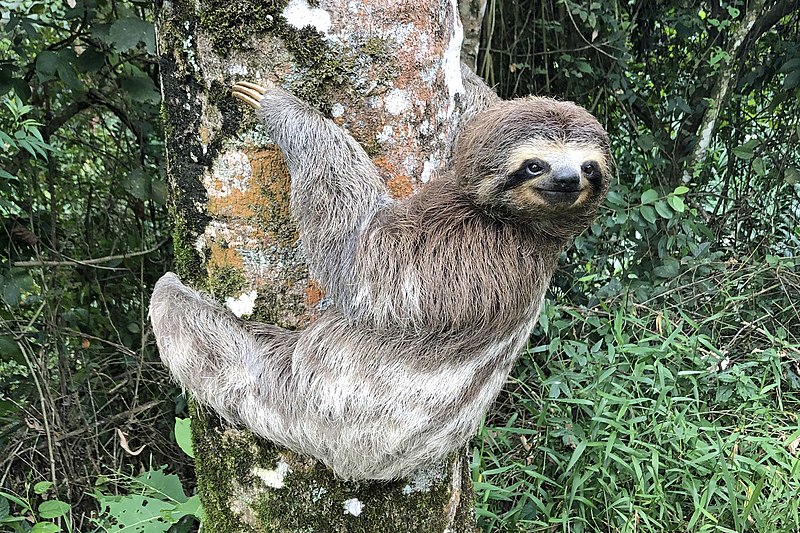
File:Bicho-preguiça_3.jpg · Wikimedia Commons · See Wikimedia Commons
sloth
Sign in to saveAlso known as sloths
alt=Sloth |thumb|Three-toed sloth crossing a road in Costa Rica Sloths are a Neotropical group of xenarthran mammals constituting the suborder Folivora, including the extant arboreal tree sloths and extinct terrestrial ground sloths. Noted for their slowness of movement, tree sloths spend most of their lives hanging upside down in the trees of the tropical rainforests of South America and Central America. Sloths are considered to be most closely related to anteaters, together making up the xenarthran order Pilosa.
Sloths are slow-moving mammals from Central and South America that spend most of their lives hanging upside down in tropical rainforest trees, and they are closely related to anteaters within a larger group of mammals called xenarthrans. They matter as part of the diverse wildlife of tropical ecosystems and represent an interesting example of how animals can evolve specialized behaviors and body structures suited to their environment.
AI-generated from the Wikipedia summary — may contain errors.
Species
樹懶也作树獭,是哺乳綱貧齒總目披毛目下樹懒亞目(学名:Folivora)動物的通稱,包括有樹懒科和二趾樹懒科。其移動的速度非常地慢,只有每分钟4米(0.24km/h)的速度,在地面上是只有每分钟2米(0.12km/h)的速度。如果不慎掉到地面,容易成为其他肉食性动物的猎物,然而牠們具有游泳的能力。共有兩科六種,分布於南美洲及中美洲的熱帶雨林中,雖然外觀上相似,但兩科之間的分別頗大。雖然被稱為二趾與三趾樹懶,但其實所有現存的樹懶均有3根腳趾,主要差異在於,二趾樹懶的前臂上僅有二指。 樹懶的粗毛夾縫中長有與其互利共生的綠藻,提供很好的保護色,而樹懶有時也會取食身上的綠藻作為營養來源。而這些綠藻也是樹懶蛾(英语:sloth moth)的食物來源,有些種類的樹懶蛾甚至只能在樹懶身上發現。 絕種的樹懶包括地懶,其中體型最大的大地懶全長可達6米(20英尺),相當於現今的非洲象。
via
Research
1,195 papers- Sloth.BMJ (Clinical research ed.) · 1996McCormick JDOI: 10.1136/bmj.313.7072.1596
- Palaeoproteomics resolves sloth relationships.Nature ecology & evolution · 2019Presslee S, Slater GJ, Pujos F et al.DOI: 10.1038/s41559-019-0909-z
- Sloth ornaments trace the first Americans.Nature ecology & evolution · 2023Nic Eoin LDOI: 10.1038/s41559-023-02168-9
- Sloth metabolism may make survival untenable under climate change scenarios.PeerJ · 2024Cliffe RN, Ewart HE, Scantlebury DM et al.DOI: 10.7717/peerj.18168
- Sloth biology: an update on their physiological ecology, behavior and role as vectors of arthropods and arboviruses.ReviewBrazilian journal of medical and biological research = Revista brasileira de pesquisas medicas e biologicas · 2001Gilmore DP, Da Costa CP, Duarte DPDOI: 10.1590/s0100-879x2001000100002
- Sloth bear attacks: regional differences and safety messaging.Scientific reports · 2022Sharp TR, Smith TS, Swaminathan S et al.DOI: 10.1038/s41598-022-07974-y
- Oropouche Virus: Clinical, Epidemiological, and Molecular Aspects of a Neglected Orthobunyavirus.ReviewThe American journal of tropical medicine and hygiene · 2017Travassos da Rosa JF, de Souza WM, Pinheiro FP et al.DOI: 10.4269/ajtmh.16-0672
- Sri Lankan Sloth Bear (Melursus ursinus inornatus) Attacks on Humans.Wilderness & environmental medicine · 2022Thalgaspitiya SPB, Siriwardana A, Chenthuran V et al.DOI: 10.1016/j.wem.2022.07.007
via PubMed
Wikidata facts
Show 9 more facts
- Commons category
- Folivora
- taxon rank
- suborder
- taxon name
- Folivora
- topic's main category
- Category:Sloths
- Commons gallery
- Folivora
- Unicode character
- 🦥
- on focus list of Wikimedia project
- Wikipedia:Vital articles/Level/4
- described by source
- Encyclopædia Britannica 11th edition
- taxon common name
- lenivci
via Wikidata · CC0
~21 min read
Encyclopedic overview
16 sectionsContents
- Taxonomy and evolution
- Evolution
- Phylogeny
- Extinctions
- Biology
- Morphology and anatomy
- Physiology
- Activity
- Behavior
- Diet
- Reproduction
- Distribution
- Human relations
- References
- Further reading
- External links
alt=Sloth |thumb|Three-toed sloth crossing a road in Costa Rica Sloths are a Neotropical group of xenarthran mammals constituting the suborder Folivora, including the extant arboreal tree sloths and extinct terrestrial ground sloths. Noted for their slowness of movement, tree sloths spend most of their lives hanging upside down in the trees of the tropical rainforests of South America and Central America. Sloths are considered to be most closely related to anteaters, together making up the xenarthran order Pilosa.
There are six extant sloth species in two genera – Bradypus (three-toed sloths) and Choloepus (two-toed sloths). Despite this traditional naming, all sloths have three toes on each rear limb – although two-toed sloths have only two digits on each forelimb. The two groups of sloths are from different, distantly related families, and are thought to have evolved their morphology via parallel evolution from terrestrial ancestors. Besides the extant species, many species of ground sloths ranging up to the size of elephants (like Megatherium) inhabited both North and South America during the Pleistocene Epoch. However, they became extinct during the Quaternary extinction event around 12,000 years ago, along with most large animals across the Americas. The extinction correlates in time with the arrival of humans, but climate change has also been suggested to have contributed. Members of an endemic radiation of Caribbean sloths also formerly lived in the Greater Antilles but became extinct after humans settled the archipelago in the mid-Holocene, around 6,000 years ago.
Excerpted from Wikipedia’s “sloth” article, available under the CC BY-SA 4.0 licence.
Gallery (23)
Available in 93 languages
- Español
- Français
- Deutsch
- 中文
- 日本語
- Русский
- Português
- Italiano
- العربية
- हिन्दी
- Afrikaans
- Albanian
- Armenian
- Asturian
- Azerbaijani
- Bahasa Indonesia
- Balinese
- Bangla
Show 74 more
- Basque
- Belarusian
- Bosnian
- Breton
- Bulgarian
- Burmese
- Catalan
- Cebuano
- Central Kurdish
- Cherokee
- Chuvash
- Cornish
- Croatian
- Czech
- Danish
- Egyptian Arabic
- Esperanto
- Estonian
- Faroese
- Filipino
- Finnish
- Galician
- Georgian
- Greek
- Guarani
- Hebrew
- Hungarian
- hyw
- Icelandic
- Ido
- Ingush
- Irish
- Javanese
- Kannada
- Kazakh
- Kyrgyz
- Latin
- Latvian
- Lingua Franca Nova
- Lithuanian
- Malay
- Malayalam
- Moksha
- Navajo
- Nederlands
- Norwegian
- Norwegian Nynorsk
- Occitan
- Oromo
- Polski
- Punjabi
- Quechua
- Romanian
- Scots
- Serbian
- Serbian (Latin)
- simple
- Slovak
- Slovenian
- Svenska
- Swahili
- Tamil
- Telugu
- Tiếng Việt
- Türkçe
- Ukrainian
- Uzbek
- Waray
- Welsh
- Wu Chinese
- zh_yue
- فارسی
- ไทย
- 한국어
via Wikidata sitelinks · CC0