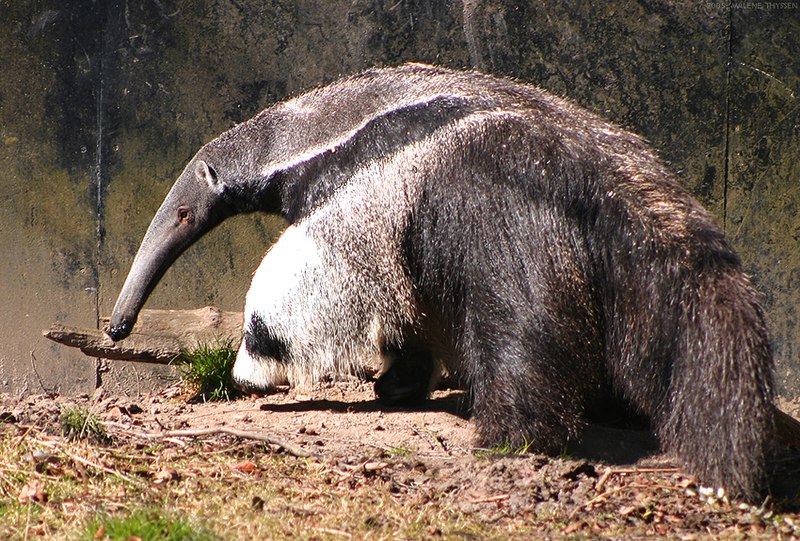
File:Myresluger2.jpg · Wikimedia Commons · See Wikimedia Commons
A giant anteater is a large mammal that uses its extremely long snout and sticky tongue to find and eat ants and termites. These animals are important members of their ecosystems in Central and South America, where they help control insect populations in their habitats.
AI-generated from the Wikipedia summary — may contain errors.
Species
VulnerableMaximum longevity: 31 years (captivity) Observations: One specimen was estimated to be 31 years old when it died in captivity (Richard Weigl 2005).
via IUCN
Wikidata facts
- Instance of
- taxon
- Parent taxon
- Myrmecophaga
- Mass
- 1.35
- Image
- Giant anteater at MAV-USP.jpg
Show 14 more facts
- taxon rank
- species
- IUCN conservation status
- Vulnerable
- taxon name
- Myrmecophaga tridactyla
- Commons category
- Myrmecophaga tridactyla
- Commons gallery
- Myrmecophaga tridactyla
- taxon common name
- veliki mravljinčar
- gestation period
- 180
- litter size
- 2
- longest observed lifespan
- 33
- start time
- 5000000-00
- taxon range
- Mazagão
- diel cycle
- diurnality
- short name
- M. tridactyla
- temporal range start
- Late Pleistocene
via Wikidata · CC0
~19 min read
Encyclopedic overview
The giant anteater (Myrmecophaga tridactyla) is an insectivorous mammal native to Central and South America. It is the largest of the four living species of anteaters, which are classified with sloths in the order Pilosa. The only extant member of the genus Myrmecophaga, the giant anteater is mostly terrestrial, in contrast to other living anteaters and sloths, which are arboreal or semiarboreal. It is recognizable by its elongated snout, bushy tail, long foreclaws, and distinctively colored fur.
The giant anteater is found in multiple habitats, including grassland and rainforest. It forages in open areas and rests in more forested habitats. It feeds primarily on ants and termites, using its foreclaws to dig them up and its long, sticky tongue to collect them. Though giant anteaters live in overlapping home ranges, they are mostly solitary except during mother-offspring relationships, aggressive interactions between males, and when mating. Mother anteaters carry their offspring on their backs until weaning them.
Excerpted from Wikipedia’s “giant anteater” article, available under the CC BY-SA 4.0 licence.
Gallery (13)
Available in 60 languages
- Español
- Français
- Deutsch
- 中文
- 日本語
- Русский
- Português
- Italiano
- العربية
- हिन्दी
- Aragonese
- Azerbaijani
- Bahasa Indonesia
- Balinese
- Basque
- Belarusian
- Bosnian
- Breton
Show 41 more
- Bulgarian
- Catalan
- Cebuano
- Croatian
- Czech
- Danish
- Egyptian Arabic
- Finnish
- Galician
- Greek
- Guarani
- Hebrew
- Hungarian
- Icelandic
- Irish
- Kashubian
- Kazakh
- Kotava
- Latvian
- Lithuanian
- Malayalam
- Navajo
- Nederlands
- Norwegian
- Norwegian Nynorsk
- Polski
- Quechua
- Serbian
- Serbian (Latin)
- simple
- Slovenian
- Svenska
- Swahili
- Tiếng Việt
- Türkçe
- Ukrainian
- Waray
- Zulu
- فارسی
- ไทย
- 한국어
via Wikidata sitelinks · CC0