Encyclopedia of Life · EOL (see source)
Squamanita
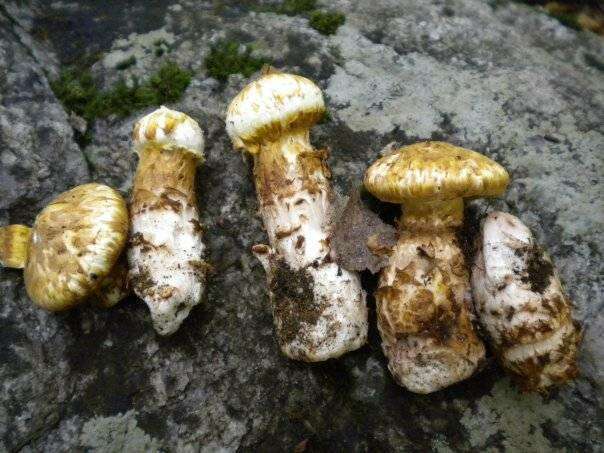
Sign in to saveSquamanita is a genus of parasitic fungi in the family Squamanitaceae. Basidiocarps (fruit bodies) superficially resemble normal agarics (gilled mushrooms) but emerge from parasitized fruit bodies of deformed host agarics.
Species
GENUS
- KingdomFungi
- PhylumBasidiomycota
- ClassAgaricomycetes
- OrderAgaricales
- FamilyTricholomataceae
Squamanita Imbach (łuskówka) – rodzaj grzybów z rodziny gąskowatych (Tricholomataceae)[1]. W Polsce występuje jeden gatunek[2]. Systematyka i nazewnictwo Pozycja w klasyfikacji według Index Fungorum: Tricholomataceae, Agaricales, Agaricomycetidae, Agaricomycetes, Agaricomycotina, Basidiomycota, Fungi[1]. Polską nazwę nadał Władysław Wojewoda w 2003 r[2]. Synonimy nazwy naukowej: Coolia Huijsman, Cystoderma subgen. Dissoderma A.H. Sm. & Singer, Dissoderma (A.H. Sm. & Singer) Singer[3]. Gatunki Squamanita basii Harmaja 1988 Squamanita cettoiana M.M. Moser 1986[4] Squamanita citricolor Thoen 1998 Squamanita contortipes (A.H. Sm. & D.E. Stuntz) Heinem. & Thoen 1973 Squamanita fimbriata Gulden, Bendiksen & Brandrud 1977 Squamanita granulifera Bas & Læssøe 1999 Squamanita odorata (Cool) Imbach 1946 Squamanita paradoxa (A.H. Sm. & Singer) Bas 1965 – łuskówka dziwna Squamanita pearsonii Bas 1965 Squamanita schreieri Imbach 1946 Squamanita squarrulosa G.S. Ridl. 1988 Squamanita umbilicata Harmaja 1988 Squamanita umbonata (Sumst.) Bas 1965 Nazwy naukowe na podstawie Index Fungorum[5]. Nazwy polskie według Władysława Wojewody[2]. Przypisy ↑ a b Index Fungorum (ang.
via GBIF
Museum specimens
- Specimen records
- 4
- With media
- 3
- Family
- Tricholomataceae
- Collections
- US, DUKE, MICH
- Recorded in
- Guyana, United States, Japan
Wikidata facts
- Instance of
- taxon
- Parent taxon
- Tricholomataceae
- Image
- Squamanita umbonata 77648.jpg
Show 5 more facts
- taxon name
- Squamanita
- taxon rank
- genus
- Commons category
- Squamanita
- topic's main category
- Category:Squamanita
- taxonomic type
- Squamanita schreieri
Sources (1)
via Wikidata · CC0
~2 min read
Encyclopedic overview
4 sectionsContents
- Taxonomy
- See also
- References
- External links
Squamanita is a genus of parasitic fungi in the family Squamanitaceae. Basidiocarps (fruit bodies) superficially resemble normal agarics (gilled mushrooms) but emerge from parasitized fruit bodies of deformed host agarics.
==Taxonomy== The genus was created in 1946 by Swiss mycologist Emil Imbach to accommodate an unusual agaric species, Squamanita schreieri, which L. Schreier had earlier described and illustrated as "Tricholoma X". In 1965 Dutch mycologist Cornelis Bas expanded the genus to five species, all of which were characterized by arising from "sclerotial bodies". The possibility that Squamanita might be parasitic on other agarics (the remains of which formed the "sclerotial bodies") was noted by British mycologist Derek Reid in 1983. The discovery of a host fruit body that formed its own pileus together with three Squamanita pilei confirmed the parasitic nature of the genus, a discovery subsequently featured in Nature under the title 'Mycological mystery tour'.
Excerpted from Wikipedia’s “Squamanita” article, available under the CC BY-SA 4.0 licence.