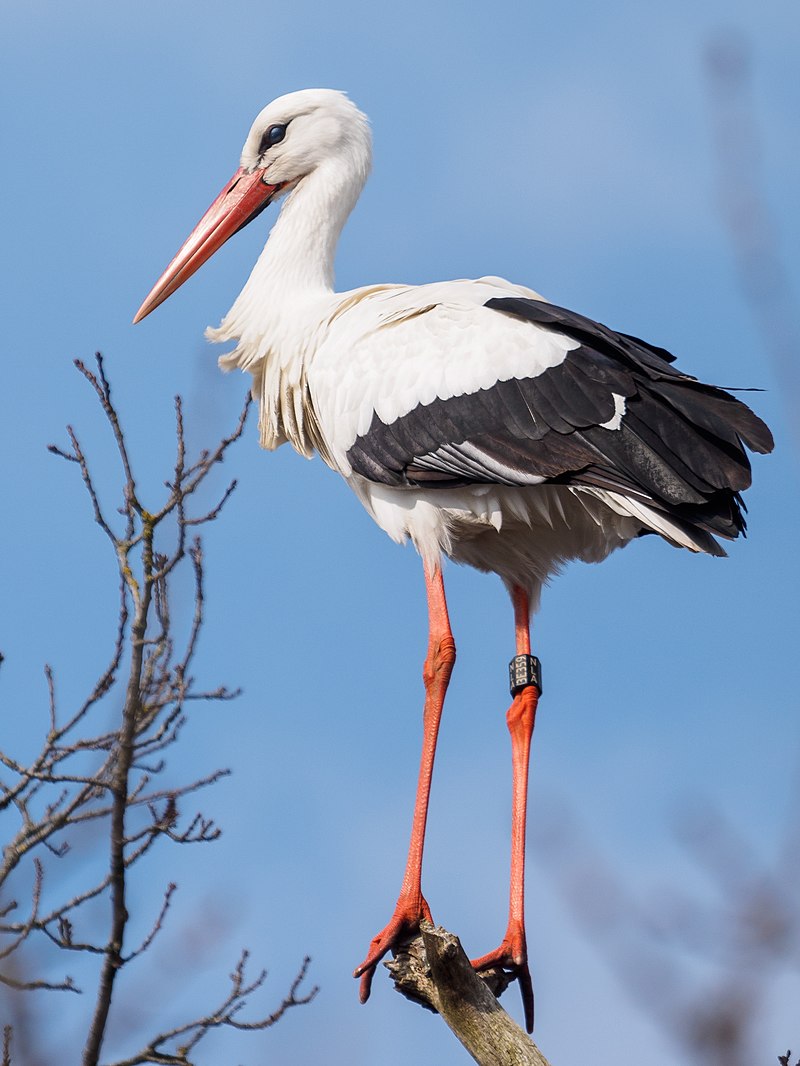
File:Ringed_white_stork.jpg · Wikimedia Commons · See Wikimedia Commons
stork
Sign in to saveAlso known as storks, ciconiids, Ciconiidae
Storks are large, long-legged, long-necked wading birds with long, stout bills. They belong to the family Ciconiidae, and make up the order Ciconiiformes . Ciconiiformes previously included a number of other families, such as herons and ibises, but those families have been moved to the order Pelecaniformes.
OverviewAI-generated
Ciconiidae, commonly known as storks, is a family of birds within the order Ciconiiformes. This taxon is classified under the class Aves and phylum Chordata. The group includes piscivorous birds that inhabit freshwater environments and temperate climates. The family was described by Sundevall in 1836 and is recognized as an accepted taxon.
The lineage of Ciconiidae dates back to approximately 30 million years ago. Its classification has been documented in the source Gujin Tushu Jicheng. The family is listed under the Commons category Ciconiidae and appears in the corresponding gallery. It is also featured on the Wikipedia:Vital articles/Level/4 focus list. Additionally, the topic is referenced by 1,177 other encyclopedia articles.
Synthesized by Vinony from 23 facts across 3 sources: Wikidata, WoRMS, Vinony graph. Generated from structured data (not the Wikipedia text) and checked against those facts — may still contain errors.
Species
storks
Family
- PhylumChordata
- ClassAves
- OrderCiconiiformes
- FamilyCiconiidae
属 请协助补充 鹳科在鸟类传统分类系统中是鸟纲鹳形目中的一个科,又俗稱送子鳥。 进化 鹳科动物的化石在北美、南美、欧洲、非洲、亚洲等许多国家都有发现,而且大量化石证据表明,这个物种十分古老而且分布广泛。鹳科的形成至少可以追溯到第三纪早期或白垩纪晚期,现代鹳类(包括鹳属Ciconia、Ephippiorhynchus、Leptoptilos等)的化石约出现在中新世(2350万年~520万年)。 参考文献 刘国强,梁兵宽主编 中国白鹳调查 中国林业出版社 2006年 ISBN 7-5038-4544-9 这是一篇與鳥類相關的小作品。你可以通过编辑或修订扩充其内容。 查 论 编 维基共享资源中相关的多媒体资源:鹳科 维基物种中的分类信息:鹳科 取自“https://zh.wikipedia.org/w/index.php?title=鹳科&oldid=42666228” 分类: 鸛科 鸛形目 隐藏分类: 本地相关图片与维基数据不同 全部小作品 鳥類小作品 使用ISBN魔术链接的页面
via
Wikidata facts
- Instance of
- taxon
- Parent taxon
- Ciconiiformes
- Image
- 00 4083 Storch (Ciconiidae).jpg
Show 9 more facts
- taxon rank
- family
- Commons category
- Ciconiidae
- taxon name
- Ciconiidae
- topic's main category
- Category:Ciconiidae
- Commons gallery
- Ciconiidae
- start time
- 30000000-0
- taxon range
- temperate climate
- taxon common name
- storkefamilien
- on focus list of Wikimedia project
- Wikipedia:Vital articles/Level/4
Sources (7)
via Wikidata · CC0
~20 min read
Encyclopedic overview
16 sectionsContents
- Etymology
- Systematics
- Phylogeny
- Fossil storks
- Morphology
- Distribution and habitat
- Migration and movements
- Behaviour
- Feeding and diet
- Breeding
- In culture
- Associations with fertility
- As food
- Footnotes
- References
- External links
Storks are large, long-legged, long-necked wading birds with long, stout bills. They belong to the family Ciconiidae, and make up the order Ciconiiformes . Ciconiiformes previously included a number of other families, such as herons and ibises, but those families have been moved to the order Pelecaniformes.
Storks dwell in many regions and tend to live in drier habitats than the closely related herons, spoonbills and ibises; they also lack the powder down that those groups use to clean off fish slime. Bill-clattering is an important mode of communication at the nest. Many species are migratory. Most storks eat frogs, fish, insects, earthworms, small birds and small mammals. There are 20 living species of storks in six genera.
Excerpted from Wikipedia’s “stork” article, available under the CC BY-SA 4.0 licence.
Gallery (23)
Available in 112 languages
- Español
- Français
- Deutsch
- 中文
- 日本語
- Русский
- Português
- Italiano
- العربية
- हिन्दी
- Albanian
- Armenian
- Asturian
- Avaric
- Azerbaijani
- Bahasa Indonesia
- Balinese
- Bangla
Show 93 more
- Basque
- be_x_old
- Belarusian
- Betawi
- Bosnian
- Breton
- Bulgarian
- Burmese
- Catalan
- Cebuano
- Central Kurdish
- Chuvash
- Corsican
- Croatian
- Czech
- Danish
- Egyptian Arabic
- Esperanto
- Estonian
- Extremaduran
- Filipino
- Finnish
- Galician
- Greek
- Guarani
- Hebrew
- Hungarian
- hyw
- Icelandic
- Ido
- Irish
- Javanese
- Kabardian
- Kabyle
- Kara-Kalpak
- Kashubian
- Kazakh
- Kotava
- Kyrgyz
- Latin
- Latvian
- Ligurian
- Limburgish
- Lingua Franca Nova
- Lithuanian
- Low German
- Lower Sorbian
- Macedonian
- Malay
- Malayalam
- Marathi
- Mazanderani
- Moksha
- Mongolian
- Moroccan Arabic
- Navajo
- nds_nl
- Nederlands
- Nias
- Northern Frisian
- Norwegian
- Norwegian Nynorsk
- Ossetic
- Pashto
- Polski
- Romanian
- Rusyn
- Serbian
- Serbian (Latin)
- simple
- Sindhi
- Slovak
- Slovenian
- Svenska
- Swahili
- syl
- Tachelhit
- Tamil
- Tatar
- Tiếng Việt
- Türkçe
- Ukrainian
- Upper Sorbian
- Uzbek
- Waray
- Western Frisian
- Western Mari
- Wu Chinese
- Yakut
- zh_yue
- فارسی
- ไทย
- 한국어
via Wikidata sitelinks · CC0