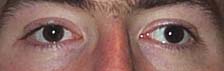
File:Strabismus.jpg · Wikimedia Commons · See Wikimedia Commons
strabismus
Sign in to saveAlso known as kreol, squint, cross-eyed, squint eyes
Strabismus is an eye disorder in which the eyes do not properly align with each other when looking at an object. The eye that is pointed at an object can alternate. The condition may be present occasionally or constantly. If present during a large part of childhood, it may result in amblyopia ("lazy eyes") and loss of depth perception. If onset is during adulthood, it is more likely to result in double vision.
Strabismus is a condition where the eyes don't align properly with each other when focusing on an object, and either eye may be the one pointed at the target. It matters because when present during childhood, it can lead to amblyopia (lazy eye) and loss of depth perception, while adult-onset strabismus typically causes double vision.
AI-generated from the Wikipedia summary — may contain errors.
Key facts
- Medical condition (new).name
- Strabismus
- Medical condition (new).synonyms
- Heterotropia, crossed eyes, squint
- Medical condition (new).image
- StrabismusVL2.jpg
- Medical condition (new).caption
- A person with exotropia, an outward deviated eye
- Medical condition (new).field
- Ophthalmology, Optometry, Orthoptics
- Medical condition (new).symptoms
- Nonaligned eyes
- Medical condition (new).complications
- Amblyopia, double vision
- Medical condition (new).types
- Esotropia (eyes crossed); exotropia (eyes diverge); hypertropia (eyes vertically misaligned)
- Medical condition (new).causes
- Muscle dysfunction, farsightedness, problems in the brain, trauma, infections
- Medical condition (new).risks
- Premature birth, cerebral palsy, family history
- Medical condition (new).diagnosis
- Observing light reflected from the pupil
- Medical condition (new).differential
- Cranial nerve disease, convergence insufficiency
- Medical condition (new).treatment
- Glasses, surgery
- Medical condition (new).frequency
- ~2% (children)
via Wikipedia infobox
Research
28,905 papers- Strabismus.ReviewArchives of ophthalmology (Chicago, Ill. : 1960) · 1968Von Noorden GKDOI: 10.1001/archopht.1968.00980050386019
- Sensory Strabismus; A Literature Review.ReviewJournal of binocular vision and ocular motility · 2024Khorrami-Nejad M, Alghurab A, Akbari MR et al.
- Strabismus-associated myopia. Review.ReviewArchivos de la Sociedad Espanola de Oftalmologia · 2017Hernández Martínez P, Rodríguez Del Valle JMDOI: 10.1016/j.oftal.2017.06.007
- Etiology-based strabismus classification scheme for pediatricians.ReviewThe Turkish journal of pediatrics · 2022Mocan MC, Pastapur A, Kaufman LDOI: 10.24953/turkjped.2020.2372
- Strabismus in Genetic Syndromes: A Review.ReviewClinical & experimental ophthalmology · 2025Kilic S, Bove J, So BN et al.DOI: 10.1111/ceo.14507
- Topical anesthesia strabismus surgery.ReviewStrabismus · 2025Bhate M, Badakere A, Donaldson CDOI: 10.1080/09273972.2024.2413381
- Strabismus.ReviewPediatric annals · 1990Catalano JDDOI: 10.3928/0090-4481-19900501-05
- Strabismus.ReviewArchives of ophthalmology (Chicago, Ill. : 1960) · 1970Von Noorden GKDOI: 10.1001/archopht.1970.00990040105025
via PubMed
Wikidata facts
- Instance of
- symptom or sign
- Subclass of
- disease
- Image
- Esotropia.jpg
Show 6 more facts
- ICPC 2 ID
- F95
- Commons category
- Strabismus
- exact match
- identifiers.org/doid/DOID:540
- ICD-9-CM
- 378.40
- NCI Thesaurus ID
- C35040
- on focus list of Wikimedia project
- WikiProject Medicine
Sources (6)
via Wikidata · CC0
~20 min read
Encyclopedic overview
19 sectionsContents
- Signs and symptoms
- Psychosocial effects
- Pathophysiology
- Diagnosis
- Latency
- Onset
- Laterality
- Direction and latency
- Other considerations
- Differential diagnosis
- Management
- Glasses
- Surgery
- Medication
- Prognosis
- In other animals
- References
- Further reading
- External links
Strabismus is an eye disorder in which the eyes do not properly align with each other when looking at an object. The eye that is pointed at an object can alternate. The condition may be present occasionally or constantly. If present during a large part of childhood, it may result in amblyopia ("lazy eyes") and loss of depth perception. If onset is during adulthood, it is more likely to result in double vision.
Strabismus can occur out of muscle dysfunction (e.g., myasthenia gravis), farsightedness, problems in the brain, trauma, or infections. Risk factors include premature birth, cerebral palsy, and a family history of the condition. Types include esotropia, where the eyes are crossed ("cross eyed"); exotropia, where the eyes diverge ("lazy eyed" or "wall eyed"); and hypertropia or hypotropia, where they are vertically misaligned. They can also be classified by whether the problem is present in all directions a person looks (comitant) or varies by direction (incomitant). Another condition that produces similar symptoms is a cranial nerve disease. Diagnosis may be made by observing the light reflecting from the person's eyes and finding that it is not centered on the pupil. This is known as the Hirschberg reflex test.
Excerpted from Wikipedia’s “strabismus” article, available under the CC BY-SA 4.0 licence.
Gallery (32)
Available in 68 languages
- Español
- Français
- Deutsch
- 中文
- 日本語
- Русский
- Português
- Italiano
- العربية
- Albanian
- Armenian
- Bahasa Indonesia
- Basque
- Belarusian
- Bosnian
- Breton
- Bulgarian
- Catalan
Show 49 more
- cdo
- Chechen
- Croatian
- Czech
- Danish
- Esperanto
- Estonian
- Filipino
- Finnish
- Galician
- Gan Chinese
- gpe
- Greek
- Hebrew
- Hungarian
- Icelandic
- Irish
- Kannada
- Latvian
- Lithuanian
- Macedonian
- Malay
- Malayalam
- Nederlands
- Norwegian
- Odia
- Polski
- Quechua
- Romanian
- Serbian
- Serbian (Latin)
- simple
- Slovak
- Slovenian
- Svenska
- Tajik
- Tamil
- Tatar
- Telugu
- Tiếng Việt
- Türkçe
- Ukrainian
- Urdu
- Uzbek
- Wu Chinese
- zh_yue
- فارسی
- ไทย
- 한국어
via Wikidata sitelinks · CC0