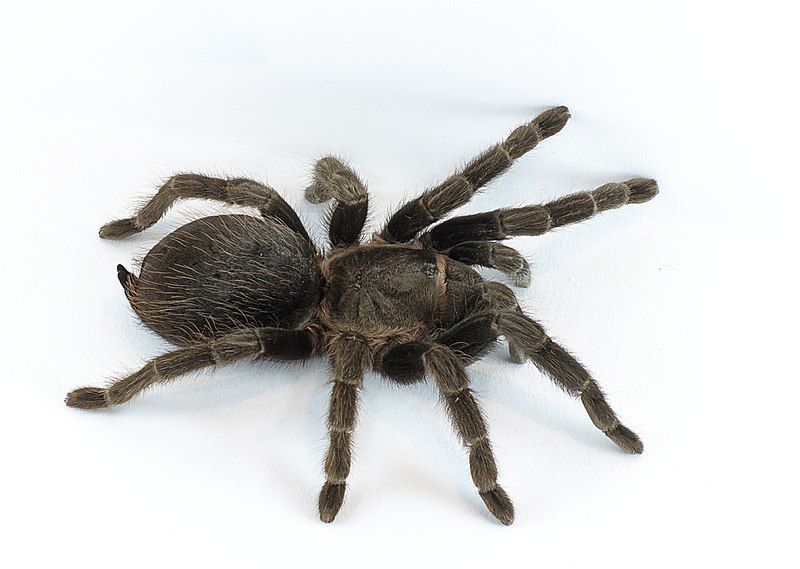
File:Brachypelma_vagans_p1.jpg · Wikimedia Commons · See Wikimedia Commons
Theraphosidae
Sign in to saveAlso known as tarantulas
Tarantulas are a group of large and often hairy spiders of the family Theraphosidae. More than a thousand species have been identified, within almost 200 genera. The term "tarantula" is usually used to describe members of the family Theraphosidae, although many other members of the same infraorder (Mygalomorphae) are commonly referred to as "tarantulas" or "false tarantulas". Some of the more common species have become popular in the exotic pet trade. Many New World species kept as pets have setae known as urticating hairs that can cause irritation to the skin, and in extreme cases, cause dama
OverviewAI-generated
Theraphosidae is a family of arachnids commonly known as tarantulas. It belongs to the order Araneae within the class Arachnida and the phylum Arthropoda. The family was described by Thorell in 1869 and is part of the superfamily Theraphosoidea. Its type genus is Theraphosa.
Specimens of this family have been recorded in the United States, Mexico, Bolivia, and Panamá. These records are held by institutions including MNA, IIZD-UASLP, FMNH, CHAS, and OMNH. The family is distinct from the tarantella.
Synthesized by Vinony from 29 facts across 5 sources: Wikidata, GBIF, Gbif Occ, iDigBio, Vinony graph. Generated from structured data (not the Wikipedia text) and checked against those facts — may still contain errors.
Species
Theraphosidae
FAMILY
- KingdomAnimalia
- PhylumArthropoda
- ClassArachnida
- OrderAraneae
- FamilyTheraphosidae
本条目翻譯品質不佳。(2015年7月28日) 翻譯者可能不熟悉中文或原文語言,也可能使用了機器翻譯,請協助翻譯本條目或重新編寫,并注意避免翻译腔的问题。明顯拙劣的機器翻譯請改掛{{Delete|G13}}提交刪除。 屬 約113屬 捕鳥蛛屬於較原始之蜘蛛,其全身密生細毛。亦稱為大蘭多毒蛛。南美洲及北美洲捕鳥蛛身上某些地方可能具一種刺激性的短毛,遇到老鼠等敵物便向敵物用後腳掃散這種自然的致癢粉。敵物之反應如工人鋪設纖維玻璃毛氈後,全身會發癢。因可使用這種護身方式,未必有亞洲等地捕鳥蛛那麼會咬。美洲捕鳥蛛,毒性因此常低於亞洲等地的。 目录 1 亞科: 1.1 (中美洲 Acanthopelminae) 1.2 (南美洲 Aviculariinae) 1.3 (非洲 Eumenophorinae) 1.4 (非洲 Harpactirinae) 1.5 (世界 Ischnocolinae) 1.6 (東南亞、華南等地 Ornithoctoninae) 1.7 (印度 Poecilotheriinae) 1.8 (遠東、澳洲、等地 Selenocosmiinae) 1.9 (印度,非洲 Selengyrinae) 1.10 (非洲西部 Stromatopelmina) 1.11 (南、北美洲 Theraphosinae) 1.12 (印度 Selenogyrinae) 亞科: (中美洲 Acanthopelminae) Acanthopelma F. O. P. Cambridge, 1897 (南美洲 Aviculariinae) 油彩粉紅趾蜘蛛 Avicularia Lamarck, 1818 Ephebopus Simon, 1892 Iridopelma Pocock, 1901 Pachistopelma Pocock, 1901 (非洲 Eumenophorinae) Anoploscelus Pocock, 1897 Batesiella Pocock, 1903 Citharischius Pocock, 1900 Encyocrates Simon, 1892 Eumenophorus Pocock, 1897 Hysterocrates Simon, 1892 Loxomphalia Simon, 1889 Loxoptygus Simon, 1903 Mascaraneus Gallon, 2005 Monocentropus Pocock, 1897 Myostola Simon, 1903 Phoneyusa Karsch, 1884 (非洲 Harpactirinae) 非洲橙巴布蜘蛛 Augacephalus Gallon, 2002 Ceratogyrus Pocock, 1897 Eucratoscelus Pocock, 1898
via GBIF
Museum specimens
- Specimen records
- 1,096
- With media
- 13
- Family
- Theraphosidae
- Collections
- MNA, IIZD-UASLP, FMNH, CHAS, OMNH, INHS
- Recorded in
- United States, Mexico, Bolivia, MéXico, Panamá, Madagascar, Costa Rica, Honduras
Wikidata facts
- Instance of
- taxon
- Parent taxon
- Theraphosoidea
- Image
- Brachypelma edit.jpg
Show 11 more facts
- taxon name
- Theraphosidae
- taxon rank
- family
- Commons category
- Theraphosidae
- topic's main category
- Category:Theraphosidae
- Commons gallery
- Theraphosidae
- taxon common name
- Tarantulas
- taxon author citation
- Thorell, 1869
- different from
- tarantella
- on focus list of Wikimedia project
- Wikipedia:Vital articles/Level/4
- taxonomic type
- Theraphosa
- described by source
- Encyclopædia Britannica 11th edition
Sources (3)
via Wikidata · CC0
~42 min read
Encyclopedic overview
25 sectionsContents
- Overview
- Identification
- Etymology
- The element ''pelma'' in genus names
- Distribution
- Habits
- Appendages
- Internal anatomy
- Digestive system
- Nervous system
- Respiratory system
- Circulatory system
- Predators
- Bites and urticating bristles
- Sexual dimorphism
- Life cycle
- Reproduction
- Taxonomy
- Subfamilies
- Genera
- Fossil record
- See also
- References
- Further reading
- External links
Tarantulas are a group of large and often hairy spiders of the family Theraphosidae. More than a thousand species have been identified, within almost 200 genera. The term "tarantula" is usually used to describe members of the family Theraphosidae, although many other members of the same infraorder (Mygalomorphae) are commonly referred to as "tarantulas" or "false tarantulas". Some of the more common species have become popular in the exotic pet trade. Many New World species kept as pets have setae known as urticating hairs that can cause irritation to the skin, and in extreme cases, cause damage to the eyes.
==Overview== Like all arthropods, the tarantula is an invertebrate that relies on an exoskeleton for muscular support. Like other Arachnida, a tarantula's body comprises two main parts, the prosoma (or cephalothorax) and the opisthosoma (or abdomen). The prosoma and opisthosoma are connected by the pedicel, or pregenital somite. This waist-like connecting piece is actually part of the prosoma and gives the opisthosoma a wide range of motion relative to the prosoma.
Excerpted from Wikipedia’s “Theraphosidae” article, available under the CC BY-SA 4.0 licence.
Gallery (30)
Available in 79 languages
- Español
- Français
- Deutsch
- 中文
- 日本語
- Русский
- Português
- Italiano
- العربية
- हिन्दी
- Albanian
- Asturian
- Azerbaijani
- Bahasa Indonesia
- Bangla
- Basque
- be_x_old
- Belarusian
Show 60 more
- Bulgarian
- Catalan
- Cebuano
- Croatian
- dag
- Danish
- Egyptian Arabic
- Esperanto
- Estonian
- Filipino
- Finnish
- Galician
- Georgian
- Hebrew
- Hungarian
- Icelandic
- Ido
- Irish
- Javanese
- Kabyle
- Kazakh
- Kurdish
- Latin
- Latvian
- Lithuanian
- Macedonian
- Malay
- Malayalam
- Mazanderani
- Minangkabau
- Navajo
- Nederlands
- Northern Frisian
- Norwegian
- Ossetic
- Pashto
- Polski
- Quechua
- Romanian
- Scots
- Serbian
- Serbian (Latin)
- Sicilian
- simple
- Slovenian
- Sundanese
- Svenska
- Swahili
- Tatar
- Tiếng Việt
- Türkçe
- Ukrainian
- Urdu
- Waray
- Welsh
- Wu Chinese
- zh_yue
- فارسی
- ไทย
- 한국어
via Wikidata sitelinks · CC0