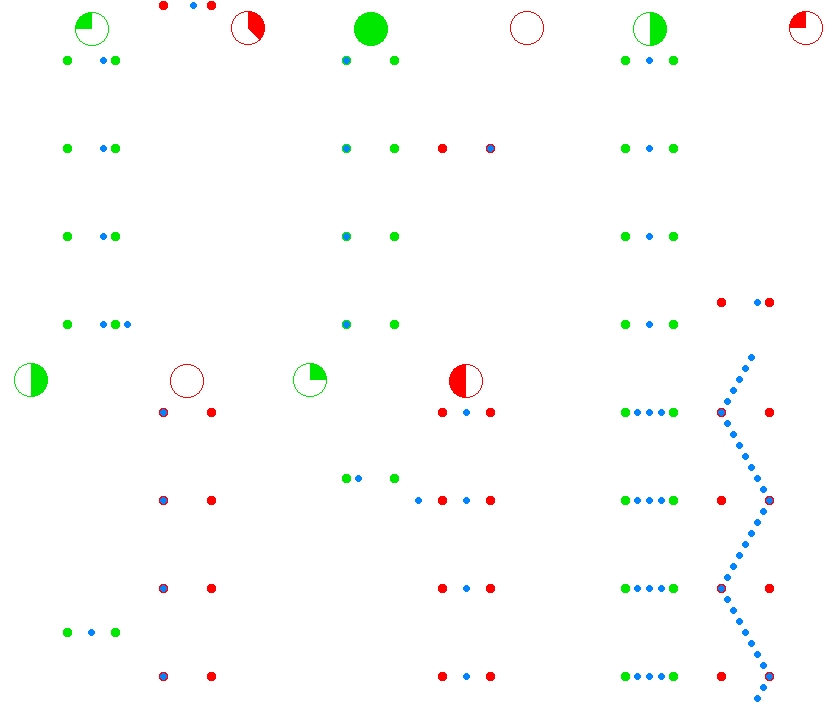
File:Time_dilation02.gif · Wikimedia Commons · See Wikimedia Commons
time dilation
Sign in to saveAlso known as spacetime dilation, space-time dilation
measured time difference as explained by relativity theory
Time dilation is the phenomenon where time passes at different rates depending on factors like gravity and motion, as predicted by Einstein's theory of relativity. This matters because it affects how we measure and understand time in extreme conditions, such as near massive objects or at very high speeds, and has practical applications in technologies like GPS satellites.
AI-generated from the Wikipedia summary — may contain errors.
Wikidata facts
- Subclass of
- physical phenomenon
- Named after
- dilation
Show 3 more facts
- Commons category
- Time dilation
- facet of
- time
- Stack Exchange tag
- physics.stackexchange.com/tags/time-dilation
via Wikidata · CC0
~38 min read
Encyclopedic overview
Time dilation is the difference in elapsed time as measured by two clocks, either because of a relative velocity, a consequence of special relativity, or a difference in gravitational potential between their locations due to gravitational time dilation. When unspecified, "time dilation" usually refers to the effect due to velocity. The dilation compares co-moving clock readings between events measured in different inertial frames and is not observed by visual comparison of clocks across moving frames.
These predictions of the theory of relativity have been repeatedly confirmed by experiment, and they are of practical concern, for instance in the operation of satellite navigation systems such as GPS and Galileo.
Excerpted from Wikipedia’s “time dilation” article, available under the CC BY-SA 4.0 licence.