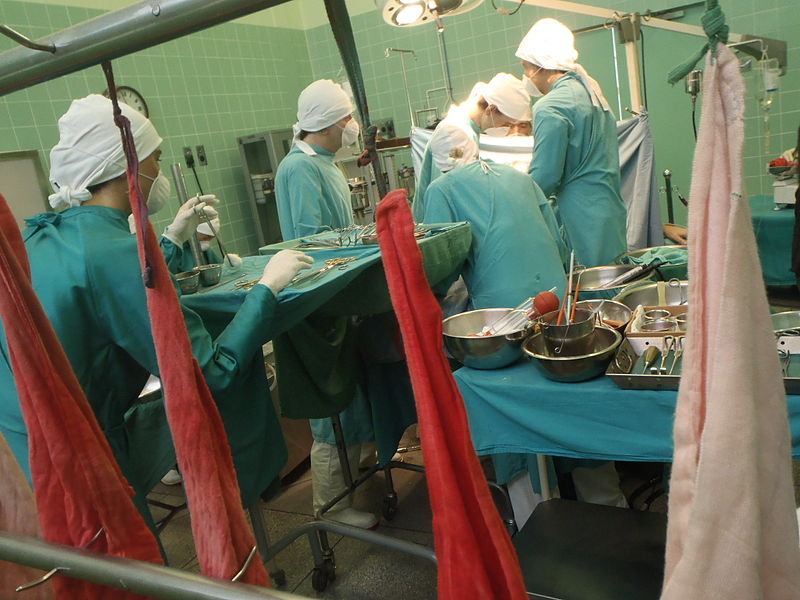
File:Lost_towel_number_15_found.JPG · Wikimedia Commons · See Wikimedia Commons
transplantation
Sign in to saveAlso known as transplant, transplant surgery, transplantation surgery, organ transplantation, allotransplantation, allograft
moving of an organ or tissue from one body or body region to another
Transplantation is the surgical procedure of moving an organ or tissue from one body or body region to another, often to replace a damaged or failing part. It matters because it can restore function and improve or save the life of someone whose own organs or tissues no longer work properly.
AI-generated from the Wikipedia summary — may contain errors.
Research
1,127,561 papers- Geographic disparities in transplantation.ReviewCurrent opinion in organ transplantation · 2021Salvalaggio PRDOI: 10.1097/MOT.0000000000000914
- Expanding heart transplantation in 2022 and beyond.ReviewCurrent opinion in cardiology · 2023Rivera NT, Baran DADOI: 10.1097/HCO.0000000000001023
- Indications of Intestinal Transplantation.ReviewGastroenterology clinics of North America · 2019Kahn AB, Tulla KA, Tzvetanov IGDOI: 10.1016/j.gtc.2019.08.010
- Age and liver transplantation.ReviewJournal of hepatology · 2019Durand F, Levitsky J, Cauchy F et al.DOI: 10.1016/j.jhep.2018.12.009
- Therapeutic apheresis in renal transplantation: An update.ReviewTransfusion and apheresis science : official journal of the World Apheresis Association : official journal of the European Society for Haemapheresis · 2024Melexopoulou C, Filiopoulos V, Marinaki SDOI: 10.1016/j.transci.2023.103844
- Transplantation of human kidney organoids elicited a robust allogeneic response in a humanized mouse model.Kidney international · 2025Mon-Wei Yu S, Choi JY, Kady J et al.DOI: 10.1016/j.kint.2025.02.027
- Transplantation's cooperative future.Liver transplantation : official publication of the American Association for the Study of Liver Diseases and the International Liver Transplantation Society · 2018Lobritto SJDOI: 10.1002/lt.25192
- High-risk Corneal Transplantation: Recent Developments and Future Possibilities.ReviewTransplantation · 2019Armitage WJ, Goodchild C, Griffin MD et al.DOI: 10.1097/TP.0000000000002938
via PubMed
Wikidata facts
- Image
- Lost towel number 15 found.JPG
Show 3 more facts
- Commons category
- Transplantation
- studied by
- transplantology
- on focus list of Wikimedia project
- Wikipedia:Vital articles/Level/4
Sources (3)
via Wikidata · CC0
~40 min read
Encyclopedic overview
Transplantation is a medical procedure in which an organ, tissue, or cells are removed from one organism and placed in a recipient organism, often to replace a damaged or missing function. The donor and recipient may be at the same location, or organs may be transported from a donor site to another location. Organs and tissues that are transplanted within the same person's body are called autografts. Transplants that are recently performed between two subjects of the same species are called allografts. Allografts can either be from a living or cadaveric source.
Organs that have been successfully transplanted include the heart, kidneys, liver, lungs, pancreas, intestine, thymus and uterus. Tissues include bones, tendons (both referred to as musculoskeletal grafts), corneae, skin, heart valves, nerves and veins. Worldwide, kidneys remain the most commonly transplanted organs, followed by liver and heart. Global analyses indicate that available transplants meet a minority of worldwide need, with the Transplant Observatory reporting substantial gaps between demand and supply and year-to-year increases in registered transplant activity in recent data releases. J. Hartwell Harrison performed the first organ removal for transplant in 1954 as part of the first kidney transplant. Corneae and musculoskeletal grafts are the most commonly transplanted tissues; these outnumber organ transplants by more than tenfold.
Excerpted from Wikipedia’s “transplantation” article, available under the CC BY-SA 4.0 licence.
Gallery (4)
Available in 80 languages
- Español
- Français
- Deutsch
- 中文
- 日本語
- Русский
- Português
- Italiano
- العربية
- हिन्दी
- Afrikaans
- Albanian
- Armenian
- Azerbaijani
- Bahasa Indonesia
- Bangla
- Bashkir
- Basque
Show 61 more
- Belarusian
- Bosnian
- Bulgarian
- Catalan
- Central Kurdish
- Croatian
- Czech
- Danish
- Esperanto
- Estonian
- Filipino
- Finnish
- Galician
- Georgian
- Greek
- Gujarati
- Hakka Chinese
- Hebrew
- Hungarian
- hyw
- Icelandic
- Interlingua
- Irish
- Kazakh
- Kyrgyz
- Latin
- Latvian
- Lithuanian
- Low German
- Macedonian
- Malay
- Malayalam
- Nederlands
- Nepali
- Newari
- Norwegian
- Norwegian Nynorsk
- nrm
- Pali
- Polski
- Romanian
- Sanskrit
- Serbian
- Serbian (Latin)
- simple
- Slovak
- Slovenian
- Svenska
- Tamil
- Tiếng Việt
- Türkçe
- Turkmen
- Ukrainian
- Uzbek
- Welsh
- Yiddish
- zh_min_nan
- zh_yue
- فارسی
- ไทย
- 한국어
via Wikidata sitelinks · CC0