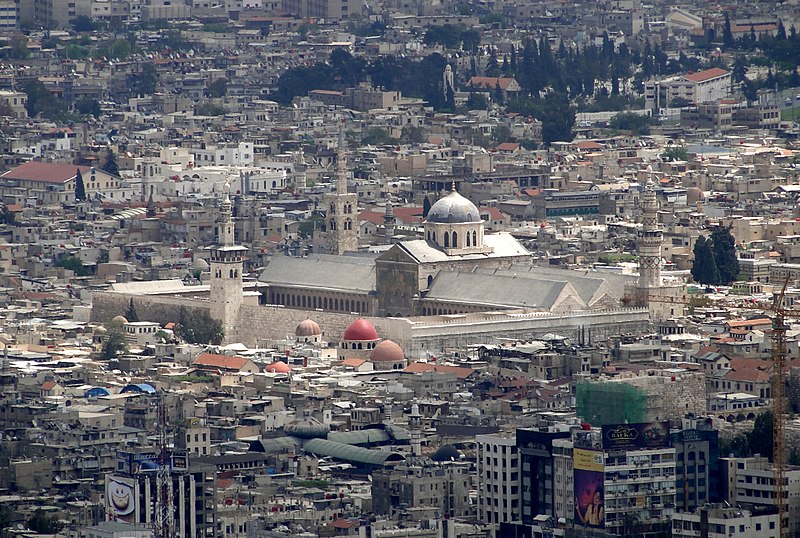
File:Umayyad_Mosque,_Damascus.jpg · Wikimedia Commons · See Wikimedia Commons
Umayyad Mosque
Sign in to saveAlso known as Shrine of John the Baptist, Archbasilica of St. John, Archbasilica of Saint John, Great Mosque of Damascus
mosque in Syria
The Umayyad Mosque is one of the oldest and largest mosques in Syria, located in Damascus, and was built during the early Islamic period under the Umayyad dynasty. It is considered an important example of early Islamic architecture and has served as a significant religious and cultural site for over 1,300 years.
AI-generated from the Wikipedia summary — may contain errors.
Wikidata facts
- Instance of
- educational institution
- Part of
- Ancient City of Damascus
- Religion
- Islam
- Country
- Syria
- Located in
- Damascus
- Founded by
- Al-Walid I
- Material used
- stone
- Dedicated to
- John the Baptist
- Image
- Ommayyad masjed.jpg
- Width
- 50
- Length
- 125
- Has use
- mosque
Show 5 more facts
- Commons category
- Umayyad Mosque
- architectural style
- Umayyad architecture
- native label
- جامع بني أمية الكبير
- inception
- 0706-00-00
- on focus list of Wikimedia project
- Wikipedia:Vital articles/Level/4
via Wikidata · CC0
~40 min read
Encyclopedic overview
The Umayyad Mosque (Arabic: ٱلْجَامِع ٱلْأُمَوِي, romanized: al-Jāmiʿ al-Umawī), also known as the Great Mosque of Damascus (Arabic: جَامِع بَنِي أُمَيَّة ٱلْكَبِيْر, romanized: Jāmiʿ Banī Umayyah al-Kabīr), located in the old city of Damascus, the capital of Syria, is one of the largest and oldest mosques in the world. Its religious importance stems from the eschatological reports concerning the mosque and historic events associated with it. Christian and Muslim tradition alike consider it the burial place of John the Baptist's head, a tradition originating in the 6th century. Two shrines inside the premises commemorate the Islamic prophet Muhammad's grandson Husayn ibn Ali, whose martyrdom is frequently compared to that of John the Baptist. It is considered to be the oldest mosque still in use in its original form.
The site has been used as a house of worship since the Iron Age, when the Arameans built on it a temple dedicated to their god of rain, Hadad. It was later associated with the Greek god Zeus during the Hellenistic period. Under Roman rule after 64 CE, it was converted into the center of the imperial cult of Jupiter, the Roman god of rain, becoming one of the largest temples in Syria. The current walls of the mosque were the inner walls of the Temple of Jupiter (built in the 1st century BC to 4th century AD). When the empire in Syria transitioned to Christian Byzantine rule, Emperor Theodosius I (r. 379–395) transformed it into a cathedral and the seat of the second-highest-ranking bishop in the Patriarchate of Antioch.
Excerpted from Wikipedia’s “Umayyad Mosque” article, available under the CC BY-SA 4.0 licence.
Gallery (12)
On the map
Available in 72 languages
- Español
- Français
- Deutsch
- 中文
- 日本語
- Русский
- Português
- Italiano
- العربية
- हिन्दी
- Achinese
- Afrikaans
- Albanian
- Armenian
- Asturian
- Avaric
- Azerbaijani
- Bahasa Indonesia
Show 53 more
- Bangla
- Bashkir
- Basque
- Bosnian
- Bulgarian
- Catalan
- Central Kurdish
- Croatian
- Czech
- Danish
- Egyptian Arabic
- Esperanto
- Finnish
- Georgian
- gpe
- Greek
- Hausa
- Hebrew
- Kashmiri
- Kazakh
- Kinyarwanda
- Latvian
- Lithuanian
- Macedonian
- Malay
- Moroccan Arabic
- Nederlands
- Norwegian
- Norwegian Nynorsk
- Polski
- Punjabi
- Romanian
- Serbian
- Serbian (Latin)
- simple
- Slovenian
- Svenska
- Swahili
- Tamil
- Tatar
- Tiếng Việt
- Türkçe
- Ukrainian
- Urdu
- Uzbek
- Waray
- Welsh
- Western Panjabi
- Wu Chinese
- zh_yue
- فارسی
- ไทย
- 한국어
via Wikidata sitelinks · CC0