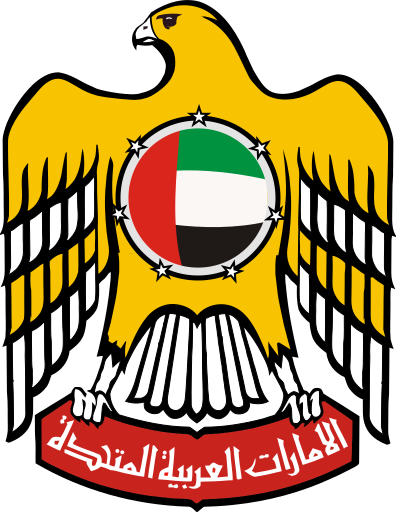
Also known as U.A.E., ae, Emirates, the United Arab Emirates, the UAE, the U.A.E., the Emirates
país de Asia
The United Arab Emirates is a West Asian country made up of seven emirates located on the Arabian Peninsula, with Abu Dhabi as its capital and Dubai as its largest city. It matters as a significant regional player in the Persian Gulf with a population exceeding 11 million and serves as a major international business hub where English is widely used alongside the official Arabic language.
AI-generated from the Wikipedia summary — may contain errors.
via Open-Meteo
Located on the coastlines of the Persian Gulf and the Gulf of Oman, the United Arab Emirates covers an area of 83,600 km², slightly smaller than Austria. As a tribal federation, the country is like a visionary fairy tale of the One Thousand and One Nights; however, in recent times, it has developed into an international financial centre.
Even well into the 20th century, the UAE was not on anybody's tourist itinerary. But investment of its fabulous oil and gas wealth, as well as a comparatively liberal interpretation of Islam (if you are a wealthy foreigner, that is), have changed that in a big way – megaprojects including artificial islands, gargantuan malls with everything on offer for those with wallets large enough, and the tallest building in the world have created a lot of buzz around the Emirates. The rapid expansion of the UAE's aviation industry in the 21st century, in large part due to the explosive growth of Dubai-based Emirates and Abu Dhabi-based Etihad Airways, has arguably turned the UAE into the center of the world. The less well-known side of the UAE includes remote, magnificent desert dunes on the edge of the Empty Quarter and awe-inspiring wadis and mountains in the northeast emirates bordering Oman.
Beneath the glittering façade, however, there is a vast underclass of poorly-paid migrant workers who are often horribly mistreated, not to mention a rather authoritarian set of ruling families who won't brook criticism from anyone – not even "unruly" members …
Distances in the UAE are relatively short and are all connected with lighted roads, highways, and abundant transportation methods. The UAE is not very walking friendly to get around mainly due to the hot weather, strong sun, and relatively spaced out attractions. Transportation is increasingly being expanded with a train connecting all the emirates being built, as well as a functioning massive network of public transportation network which can transport you to any place in the UAE with ease.
thumb|Qasr al Sarab in Liwa Oasis. thumb|Jebel Jais in Ras Al Khaimah.
There are plenty of things to see in the United Arab Emirates, both in terms of the Earth's natural wonderful landscape as well as the best of human's constructed attractions. From the world's largest tower in Dubai to the world's largest contiguous sand desert in the world in Liwa Oasis (which was the film set of planet Jakku in Star Wars: The Force Awakens). Most of the United Arab Emirates lies on the coast of the Persian Gulf, except for Fujairah which lies on the Gulf of Oman, offering both experiences of beautiful beaches in both gulf waters. The western side of the UAE's landscape is a sand terrain, with the Empty Quarter desert forming the south side of the UAE and containing some of the largest sand dunes in the world. The golden sand dunes form a wonderful sight and offer great adventurous safari rides into the wilderness of the desert. The northeastern side terrain is mountainous, offering mountain climbing activities in Ras Al Khaimah as well as the world's longest zip line that shoots from the tops of a mountain.
Los Emiratos Árabes Unidos (EAU) es un país soberano constituido en monarquía federal de Oriente Próximo, situado en la península de Arabia. Está compuesto por siete emiratos: Abu Dabi, Ajmán, Dubái, Fuyaira, Ras al-Jaima, Sarja y Umm al-Qaywayn. Limita con Omán al sureste, con el golfo Pérsico al norte y con Arabia Saudita al oeste y sur. El petróleo es la principal fuente de ingresos y el componente esencial de su PIB. Los Emiratos Árabes Unidos son la 30.ª economía por volumen de PIB y en cuanto al índice de desarrollo humano, elaborado por Naciones Unidas, fueron situados en el puesto n.º 42 entre 188 países en 2016. Los primeros asentamientos importantes en la región datan de la Edad del Bronce. En el siglo VII d. C. se vio la llegada del Islam y, durante el siglo XVI, el territorio cayó bajo la influencia de las potencias coloniales europeas, asentándose finalmente el dominio británico. Tras el fin del protectorado del Reino Unido, en diciembre de 1971, seis jeques formaron la unión suscribiendo la Constitución de 1971, a la cual se unió Ras al-Jaima unos meses después. Cada emirato conserva una considerable autonomía política, judicial y económica.
Abstract from DBpedia / Wikipedia · CC BY-SA
3 mapped locations
via REST Countries
via World Bank Open Data · CC BY 4.0
via OpenStreetMap · GeoNames
via Wikimedia Pageviews API
via PubMed
via Wikidata · CC0
The UAE was initially a collection of small fishing villages with Eastern Arabian culture which has boomed significantly after the unification of the seven emirates. Hence, in every emirate's capital you will find an old district with old buildings consistent of mostly windcatchers and military forts that were common in the region then, and more progressive glass skyscrapers that si…
thumb|The turquoise waters surrounding the Islands of [[Abu Dhabi along the Corniche.]] thumb|Fujairah fort in Fujairah.
One of the main focuses of tourist life (other than shopping) is the beach. The waters of the UAE, although cloudy due to heavy coastal construction, are still, for those from less torrid climes, remarkably warm, clean, and beautiful. There are long stretches of white-sand beaches, ranging from completely undeveloped to highly touristed (even in cities like Dubai). The snorkeling and diving can be magnificent, especially along the eastern (Indian Ocean) coast. Vast swaths of desert stretch to the south of the major urban areas, offering dramatic views and terrifying rides in fast-driven safaris. The mountains are dramatic, steep rocky crags, and a visit to them (for example, the town of Hatta) is well rewarded with amazing views. Women wearing bathing suits will draw unwanted attention at the public beaches; it is advisable to pay for a one-day entry pass to a private beach at a hotel.
There are plenty of man-made wonders to enjoy as well. Ferrari World in Abu Dhabi is the world's largest indoor theme park, and as the name suggests, is centered around experiencing the world of Ferrari and includes the fastest rollercoaster in the world, accelerating from 0 to 149 mph (240 km/h) in 4 seconds. This is alongside the Yas Marina Circuit, which hosts the Abu Dhabi Formula One Grand Prix. The Yas Marina Circuit is widely known as the most technologically advance…
thumb|240px|Popular Emirati dessert called Lugaimat. thumb|240px|A fancy Arabic-cuisine mixed grill. Clockwise from top: lamb kofta, chicken shish tawuk, beef shish kebab, pilaf (Arabic rice), vegetables.
The UAE's traditional cuisine is the Emirati and Eastern Arabian cuisine; however, the country also offers a global cuisine. The more than 165 nationalities residing in the Emirates have made the country a destination which offers and caterers to all cuisines or religious compliant food for everyone.
thumb|300px|Fast Track Lobby Bar at the Radisson Blu Hotel in the capital Abu Dhabi. The legal drinking age in the UAE is 21.
Dubai has a burgeoning nightlife scene and even formerly straitlaced Abu Dhabi has loosened up and tried to catch up. Alcohol is available in alcohol stores, 5-star hotel restaurants and bars in all emirates except Sharjah. Sharjah is a dry emirate, but it is legal for non-Muslims to bring in alcohol purchased elsewhere for consumption in private.
As a tourist, you do not need a license to purchase alcohol, but will need to present your passport with the immigration entry stamp. If you are a foreign resident, you may need a license to purchase alcohol depending on what emirate you are in; Abu Dhabi does not require a license, while Dubai requires one that can be applied for free-of-charge at any liquor store. Public drinking outside licensed venues is illegal in the UAE.
During Ramadan, no alcohol is served during daylight (fasting) hours. Dubai and Abu Dhabi permit bars to serve alcohol at night, but bands stop playing, background music is off or quiet, no dancing is allowed and nightclubs are usually closed. On certain holy days in the Islamic calendar, no alcohol is served publicly in any of the UAE.
Do not under any circumstance drink and drive in the UAE. If by chance you are in an accident, this becomes a card for going directly to jail — especially during Ramadan. Taxis and ride-share apps such as Uber are widely available if you have …
thumb |upright=1.5 |Palm Jumeirah in Dubai
For the visitor, the UAE has one of the most spectacular ranges of tourist accommodations in the world. There are staggeringly beautiful, modern hotels, which can be expensive. However, more modest housing is also available. Hotels and accommodation in the Emirates are always available - in fact, hotels are a major revenue source for investors in the UAE. The hotels and accommodation throughout the Emirates are stunning and extraordinarily luxurious because of the high luxury standards in the Emirates (particularly in Dubai) as well as the relatively new buildings and skyscrapers. Some of the most famous lodging destinations that are famous for being portrayed in movies are the Emirates Palace in Abu Dhabi and the Burj Al Arab in Dubai. Emirates Palace in Abu Dhabi also serves as a lodging destination for foreign head of states or diplomats visiting the capital city Abu Dhabi.
Almost all hotels serve alcohol with the notable exception of hotels in Sharjah. Most hotels also have various bars, night clubs, and meeting hot spots. Most resorts are built on artificial made islands such as the Palm Jumeriah in Dubai and Al Marjan Island in Ras Al Khaimah. Beach access and amenities are a given when booking a resort or a hotel on a beach.
thumb|Emirati men wearing traditional attire while performing the Emirati weapon dance Razfah Emiratis share a common culture with the rest of the Arab world, so what would be good manners in other Arab countries would generally be good manners in the Emirates too.
Emiratis are proud but welcoming people and, when not in their cars, are generally extremely civil and friendly. Their culture can be very conservative, but they are quite attuned to the ways, customs, events, media, and manners of the world.
Local men usually wear a "Kandoura", a long robe (typically white), and ghutra, a red-checked or white headdress. Local women wear a black robe-like garment (abaya) and a black head scarf (shayla).
Travelers should be aware and respect the more traditional outlook in the UAE, but Western travelers will find most of the UAE quite comfortable.
Like other Arab countries, Emirati society is very tribal, with a strong emphasis on family honour. Do not speak badly of someone's family member.
Although women are not legally required to wear the hijab, revealing fashions such as tank tops and shorts are discouraged. Hijab and modest clothing are necessary to visit mosques or religious sites. Some mosques such as the Sheikh Zayed mosque in Abu Dhabi provide modest clothing for tourists visiting the site. Short skirts and shorts might incur stares. There are quite a few tourist- or expatriate-dominated zones where even "provocative" dress may be seen, although not welcomed, and swim…
thumb|Dubai Police uses a fleet of super-cars. The super cars police patrols are found in tourist hot spots and allows tourists to take pictures with the officers. The UAE is one of the safest countries in the world with regard to crime. However, there is a very high rate of automobile accidents, so you should take extra care when driving a vehicle or crossing the road. Also, the law enforcement is harsh, with severe punishments for what in most places would pass as just inappropriate behaviour or at most a misdemeanor.
Homosexuality is illegal in the UAE, and it may carry the penalty of death or life in prison, so gay and lesbian tourists should be discreet and avoid any public displays of affection.
Sex outside marriage is illegal, but the penalty is not enforced unless it results in pregnancy. Public displays of affection are also illegal and punishable by fine or jail regardless of gender or sexual orientation. Caution is definitely advised. Public sex, nudity, and any form of sexual activity conducted in public is illegal.
The UAE has extremely strict laws on drug usage; the punishment for possession is typically 4 years in prison, and tourists have been arrested and sentenced under this law for having microscopic specks of drugs or even drug ingredients on their clothing without their knowledge. Another trap for the unwary is that if you are suspected of being under the influence of drugs or alcohol, a blood test can be taken, and if it shows evidence of substances t…
General medical care in the Emirates is quite good, with clinics for general and specialized care widely available, including some which are now open 24 hours. Hospitals in the major centers are well-equipped to deal with any medical emergencies. There is an ambulance system in all major population centres; however, coverage can be patchy in the more remote areas. Ambulances are designed for transportation rather than providing care as first responders, so don't expect top-flight on-site care. Emirati citizens are provided with free healthcare under the welfare state, but this does not cover foreigners, who are required to purchase health insurance as part of their visa conditions.
The main government hospital in Abu Dhabi is quite good; as is the Sheikh Khalifa Medical City, now managed by Cleveland Clinic.
In Dubai, the government hospitals are Rashid hospital, which has a new Trauma Centre and Dubai Hospital which are very good. Welcare Hospital International Modern Hospital American Hospital Zulekha Hospital NMC Hospital, and Belhoul Hospital in the private sector all have a good reputation. The country is free of malaria and prophylaxis is not needed. In Sharjah, the Kuwaiti (government) Hospital accepts expatriates. The private hospitals in Sharjah are the Zahra hospital, Zulekha Hospital and Central Private Hospital. Prices including healthcare are generally cheaper in Sharjah and although all hospitals meet the Ministry of Health standards the Central Private Hospit…
Travel guide from Wikivoyage (CC BY-SA 4.0)
via Wikidata sitelinks · CC0
Discovered by embedding cosine similarity (sentence-transformers MiniLM, 384-dim).