Encyclopedia of Life · EOL (see source)
Species
SPECIES
- KingdomBacteria
- PhylumProteobacteria
- ClassGammaproteobacteria
- OrderEnterobacterales
- FamilyVibrionaceae
創傷弧菌(學名:Vibrio vulnificus、俗稱:海洋弧菌),是一種棲息於海洋中的細菌。如果傷口暴露在含有這種細菌的海水中,創傷弧菌會在傷口上繁殖,可能引發潰爛,甚至導致組織壞死。若食用了遭污染的海鮮,也有罹患腸胃炎的可能。在2003年12月,中華民國國家衛生研究院主導的基因體定序團隊,完成了創傷弧菌的基因體定序與分析工作。
via GBIF
Museum specimens
- Specimen records
- 4
- Family
- Vibrionaceae
- Collections
- CIAD
- Recorded in
- Mexico, United States
Research
2,851 papers- Vibrio vulnificus, an Underestimated Zoonotic Pathogen.Advances in experimental medicine and biology · 2023
- Vibrio vulnificus.Trends in microbiology · 2020
- Pathogenic mechanism of Vibrio vulnificus infection.Future microbiology · 2023
- Vibrio vulnificus infection: a persistent threat to public health.The Korean journal of internal medicine · 2018
- Vibrio vulnificus.Nursing · 2005
via PubMed
Wikidata facts
Show 7 more facts
- taxon name
- Vibrio vulnificus
- taxon rank
- species
- taxon common name
- 創傷弧菌
- Gram staining
- gram-negative bacteria
- Commons category
- Vibrio vulnificus
- short name
- V. vulnificus
Sources (2)
via Wikidata · CC0
~22 min read
Encyclopedic overview
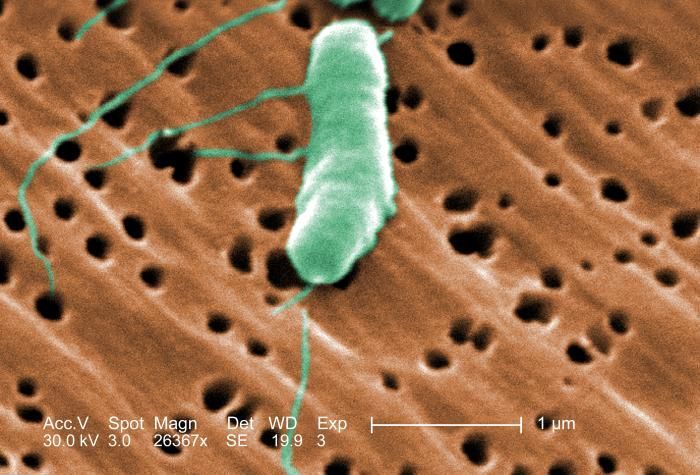
Vibrio vulnificus is a species of Gram-negative, motile, curved rod-shaped (vibrio), pathogenic bacteria of the genus Vibrio. Present in marine environments such as estuaries, brackish ponds, or coastal areas, V. vulnificus is related to V. cholerae, the causative agent of cholera. At least one strain of V. vulnificus is bioluminescent. Increasing seasonal ocean temperatures and low-salt marine environments like estuaries favor a greater concentration of Vibrio within filter-feeding shellfish; V. vulnificus infections in the Eastern United States have increased eightfold from 1988–2018.
Infection with V. vulnificus leads to rapidly expanding skin infections by entering a wound causing cellulitis or even sepsis. V. vulnificus is also a source of foodborne illness. It was first isolated as a source of disease in 1976.
Excerpted from Wikipedia’s “Vibrio vulnificus” article, available under the CC BY-SA 4.0 licence.