
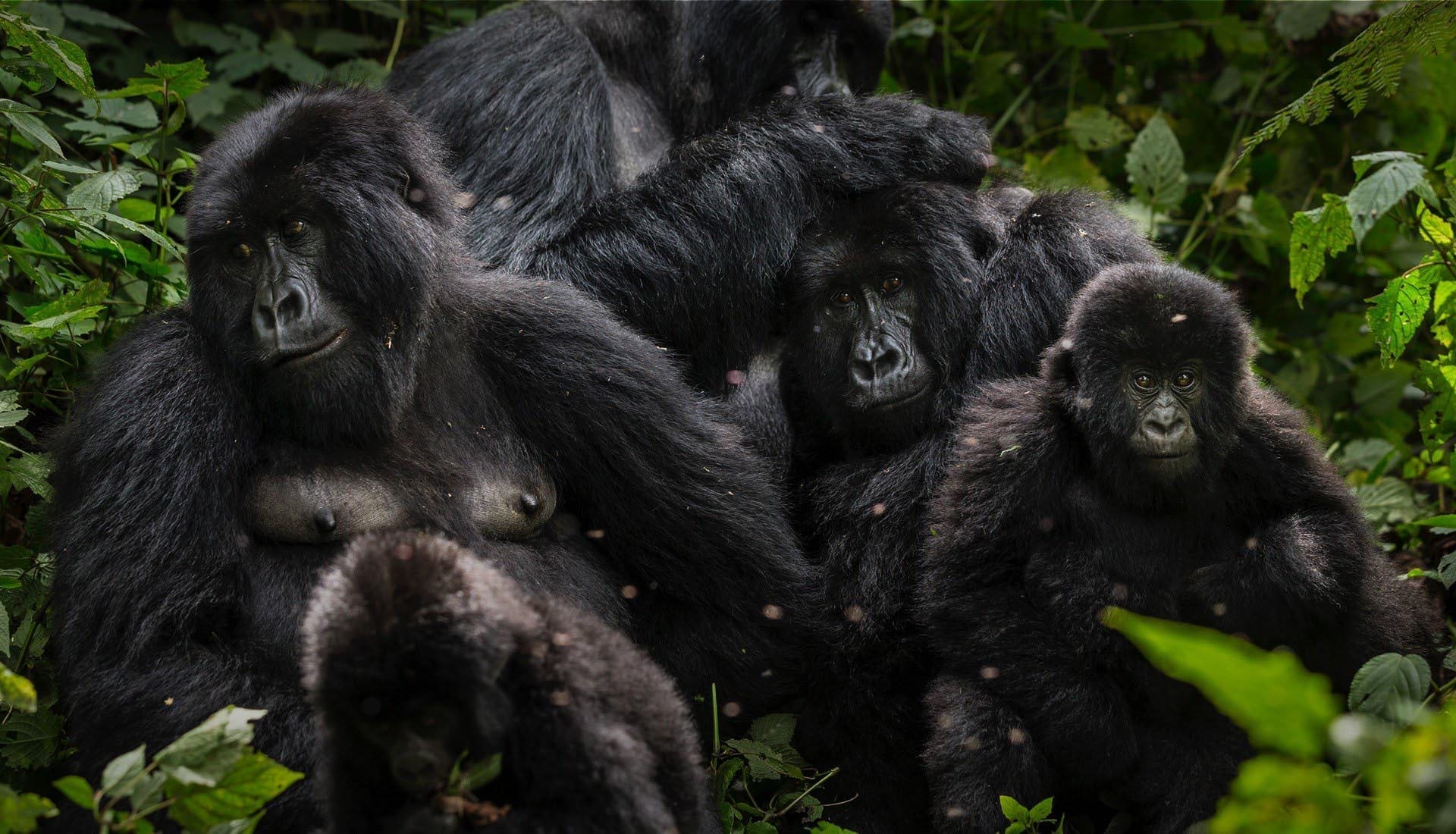
File:Virunga_National_Park-107997.jpg · Wikimedia Commons · See Wikimedia Commons
Virunga National Park
Sign in to saveAlso known as Albert National Park
national park in the Democratic Republic of the Congo
Virunga National Park is a protected nature reserve located in the Democratic Republic of the Congo that preserves important wildlife and ecosystems in Central Africa. It matters because it protects rare and endangered species and their habitats in a region of significant ecological importance.
AI-generated from the Wikipedia summary — may contain errors.
Official website
Virunga National Park | Support Our Conservation Efforts
Virunga National Park is one of the most biologically diverse areas on the planet and home to the world's critically endangered mountain gorillas.
virunga.org →Virunga National Park is a UNESCO World Heritage Site internationally recognized for its exceptional wildlife and habitats. Explore one of the most biodiverse protected areas in the world. Virunga National Park is a UNESCO World Heritage Site located in the east of the Democratic Republic of Congo. Virunga is the continent’s most biologically diverse protected area and a national park embarking on an ambitious development programme known as the “Virunga Alliance”. Situated in a region which has been deeply impacted by the effects of war and armed conflict for over 20 years, Virunga is currently protected by a dedicated team of 800+ Rangers. These local men and women go through intensive training, risking their lives on a daily basis to safeguard the Park’s exceptional wildlife, including the last of the world’s endangered mountain gorillas. Alongside this essential conservation work, the Park is committed to supporting local communities. Virunga has a vision for responsibly harnessing the Park’s natural resources to create new opportunities for the four million people that live within a day’s walk of its borders. Focussing on three key areas: hydropower, sustainable agriculture and fisheries, and tourism, Virunga National Park is working to economically transform the region – creating jobs and reducing poverty rates. This innovative, community focussed approach to conservation is working to reduce the pressures currently faced by the Park’s Rangers from armed groups, illegal poaching, and land encroachment. Click here to learn more about the work of the Virunga Alliance. Virunga has the highest number of amphibian species in the Albertine Rift, an area which encompasses parts of Uganda, the Democratic Republic of the Congo, Rwanda, Burundi and Tanzania. Virunga is the only site on earth to have three types of great apes – the mountain gorilla, eastern lowland gorilla, and eastern chimpanzee. Around one third of the world population of endangered mountain gorillas live in the lush volcanic forests of Virunga National Park. The endangered eastern lowland gorilla, also known as the Grauer’s gorilla, is a sub-species of the eastern gorilla that resides in the lowland tropical rainforests of eastern Congo. Both savanna elephants and forest elephants reside in Virunga National Park, making it one of the few places in the world where both species co-exist. Hippos, which can weigh up to 4,400 pounds (almost 2,000 kilograms), make their home in many different rivers, lakes, and pools throughout Virunga. Chimpanzees are an endangered species and one of the four species of great apes. Like humans, chimps communicate with facial expressions, gestures, and sounds. Okapis are shy and solitary animals that resemble zebras but are more closely related to the giraffe and are endemic to the DRC. Lions are carnivores that consume a wide variety of prey, from wildebeest, impala, zebra, giraffe, buffalo and wild hogs to the occasional rhino, hippo, or elephant when food is scarce. Both savanna and forest buffalo are found in the park and can be found roaming the Rwindi plains in the Park’s Central Sector. The endangered Rwenzori duiker or Rwenzori red duiker is a stocky, small antelope endemic to the alpine zones of the Rwenzori mountains. The grey crowned crane lives in wetlands, grasslands, savannas, and forests near the Ishasha and Rwindi Rivers. Standing over 3 feet (1 meter) tall, it’s known for its grey plumage, red throat pouch, and golden crown. Only about 30,000 remain in the wild — 12,000 in South Africa and 18,000 in East Africa. African fish eagles are powerful birds of prey found across Sub-Saharan waterways.Though they mainly eat fish, they’ll also feed on carrion, birds, monkeys, and crocodile hatchlings when needed. Females, larger than males, have up to an 8-foot (2.4 meters) wingspan and are easily recognized by their brown bodies, white heads, yellow faces, and strong black wings. Shoebills inhabit the swamps
Read more on their site →Excerpt from the official site · 24,569 chars · not written by Vinony
Wikidata facts
- Instance of
- national park
- Located in
- Orientale Province
- Area
- 800000
- Creator
- Albert I of Belgium
- Location
- Democratic Republic of the Congo
- Official website
- virunga.org
- Image
- Virunga National Park Landscape.jpg
- Significant event
- list of World Heritage in Danger
Show 8 more facts
- Commons category
- Virunga National Park
- topic's main category
- Category:Virunga National Park
- heritage designation
- Ramsar site
- inception
- 1925-00-00
- significant place
- Goma
- social media followers
- 5950
- native label
- Parc national des Virunga
via Wikidata · CC0
~20 min read
Encyclopedic overview
Virunga National Park (French: Parc national des Virunga, abbreviated as PNVi) is a national park in the Albertine Rift Valley in the eastern part of the Democratic Republic of the Congo. It was created in 1925. In elevation, it ranges from 680 m (2,230 ft) in the Semliki River valley to 5,109 m (16,762 ft) in the Rwenzori Mountains. From north to south it extends approximately 300 km (190 mi), largely along the international borders with Uganda and Rwanda in the east. It covers an area of 7,800 km (3,000 sq mi). It is bounded to the north by the Puemba River and to the south by Tchegera Island in Lake Kivu.
Two active volcanoes, Mount Nyiragongo and Nyamuragira, are located in the park. They have significantly shaped the national park's diverse habitats and wildlife. More than 3,000 faunal and floral species have been recorded, of which more than 300 are endemic to the Albertine Rift including eastern gorilla (Gorilla beringei) and golden monkey (Cercopithecus kandti).
Excerpted from Wikipedia’s “Virunga National Park” article, available under the CC BY-SA 4.0 licence.
Gallery (12)
On the map
Available in 71 languages
- Español
- Français
- Deutsch
- 中文
- 日本語
- Русский
- Português
- Italiano
- العربية
- हिन्दी
- Akan
- Akan
- Albanian
- Armenian
- Azerbaijani
- Bahasa Indonesia
- Balinese
- Basque
Show 52 more
- Bulgarian
- Burmese
- Catalan
- Cebuano
- Croatian
- Czech
- dag
- Danish
- Esperanto
- Estonian
- Finnish
- Frafra
- Galician
- Georgian
- Hausa
- Hebrew
- Hungarian
- Icelandic
- Kazakh
- Kinyarwanda
- Kotava
- Kurdish
- Kyrgyz
- Latvian
- Lingala
- Lithuanian
- Macedonian
- Maithili
- Malay
- Malayalam
- Maltese
- Mossi
- Nederlands
- Nepali
- Norwegian
- Polski
- Romanian
- Serbian
- Serbian (Latin)
- Slovak
- Slovenian
- Svenska
- Swahili
- Tiếng Việt
- Türkçe
- Ukrainian
- Urdu
- Western Panjabi
- Wu Chinese
- فارسی
- ไทย
- 한국어
via Wikidata sitelinks · CC0