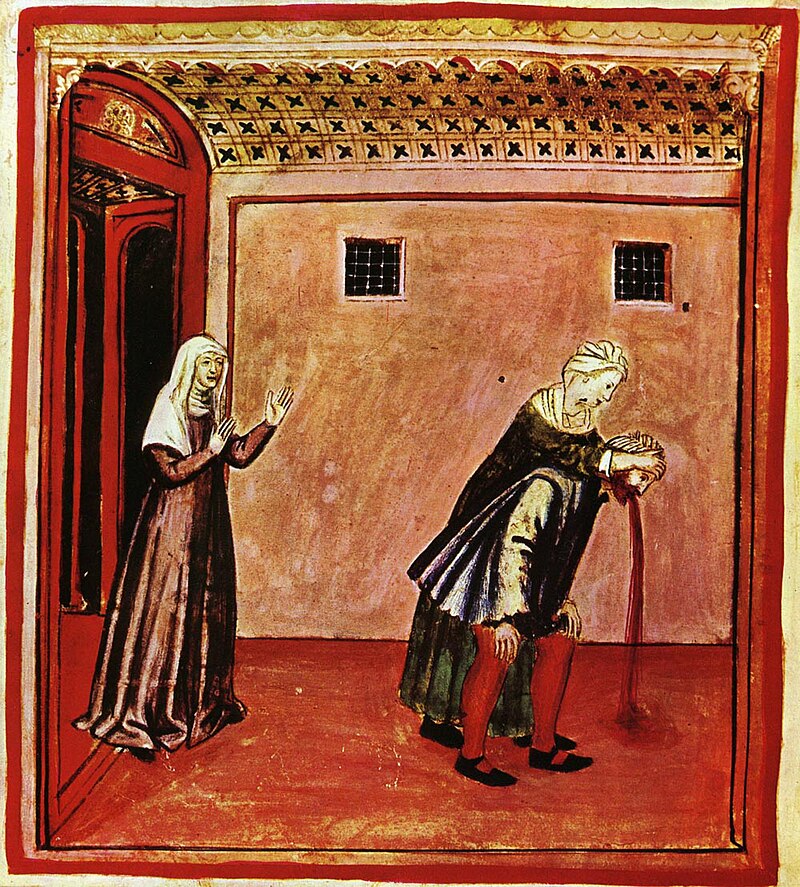
File:49-aspetti_di_vita_quotidiana,_vomito,Taccuino_Sanitatis,_Ca.jpg · Wikimedia Commons · See Wikimedia Commons
vómito
Sign in to saveAlso known as vomit, emesis, throwing up, puking, barfing, retching
expulsión violenta y espasmódica del contenido del estómago a través de la boca
OverviewAI-generated
Vomiting is a medical condition documented in various classification systems, including the ICPC 2 under ID D10 and the NCI Thesaurus under ID C3442. It is represented by the Unicode character 🤮 and has exact matches in the Human Phenotype Ontology (HP_0002013) and Symptom Ontology (SYMP_0019145).
The subject is categorized under the Commons category "Vomiting." Academic literature regarding this topic is extensive, with PubMed indexing 111,873 articles associated with the query. Additionally, the topic is referenced by 2,070 other encyclopedia articles.
Synthesized by Vinony from 8 facts across 3 sources: Wikidata, PubMed, Vinony graph. Generated from structured data (not the Wikipedia text) and checked against those facts — may still contain errors.
Key facts
- Medical condition (new).name
- Vomiting
- Medical condition (new).synonyms
- Emesis, throwing up, puking, barfing, spewing, upchucking, heaving, hurling, ralphing, being sick, urping
- Medical condition (new).image
- File:49-aspetti di vita quotidiana, vomito,Taccuino Sanitatis, Ca.jpg
- Medical condition (new).alt
- A Renaissance drawing with vivid colours depicting a woman holding the head of a man, who is bent over and expelling a brownish-red material from his mouth. A second woman stands at the left of the image in the doorway to the room, and appears to offer support. A crude representation of vomiting.
- Medical condition (new).caption
- 14th-century illustration of vomiting from the Casanatense Tacuinum Sanitatis
- Medical condition (new).field
- Gastroenterology
- Medical condition (new).symptoms
- Nausea
- Medical condition (new).complications
- Aspiration, electrolyte and water loss, damage to the enamel of the teeth, tear of the esophageal mucosa
- Medical condition (new).risks
- History of migraine, history of PONV or motion sickness in a child's parent or sibling, better ASA physical status, intense preoperative anxiety, certain ethnicities or surgery types, decreased perioperative fluids, crystalloid versus colloid administration
via Wikipedia infobox
Research
111,873 papers- Acute vomiting.ReviewThe Veterinary clinics of North America. Small animal practice · 1994King LG, Donaldson MTDOI: 10.1016/s0195-5616(94)50134-7
- Emetophobia (fear of vomiting): A meta-analysis.ReviewJournal of anxiety disorders · 2025Meule A, Seufert L, Kolar DRDOI: 10.1016/j.janxdis.2025.103053
- Use of orally administered dexmedetomidine to induce emesis in cats.Journal of feline medicine and surgery · 2024Maxwell KM, Odunayo A, Wissel CDOI: 10.1177/1098612X241248980
- Psychogenic vomiting: a review.ReviewThe American journal of gastroenterology · 1982Wruble LD, Rosenthal RH, Webb WL Jr
- Prevention of vomiting after paediatric strabismus surgery: a systematic review using the numbers-needed-to-treat method.British journal of anaesthesia · 1995Tramèr M, Moore A, McQuay HDOI: 10.1093/bja/75.5.556
- Postoperative nausea and vomiting.ReviewThe Surgical clinics of North America · 2005Williams KSDOI: 10.1016/j.suc.2005.09.005
- Early diagnosis of neonatal-onset cyclic vomiting syndrome.Nagoya journal of medical science · 2023Ogata M, Shimizu D, Ichikawa S et al.DOI: 10.18999/nagjms.85.2.357
- Sudden Chest Pain During Vomiting After Drinking.Gastroenterology · 2022Hirose T, Kakushima N, Fujishiro MDOI: 10.1053/j.gastro.2021.07.048
via PubMed
Wikidata facts
- Image
- Vomiting.jpg
Show 11 more facts
- Commons category
- Vomiting
- topic's main category
- Category:Vomiting
- has cause
- peptic ulcer disease
- drug or therapy used for treatment
- lorazepam
- ICPC 2 ID
- D10
- NCI Thesaurus ID
- C3442
- Unicode character
- 🤮
- exact match
- purl.obolibrary.org/obo/SYMP_0019145
- P8168
- D-U-N-S
- different from
- regurgitation
- health specialty
- gastroenterology
via Wikidata · CC0
Article · Español
El vómito, también llamado emesis, es la expulsión violenta y espasmódica del contenido del estómago a través de la boca. Aunque posiblemente se desarrolló evolutivamente como un mecanismo para expulsar del cuerpo venenos ingeridos, puede aparecer como síntoma de muchas enfermedades no relacionadas con estos, ni siquiera con el estómago (gastritis), como puede serlo una patología cerebral u ocular. La sensación que se tiene justo antes de vomitar (pródromo) se llama náusea (también llamada coloquialmente arcada, ansia, fatiga o angustia, dependiendo de la región) que puede preceder al vómito o también puede aparecer aislada. Los medicamentos llamados antieméticos pueden ser necesarios para la supresión de la náusea y el vómito. Los eméticos (Psychotria ipecacuanha o emetina) ya no se usan desde la generalización del lavado gástrico, pues al provocar el vómito, el ácido clorhídrico del estómago o el tóxico ingerido dañan el esófago (por dos veces en la ingesta de cáusticos con lesiones bastantes graves ya difícilmente remediables después). También se entiende por vómito aquello que se vomita (quimo).
Abstract from DBpedia / Wikipedia · CC BY-SA
Gallery (9)
Available in 106 languages
- Español
- Français
- Deutsch
- 中文
- 日本語
- Русский
- Português
- Italiano
- العربية
- हिन्दी
- Albanian
- Armenian
- azb
- Azerbaijani
- Bahasa Indonesia
- Bangla
- Basque
- bat_smg
Show 87 more
- Belarusian
- Bikol
- Bosnian
- Breton
- Bulgarian
- Catalan
- cdo
- Central Kurdish
- Chechen
- Croatian
- Czech
- Danish
- Divehi
- eml
- Erzya
- Esperanto
- Estonian
- Finnish
- Galician
- Georgian
- gpe
- Greek
- Hausa
- Hawaiian
- Hebrew
- Hungarian
- Icelandic
- Ido
- Iloko
- Inuktitut
- Irish
- Kannada
- Kashmiri
- Kazakh
- Kyrgyz
- Latin
- Latvian
- Limburgish
- Lithuanian
- Macedonian
- Malay
- Malayalam
- Marathi
- Mari
- Mazanderani
- Nederlands
- Nepali
- Norwegian
- Norwegian Nynorsk
- Odia
- Polski
- Punjabi
- Quechua
- Romanian
- Serbian
- Serbian (Latin)
- Shona
- simple
- Sindhi
- Sinhala
- Slovak
- Slovenian
- Sundanese
- Svenska
- Swahili
- Tajik
- Tamil
- Telugu
- Tiếng Việt
- Tulu
- Türkçe
- Turkmen
- Ukrainian
- Urdu
- Uzbek
- Walloon
- Wayuu
- Welsh
- Wu Chinese
- Yakut
- Yiddish
- Yoruba
- zh_yue
- Zhuang
- فارسی
- ไทย
- 한국어
via Wikidata sitelinks · CC0