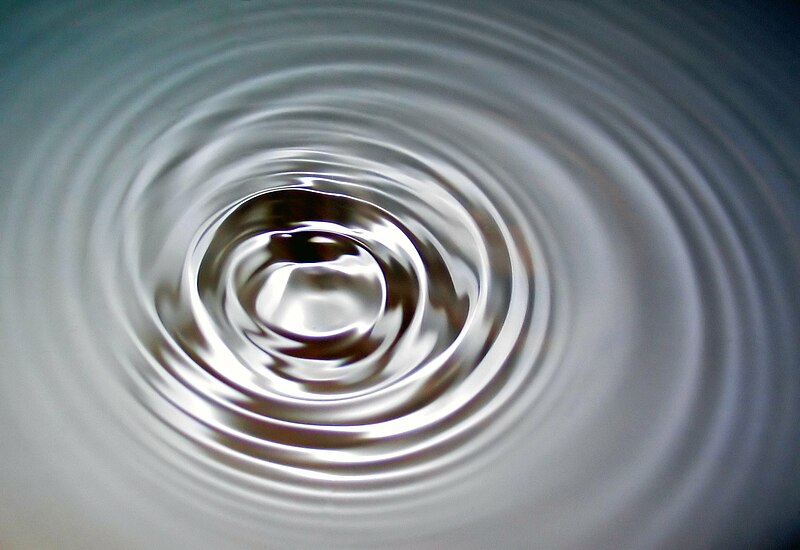
File:2006-01-14_Surface_waves.jpg · Wikimedia Commons · See Wikimedia Commons
A wave is a disturbance that travels through a material or space, like the ripples you see moving across the surface of water. Waves are important because they're how energy moves from one place to another, and they appear everywhere in nature—in water, sound, light, and many other forms.
AI-generated from the Wikipedia summary — may contain errors.
Wikidata facts
- Subclass of
- oscillation
- Has part
- longitudinal wave
- Image
- Blender3D CircularWaveAnim.gif
Show 8 more facts
- described by source
- Brockhaus and Efron Encyclopedic Dictionary
- Commons category
- Waves
- topic's main category
- Category:Waves
- Commons gallery
- Wave
- has characteristic
- waveform
- different from
- Fala
- on focus list of Wikimedia project
- Wikipedia:Vital articles/Level/4
- Stack Exchange tag
- engineering.stackexchange.com/tags/waves
via Wikidata · CC0
~42 min read
Encyclopedic overview
59 sectionsContents
- Definition
- Mathematical description
- Single waves
- Superposition
- Wave spectrum
- Wave families
- Differential wave equations
- Wave in elastic medium
- Wave forms
- Amplitude and modulation
- Phase velocity and group velocity
- Special waves
- Sine waves
- Plane waves
- Standing waves
- Solitary waves
- Physical properties
- Propagation
- Reflection of plane waves in a half-space
- SV wave propagation
- P wave propagation
- Wave velocity
- Transmission and media
- Absorption
- Reflection
- Refraction
- Diffraction
- Interference
- Polarization
- Dispersion
- Doppler effect
- Mechanical waves
- Waves on strings
- Acoustic waves
- Gravity waves
- Body waves
- Seismic waves
- Shock waves
- Shear waves
- Gravitational waves
- Other
- Electromagnetic waves
- Quantum mechanical waves
- Schrödinger equation
- Dirac equation
- de Broglie waves
- See also
- Waves in general
- Parameters
- Waveforms
- Electromagnetic waves
- In fluids
- In quantum mechanics
- In relativity
- Other specific types of waves
- Related topics
- References
- Sources
- External links
thumb|Surface waves in water showing water ripples
In mathematics and physical science, a wave is a propagating dynamic disturbance (change from equilibrium) of one or more quantities. Periodic waves oscillate repeatedly about an equilibrium (resting) value at some frequency. When the entire waveform moves in one direction, it is said to be a travelling wave; by contrast, a pair of superimposed periodic waves traveling in opposite directions makes a standing wave. In a standing wave, the amplitude of vibration has nulls at some positions where the wave amplitude appears smaller or even zero.
Excerpted from Wikipedia’s “wave” article, available under the CC BY-SA 4.0 licence.
Gallery (52)
Available in 106 languages
- Español
- Français
- Deutsch
- 中文
- 日本語
- Русский
- Português
- Italiano
- العربية
- हिन्दी
- Afrikaans
- Albanian
- Aragonese
- Aramaic
- Armenian
- Asturian
- Azerbaijani
- Bahasa Indonesia
Show 87 more
- Bangla
- Basque
- be_x_old
- Belarusian
- Bhojpuri
- Bosnian
- Bulgarian
- Burmese
- Catalan
- Central Kurdish
- Chuvash
- Croatian
- Czech
- Danish
- Egyptian Arabic
- Esperanto
- Estonian
- Fijian
- Filipino
- Finnish
- Galician
- Georgian
- Greek
- Haitian Creole
- Hebrew
- Hungarian
- Icelandic
- Ido
- Kannada
- Kazakh
- Kurdish
- Kyrgyz
- Latin
- Latvian
- Limburgish
- Lithuanian
- Lojban
- Low German
- Macedonian
- Malay
- Malayalam
- Marathi
- Nederlands
- Northern Frisian
- Norwegian
- Norwegian Nynorsk
- Occitan
- Pashto
- Piedmontese
- Polski
- Punjabi
- Quechua
- rki
- Romanian
- rsk
- Rusyn
- Scots
- Serbian
- Serbian (Latin)
- Shona
- simple
- Slovak
- Slovenian
- Somali
- Sundanese
- Svenska
- Swahili
- Tachelhit
- Tamil
- Telugu
- Tiếng Việt
- Toki Pona
- Türkçe
- Ukrainian
- Urdu
- Uzbek
- Waray
- Welsh
- Western Panjabi
- Wu Chinese
- Yiddish
- zh_classical
- zh_min_nan
- zh_yue
- فارسی
- ไทย
- 한국어
via Wikidata sitelinks · CC0