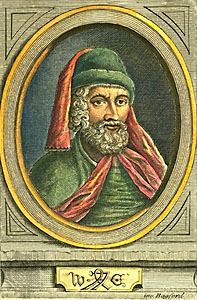
File:William_caxton.jpg · Wikimedia Commons · See Wikimedia Commons
William Caxton
Sign in to saveEnglish merchant, diplomat, writer and printer
OverviewAI-generated
William Caxton was a male linguist, translator, writer, and publisher born in 1422 in Hadlow. A citizen of the Kingdom of England, he wrote in Middle English and spoke Middle English and Renaissance Latin. He translated works from Middle French and medieval Latin into Middle English.
His notable works include Here begynneth the Hystorye of reinard the Foxe, Foure sonnes of Aymon, Chronicles of England, The history of Reynard the Fox, and Polycronycon. Caxton died in London in 1491 and is buried at St Margaret's Church, Westminster. His writings are held in collections such as The Nelson-Atkins Museum of Art.
Synthesized by Vinony from 20 facts across 2 sources: Wikidata, Open Library. Generated from structured data (not the Wikipedia text) and checked against those facts — may still contain errors.
Person · Open Library
- Born
- 1422
- Died
- 1491
- Works
- 181
Top works
- Here begynneth the Hystorye of reinard the Foxe ...
- [Reynard the foxe.]
- [Eneydos
- Foure sonnes of Aymon
- Chronicles of England
via Open Library + Wikidata
Key facts
- Born
- c. 1422
- Died
- c. 1491 (aged c. 68–69 )
- Resting place
- St Margaret's, Westminster
- Occupation
- Merchant diplomat writer printer
- Period
- Late Plantagenet early English Renaissance
- Notable work
- Recuyell of the Historyes of Troye Dictes or Sayengis of the Philosophres Brut Chronicles
via Wikipedia infobox
Wikidata facts
- Instance of
- human
- Given name
- William
- Gender
- male
- Citizenship
- Kingdom of England
- Place of birth
- Hadlow
- Place of death
- London
- Occupation
- printer
- Languages spoken
- renaissance Latin
- Image
- William caxton.jpg
Show 11 more facts
- Commons category
- William Caxton
- date of birth
- 1422-00-00
- date of death
- 1491-01-01
- described by source
- The Catholic Encyclopedia
- place of burial
- St Margaret's Church, Westminster
- writing language
- Middle English
- has works in the collection
- The Nelson-Atkins Museum of Art
- P13311
- Edward Frenkel
- Commons Creator page
- William Caxton
- translates from
- medieval Latin
- translates into
- Middle English
via Wikidata · CC0
~17 min read
Encyclopedic overview
Printer's mark of William Caxton, 1478. A variant of the merchant's mark William Caxton (c. 1422 – c. 1491) was an English merchant, diplomat and writer. He is thought to be the first person to introduce a printing press into England in 1476, and as a printer to be the first English retailer of printed books.
His parentage and date of birth are not known for certain, but he may have been born between 1415 and 1424, perhaps in the Weald or wood land of Kent, perhaps in Hadlow or Tenterden. In 1438 he was apprenticed to Robert Large, a wealthy London silk mercer.
Excerpted from Wikipedia’s “William Caxton” article, available under the CC BY-SA 4.0 licence.