
File:William_Ewart_Gladstone,_1892_(cropped).jpg · Wikimedia Commons · See Wikimedia Commons
William Ewart Gladstone
Sign in to saveAlso known as William Gladstone, Gladstone, W. E. Gladstone, The Rt Hon William Ewart Gladstone, Gladstone, W. E. (William Ewart)
British Liberal prime minister (1809–1898)
William Ewart Gladstone was a British Liberal politician who served as prime minister four times during the 19th century and lived to be 88 years old. He matters because he was one of the most influential political leaders of his era, shaping British policy and governance during a period of significant national change.
AI-generated from the Wikipedia summary — may contain errors.
Described at

History of William Ewart Gladstone - GOV.UK
gov.uk →“The love of freedom itself is hardly stronger in England than the love of aristocracy.” Queen Victoria described him as a “half-mad firebrand” while to a large part of the British working classes he was the "Grand Old Man". Four times prime minister, Gladstone provoked strong reactions. He served as Prime Minister for 4 separate periods. More than any other Prime Minister. Gladstone was elected Tory MP for Newark in December 1832, aged 23, with ultra-conservative views. In Parliament he spoke out against the abolition of slavery, because his family used slaves on their West Indian plantation. He also opposed the recent democratic electoral reforms. Gladstone’s talent for public speaking caught the attention of Robert Peel , then Prime Minister, who made him a Junior Lord of the Treasury and later Under-Secretary at the Colonial Office. He followed Peel in resigning in 1835, and spent the following 6 years in Opposition. In 1840 Gladstone began his ‘rescue and rehabilitation’ of London’s prostitutes. Even while serving as Prime Minister in later years, he would walk the streets, trying to convince prostitutes to change their ways. He spent a large amount of his own money on this work. When the Tory party broke apart in 1846, Gladstone followed Peel in becoming a Liberal-Conservative, now believing strongly in free trade. In 1847 he returned to Parliament as MP for Oxford University, having lost his Newark seat. He was Chancellor again under Palmerston between 1859 and 1865, though their relationship was an uncomfortable one, and yet again under Russell from 1865 to 1866. During these years he became persuaded of the case for a wider franchise, saying: “Every man who is not presumably incapacitated by some consideration of personal unfitness or of political danger is morally entitled to come within the pale of the Constitution.” In 1867, Gladstone became leader of the Liberal party following Palmerston’s resignation, and became Prime Minister for the first time the following year. His policies were intended to improve individual liberty while loosening political and economic restraints. But in 1874 a heavy defeat at the general election led to his arch-rival Disraeli becoming Prime Minister. Gladstone retired as leader of the Liberal Party, but remained an intimidating opponent, attacking the government fiercely over their weak response to Turkish brutality in the Balkans, known as the Eastern Crisis. Yet trouble overseas created problems. He failed to rescue General Gordon from Khartoum, leading to the loss of British control in Sudan, and a dent in Gladstone’s popularity. Critics reversed his ‘GOM’ nickname (for ‘Grand Old Man’) to ‘MOG’ (‘Murderer of Gordon’). In 1885 the government’s Budget was defeated, prompting him to resign, with Lord Salisbury becoming Prime Minister. Gladstone declined an earldom offered by Queen Victoria, preferring to remain in office. In February 1886, aged 76, he became Prime Minister for the third time. Working in alliance with the Irish Nationalists, he immediately introduced an Irish Home Rule Bill, proposing a parliament for Ireland. It was defeated, and he lost the General Election held in July 1886. Gladstone devoted the next 6 years to convincing the British electorate to grant Home Rule. Campaigning on the issue, the Liberals won the 1892 election, and he returned for a fourth administration. He once more introduced the Irish Home Rule Bill, but it was rejected by the Lords. He resigned in March 1894, having failed to retain the support of his Cabinet. Gladstone died on 19 May 1898 from cancer, which started behind the cheekbone and spread across his body. He was buried in Westminster Abbey. Do not include personal or financial information like your National Insurance number or credit card details.
Excerpt from a page describing this subject · 8,201 chars · not written by Vinony
Wikidata facts
- Instance of
- human
- Gender
- male
- Citizenship
- United Kingdom
- Place of death
- Hawarden Castle
- Spouse
- Catherine Gladstone
- Occupation
- politician
- Educated at
- Eton College
- Employer
- University of Edinburgh
- Political party
- Liberal Party
- Languages spoken
- English language
- Religion
- Anglicanism
- Field of work
- politics
- Image
- William Ewart Gladstone, 1892 (cropped).jpg
- Work location
- London
Show 21 more facts
- on focus list of Wikimedia project
- Wikipedia:Vital articles/Level/4
- contributed to creative work
- Popular Science
- candidacy in election
- 1865 United Kingdom general election
- place of burial
- Westminster Abbey
- described by source
- The Nuttall Encyclopædia
- member of
- Accademia della Crusca
- Commons category
- William Gladstone
- date of birth
- 1809-12-29
- date of death
- 1898-05-19
- Commons Creator page
- William Ewart Gladstone
- archives at
- National Library of Wales
- topic's main category
- Category:William Ewart Gladstone
- Commons gallery
- William Ewart Gladstone
- name in native language
- William Ewart Gladstone
- honorific prefix
- The Right Honourable
- writing language
- English language
- ethnic group
- English people
- pseudonym
- Scrutator
- P12749
- Kwesi Ahoomey-Zunu
- P13311
- Dyson sphere
via Wikidata · CC0
Works in European collections
29 objects attributed to William Ewart Gladstone, held across European museums, libraries & archives · via Europeana









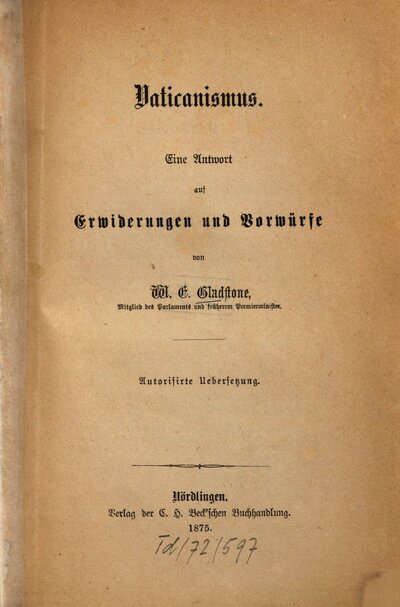
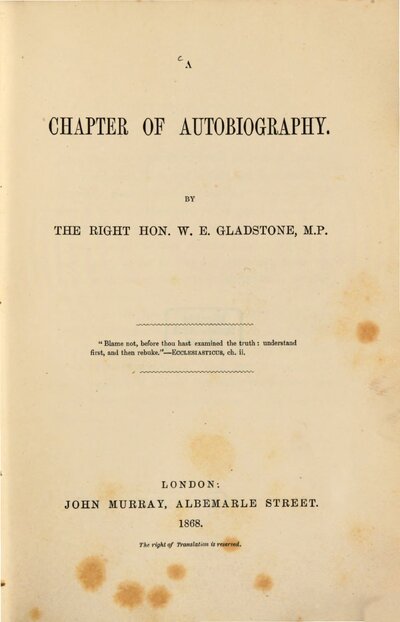

~40 min read
Encyclopedic overview
William Ewart Gladstone (/ˈjuːərt ˈɡlædstən/ YOO-ərt GLAD-stən; 29 December 1809 – 19 May 1898) was a British statesman who served four times as Prime Minister of the United Kingdom. He began in politics as a Conservative Member of Parliament (MP) for Newark and ended as the face of the Liberal Party. His four non-consecutive terms — the most of any British prime minister — took place between 1868 and 1894. He also served four times as Chancellor of the Exchequer, five times as Leader of the House of Commons, and MP for over 60 years, from 1832 to 1845 and from 1847 to 1895, representing a total of five constituencies. His political career thus spanned nearly the entire Victorian era.
Gladstone was born in Liverpool to the prominent Scottish merchant and slaveholder Sir John Gladstone. A graduate of Eton and Oxford, Gladstone first entered the House of Commons in 1832 as a High Tory, a grouping that joined the Conservative Party under Sir Robert Peel in 1834. Gladstone served as a minister in both of Peel's governments, and in 1846 joined the breakaway Peelite faction that merged into the new Liberal Party in 1859. He was chancellor under Lord Aberdeen (1852–1855), Lord Palmerston (1859–1865) and Lord Russell (1865–1866). Gladstone's own political doctrine – which promoted equality of opportunity and the repeal of taxes and protectionist trade barriers – came to be known as Gladstonian liberalism.
Excerpted from Wikipedia’s “William Ewart Gladstone” article, available under the CC BY-SA 4.0 licence.
Gallery (12)
Available in 77 languages
- Español
- Français
- Deutsch
- 中文
- 日本語
- Русский
- Português
- Italiano
- العربية
- हिन्दी
- Armenian
- Asturian
- Azerbaijani
- Bahasa Indonesia
- Bangla
- Basque
- be_x_old
- Belarusian
Show 58 more
- Bulgarian
- Burmese
- Catalan
- Central Kurdish
- Cornish
- Czech
- Danish
- Egyptian Arabic
- Esperanto
- Estonian
- Finnish
- Galician
- Georgian
- Greek
- Hebrew
- Hungarian
- Icelandic
- Ido
- Irish
- Kurdish
- Latin
- Latvian
- Lithuanian
- Lombard
- Macedonian
- Malagasy
- Malay
- Marathi
- Mingrelian
- Nederlands
- Nepali
- Norwegian
- Norwegian Nynorsk
- Pampanga
- Pashto
- Polski
- Romanian
- Scots
- Scottish Gaelic
- Serbian
- Serbian (Latin)
- simple
- Svenska
- Tajik
- Tamil
- Tiếng Việt
- Türkçe
- Ukrainian
- Uzbek
- Waray
- Welsh
- Wu Chinese
- Yoruba
- zh_classical
- zh_yue
- فارسی
- ไทย
- 한국어
via Wikidata sitelinks · CC0