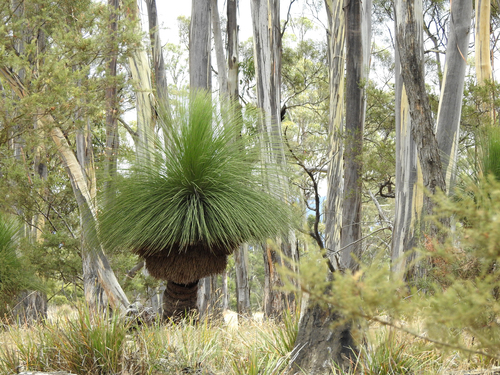
(c) Susan Kruss, some rights reserved (CC BY-NC), uploaded by Susan Kruss · cc-by-nc
Xanthorrhoea
Sign in to saveAlso known as grass tree, Australian grass tree
Xanthorrhoea () is a genus of about 30 species of succulent flowering plants in the family Asphodelaceae. They are endemic to Australia. Common names for the plants include grasstree, grass gum-tree (for resin-yielding species), kangaroo tail, balga (Western Australia), yakka (South Australia), yamina (Tasmania, from the palawa kani language), and black boy (or "blackboy"). The most common species is Xanthorrhoea australis, and some of these names are applied specifically to this species.
Species
Austral Grass-tree
GENUS
- KingdomPlantae
- PhylumTracheophyta
- ClassLiliopsida
- OrderAsparagales
- FamilyAsphodelaceae
Common Name: yellow accroides free (trade name)
via GBIF · Kew POWO
Museum specimens
- Specimen records
- 72
- With media
- 30
- Family
- Xanthorrhoeaceae
- Collections
- MEL, MO, CM, MICH, NY, BPBM
- Recorded in
- Australia, United States
Wikidata facts
- Instance of
- taxon
- Image
- Xanthorrhoea preissii1.jpg
Show 8 more facts
- Commons gallery
- Xanthorrhoea
- taxon rank
- genus
- Commons category
- Xanthorrhoea
- topic's main category
- Category:Xanthorrhoea
- taxonomic type
- Xanthorrhoea resinosa
- taxon name
- Xanthorrhoea
- taxon common name
- 刺叶树属
Sources (1)
via Wikidata · CC0
~14 min read
Encyclopedic overview
12 sectionsContents
- Description
- Systematics
- Taxonomy
- Names
- Diversity and distribution
- Habitat
- Ecology
- Cultivation
- Uses
- Gallery
- References
- External links
Xanthorrhoea () is a genus of about 30 species of succulent flowering plants in the family Asphodelaceae. They are endemic to Australia. Common names for the plants include grasstree, grass gum-tree (for resin-yielding species), kangaroo tail, balga (Western Australia), yakka (South Australia), yamina (Tasmania, from the palawa kani language), and black boy (or "blackboy"). The most common species is Xanthorrhoea australis, and some of these names are applied specifically to this species.
==Description== thumb|right|The dead "trunk" of Xanthorrhoea is a hollow ring of accumulated leaf bases. Nutrient transport was via vascular bundles that run down the centre. The Ground tissue#Parenchyma|parenchymatous tissue is decomposed. All species in the genus are perennials and have a secondary thickening meristem in the stem. Many, but not all, species develop an above ground stem. The stem may take up to twenty years to emerge. Plants begin as a crown of rigid grass-like leaves, the caudex slowly growing beneath. The main stem or branches continue to develop beneath the crown. This is rough-surfaced, built from accumulated leaf-bases around the secondarily thickened trunk. The trunk is sometimes unbranched, some species will branch if the growing point is damaged, and others naturally grow numerous branches.
Excerpted from Wikipedia’s “Xanthorrhoea” article, available under the CC BY-SA 4.0 licence.