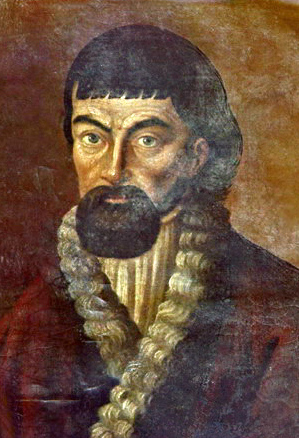
File:Yemelyan_Pugachev_(2).jpg · Wikimedia Commons · See Wikimedia Commons
Yemelyan Pugachev
Sign in to saveAlso known as Yemelyan Ivanovich Pugachev, Yemelyan Pugachyov
leader of a Russian peasant uprising (1742–1775)
Yemelyan Pugachev was a Cossack who led a major peasant rebellion against the Russian government in the 1770s, attracting thousands of followers from among serfs, Cossacks, and other oppressed groups. His uprising is historically significant as one of the largest peasant revolts in Russian history, and its eventual suppression marked a turning point in Russian imperial power and social control.
AI-generated from the Wikipedia summary — may contain errors.
Wikidata facts
- Instance of
- human
- Gender
- male
- Citizenship
- Russian Empire
- Place of birth
- Pugachyovskaya
- Place of death
- Moscow
- Occupation
- politician
- Languages spoken
- Russian
- Religion
- Eastern Orthodoxy
- Military branch
- Don Cossacks
- Military rank
- khorunzhy
- Image
- Yemelyan Pugachev (2).jpg
Show 11 more facts
- described by source
- Encyclopædia Britannica 11th edition
- Commons category
- Yemelyan Pugachev
- date of birth
- 1742-00-00
- date of death
- 1775-01-10
- birth name
- Емельян Иванович Пугачёв
- name in native language
- Емельян Иванович Пугачёв
- manner of death
- capital punishment
- social classification
- Cossacks
- cause of death
- decapitation
- allegiance
- Russian Empire
- present in work
- The Captain's Daughter
Sources (2)
via Wikidata · CC0
~11 min read
Encyclopedic overview
Yemelyan Ivanovich Pugachev (also spelled Pugachyov; Russian: Емельян Иванович Пугачёв; c. 1742 – 21 January [O.S. 10 January] 1775) was an ataman of the Yaik Cossacks and the leader of the Pugachev's Rebellion, a major popular uprising in the Russian Empire during the reign of Catherine the Great.
The son of a Don Cossack landowner, Pugachev served in the Imperial Russian Army during the Seven Years' War and the Russo-Turkish War of 1768–1774. In 1770 he deserted the Russian military and spent years as a fugitive, gaining popularity among the peasants, Cossacks and Old Believers against a backdrop of intensified unrest. In 1773, he initiated open revolt against Catherine. Claiming to be Catherine's late husband Tsar Peter III, Pugachev proclaimed an end to serfdom and amassed a large army. His forces quickly overran much of the region between the Volga and the Urals, and in 1774 they captured Kazan and burned the city to the ground. In August 1774, General Johann von Michelsohnen inflicted a crushing defeat on the rebels at Tsaritsyn. Pugachev was captured soon after by his own Cossacks and turned over to the authorities. He was then sent to Moscow and executed in January 1775. Alexander Pushkin wrote a notable history of the rebellion, The History of Pugachev, and recounted the events of the uprising in his novel The Captain's Daughter (1836).
Excerpted from Wikipedia’s “Yemelyan Pugachev” article, available under the CC BY-SA 4.0 licence.
Gallery (5)
Available in 58 languages
- Español
- Français
- Deutsch
- 中文
- 日本語
- Русский
- Português
- Italiano
- العربية
- Armenian
- Asturian
- Azerbaijani
- Bahasa Indonesia
- Bashkir
- Basque
- be_x_old
- Belarusian
- Breton
Show 39 more
- Bulgarian
- Catalan
- Central Kurdish
- Chuvash
- Croatian
- Czech
- Danish
- Egyptian Arabic
- Esperanto
- Estonian
- Finnish
- Galician
- Georgian
- Greek
- Hebrew
- Hungarian
- Icelandic
- Kazakh
- Latin
- Latvian
- Lithuanian
- Mongolian
- Nederlands
- Norwegian
- Polski
- Romanian
- Serbian
- Slovak
- Svenska
- Tatar
- Tiếng Việt
- Türkçe
- Udmurt
- Ukrainian
- Uzbek
- Western Frisian
- Yakut
- فارسی
- 한국어
via Wikidata sitelinks · CC0