Category
page 1Calcium minerals

gypsum
Gypsum is a soft sulfate mineral composed of calcium sulfate dihydrate, with the chemical formula . It is widely mined and is used as a fertilizer and as the main constituent in many forms of plaster, drywall and blackboard or sidewalk chalk. Gypsum also crystallizes as translucent crystals of selenite. It forms as an evaporite mineral and as a hydration product of anhydrite. The Mohs scale of mineral hardness defines gypsum as hardness value 2 based on scratch hardness comparison.

calcite
Calcite is a carbonate mineral and the most stable polymorph of calcium carbonate (CaCO3). It is a very common mineral, particularly as a component of limestone. Calcite defines hardness 3 on the Mohs scale of mineral hardness, based on scratch hardness comparison. Large calcite crystals are used in optical equipment, and limestone composed mostly of calcite has numerous uses.

dolomite
carbonate mineral – CaMg(CO₃)₂

alabaster
thumb|Calcite alabaster: The tomb of Tutankhamun (d. 1323 BC) contained a practical objet d’art, a cosmetics jar made of Egyptian alabaster, which features a lid surmounted by a lioness (goddess Bast).

apatite
Apatite is a group of phosphate minerals, usually hydroxyapatite, fluorapatite and chlorapatite, with high concentrations of OH−, F− and Cl− ion, respectively, in the crystal. The formula of the admixture of the three most common endmembers is written as Ca10(PO4)6(OH,F,Cl)2, and the crystal unit cell formulae of the individual minerals are written as Ca10(PO4)6(OH)2, Ca10(PO4)6F2 and Ca10(PO4)6Cl2.
lime
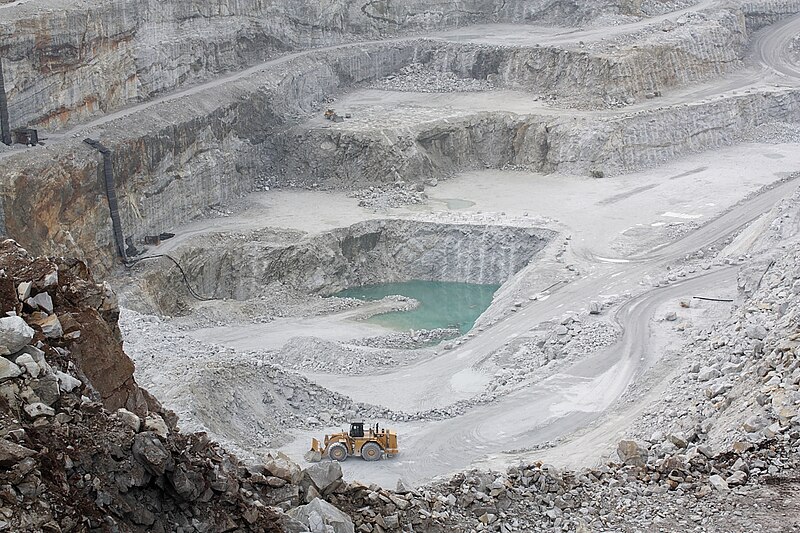
calcium oxide or hydroxide

aragonite
Aragonite is a carbonate mineral and one of the three most common naturally occurring crystal forms of calcium carbonate (), the others being calcite and vaterite. It is formed by biological and physical processes, including precipitation from marine and freshwater environments.

travertine
thumb|upright=1.6|Travertine terraces at Mammoth Hot Springs, [[Yellowstone National Park, in 2016]]

anhydrite
Anhydrite, or anhydrous calcium sulfate, is a mineral with the chemical formula CaSO4. It is in the orthorhombic crystal system, with three directions of perfect cleavage parallel to the three planes of symmetry. It is not isomorphous with the orthorhombic barium (baryte) and strontium (celestine) sulfates, as might be expected from the chemical formulas. Distinctly developed crystals are somewhat rare, the mineral usually presenting the form of cleavage masses. The Mohs hardness is 3.5, and the specific gravity is 2.9. The color is white, sometimes greyish, bluish, or purple. On the best deve

labradorite
Labradorite ((Ca, Na)(Al, Si)4O8) is a calcium-enriched feldspar mineral first identified in Labrador, Canada, which can display an iridescent effect (schiller).

bentonite
upright=1.3|thumb|Bentonite layers from an ancient deposit of weathering|weathered [[volcanic ash tuff in Wyoming]]
thumb|Gray shale and bentonites (Benton Shale; Colorado Springs, Colorado)

actinolite
thumb|upright=0.3|Gem-quality actinolite blade, from Mogok, Burma

anorthite
Anorthite (2Si2O8. Anorthite is found in igneous rocks.

diopside
Diopside is a monoclinic pyroxene mineral with composition . It forms complete solid solution series with hedenbergite () and augite, and partial solid solutions with orthopyroxene and pigeonite. It forms variably colored, but typically dull green crystals in the monoclinic prismatic class. It has two distinct prismatic cleavages at 87 and 93° typical of the pyroxene series. It has a Mohs hardness of six, a Vickers hardness of 7.7 GPa at a load of 0.98 N, and a specific gravity of 3.25 to 3.55. It is transparent to translucent with indices of refraction of nα=1.663–1.699, nβ=1.671–1.705, and n

augite
Augite, also known as Augurite, is a common rock-forming pyroxene mineral with formula . The crystals are monoclinic and prismatic. Augite has two prominent cleavages, meeting at angles near 90 degrees.

plagioclase
thumb|Plagioclase displaying cleavage (crystal)|cleavage (unknown scale)
thumb|In volcanic rocks, [[fine-grained plagioclase can display a "microlitic" texture of many small crystals.]]

montmorillonite
Montmorillonite is a very soft phyllosilicate group of minerals that form when they precipitate from water solution as microscopic crystals, known as clay. It is named after Montmorillon in France. Montmorillonite, a member of the smectite group, is a 2:1 clay, meaning that it has two tetrahedral sheets of silica sandwiching a central octahedral sheet of alumina. The particles are plate-shaped with an average diameter around 1 μm and a thickness of 0.96 nm; magnification of about 25,000 times, using an electron microscope, is required to resolve individual clay particles. Members of this group

epidote
Epidote is a calcium aluminium iron sorosilicate mineral.
lazurite
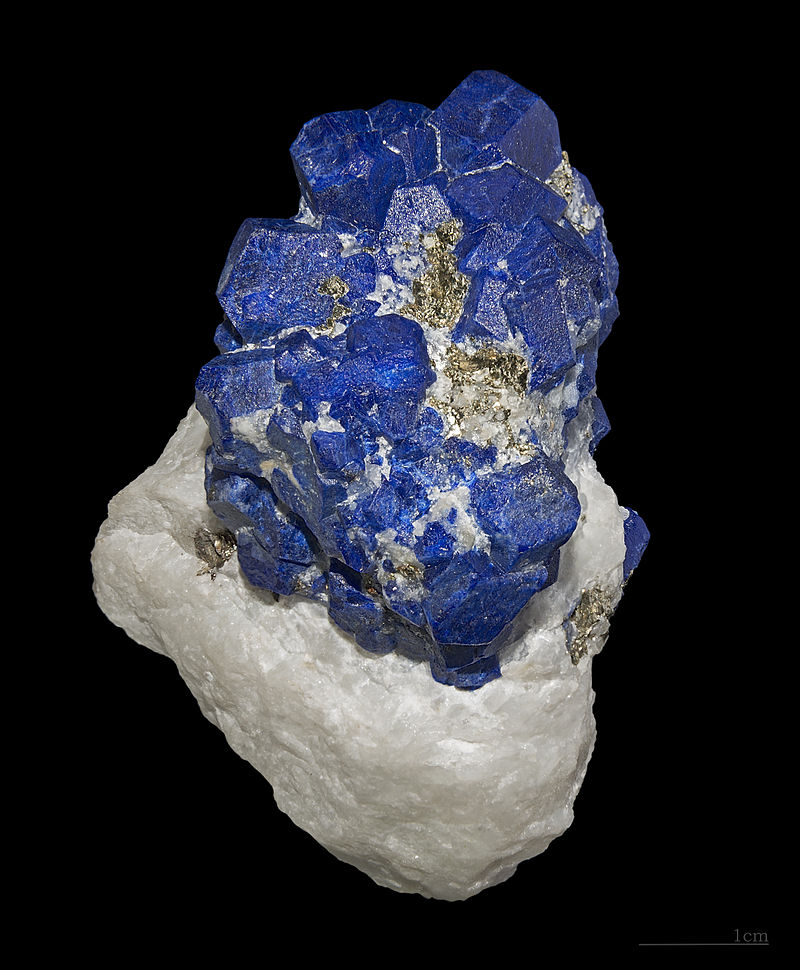
Lazurite, old name Azure spar is a tectosilicate mineral with sulfate, sulfur and chloride with formula . It is a feldspathoid and a member of the sodalite group. Lazurite crystallizes in the isometric system although well‐formed crystals are rare. It is usually massive and forms the bulk of the gemstone lapis lazuli.

rhodonite
Rhodonite is a manganese inosilicate, with the formula (Mn, Fe, Mg, Ca)SiO3, and member of the pyroxenoid group of minerals, crystallizing in the triclinic system. The term rhodonite was first introduced by Germar. . It commonly occurs as cleavable to compact masses with a rose-red color often tending to brown due to surface oxidation. The rose-red hue is caused by the manganese cation (Mn).
thumb|left|Pink rhodonite contrasting with black manganese oxides is sometimes used as gemstone material as seen in this specimen from Humboldt County, [[Nevada.]]
Rhodonite crystals often have a thick tab

titanite
thumb|150px|Titanite crystal model

wollastonite
Wollastonite is a calcium inosilicate mineral (CaSiO3) that may contain small amounts of iron, magnesium, and manganese substituting for calcium. It is usually white. It forms when impure limestone or dolomite is subjected to high temperature and pressure, which sometimes occurs in the presence of silica-bearing fluids as in skarns or in contact with metamorphic rocks. Associated minerals include garnets, vesuvianite, diopside, tremolite, epidote, plagioclase feldspar, pyroxene and calcite. It is named after the English chemist and mineralogist William Hyde Wollaston (1766–1828).
%20crystallographic%20standard%20alignment.png)
perovskite
Perovskite (pronunciation: ) is an orthorhombic calcium titanium oxide mineral composed of calcium titanate (chemical formula ). Its name is also applied to the class of compounds which have the same type of crystal structure as , known as the perovskite structure, which has a general chemical formula for chalcogen (group 16) perovskites, or for the halogen (group 17) perovskites (the kind typically found in modern photovoltaics like photodiodes and solar panels). Many different cations can be embedded in this structure, allowing the development of diverse engineered materials.

hornblende
Hornblende is a complex inosilicate series of minerals. It is not a recognized mineral in its own right, but the name is used as a general or field term, to refer to a dark amphibole. Hornblende minerals are common in igneous and metamorphic rocks.
scheelite
Scheelite is a calcium tungstate mineral with the chemical formula CaWO4. It is an important ore of tungsten (wolfram). Scheelite is originally named after Swedish chemist Carl Wilhelm Scheele (1742–1786). Well-formed crystals are sought by collectors and are occasionally fashioned into gemstones when suitably free of flaws. Scheelite has been synthesized using the Czochralski process; the material produced may be used to imitate diamond, as a scintillator, or as a solid-state lasing medium. It was also used in radium paint in the same fashion as was zinc sulphide, and Thomas Edison invented a
%20-%20Alchuri%2C%20Shigar%20Valley%2C%20Gilgit-Baltistan%2C%20Pakistan.jpg)
vesuvianite
Vesuvianite, also known as idocrase, is a green, brown, yellow, or blue silicate mineral. Vesuvianite occurs as tetragonal crystals in skarn deposits and limestones that have been subjected to contact metamorphism. It was first discovered within included blocks or adjacent to lavas on Mount Vesuvius, hence its name. Attractive-looking crystals are sometimes cut as gemstones. Localities which have yielded fine crystallized specimens include Mount Vesuvius and the Ala Valley near Turin, Piedmont.

hydroxylapatite
thumb|Hydroxyapatite
thumb|Needle-like hydroxyapatite crystals on stainless steel. Scanning electron microscope picture from [[University of Tartu.]]
thumb|Nanoscale coating of Ca-HAp, image taken with Scanning probe microscopy|scanning probe microscope
thumbnail|right|A 3D visualization of half of a hydroxyapatite unit cell, from x-ray crystallography
Hydroxyapatite (IMA name: hydroxylapatite) (Hap, HAp, or HA) is a naturally occurring mineral form of apatite with the formula , often written to denote that the crystal unit cell comprises two entities. It is the hydroxyl endmember of the compl
autunite
Autunite (hydrated calcium uranyl phosphate), with formula Ca(UO2)2(PO4)2·10–12H2O, is a yellow-greenish fluorescent phosphate mineral with a hardness of 2–. Autunite crystallizes in the orthorhombic system and often occurs as tabular square crystals, commonly in small crusts or in fan-like masses. Due to the moderate uranium content of 48.27% it is radioactive and also used as uranium ore. Autunite fluoresces bright green to lime green under UV light. The mineral is also called calco-uranite, but this name is rarely used and effectively outdated.
zoisite
Zoisite, first known as saualpite, after its type locality, is a calcium aluminum hydroxy sorosilicate belonging to the epidote group of minerals. Its chemical formula is Ca2Al3(SiO4)(Si2O7)O(OH).

tremolite
Tremolite is a member of the amphibole group of silicate minerals with composition Ca2(Mg5.0-4.5Fe2+0.0-0.5)Si8O22(OH)2. Tremolite forms by metamorphism of sediments rich in dolomite and quartz, and occurs in two distinct forms, crystals and fibers. Tremolite forms a series with actinolite and ferro-actinolite. Pure magnesium tremolite is creamy-white, but the color grades to dark green with increasing iron content. It has a hardness on Mohs scale of 5 to 6. Nephrite, one of the two minerals known as the gemstone jade, is a green crystalline variety of tremolite.

andradite
thumb|Andradite garnet – Jiangxi, Nantan, China.
Andradite is a mineral species of the garnet group. It is a nesosilicate, with chemical formula Ca3Fe2Si3O12.

grossular
Grossular is a calcium-aluminium species of the garnet group of minerals. It has the chemical formula of Ca3Al2(SiO4)3 but the calcium may, in part, be replaced by ferrous iron and the aluminium by ferric iron. The name grossular is derived from the botanical name for the gooseberry, grossularia, in reference to the green garnet of this composition that is found in Siberia. Other shades include cinnamon brown (cinnamon stone variety), red, and yellow. Grossular is a gemstone.
%20-%20Saranowskiy%20Mine%2C%20Ural%2C%20Rosja.jpg)
uvarovite
thumb|Uvarovite - Saranowskiy Mine, Ural. Russia.
Uvarovite is a chromium-bearing garnet group species with the formula: Ca3Cr2(SiO4)3. It was discovered in 1832 by Germain Henri Hess who named it after Count Sergei Uvarov (1765–1855), a Russian statesman and amateur mineral collector. It is classified in the ugrandite group alongside the other calcium-bearing garnets andradite and grossular.
axinite
Axinite is a brown to violet-brown, or reddish-brown bladed group of minerals composed of calcium aluminium boro-silicate, . Axinite is pyroelectric and piezoelectric.
allanite group
Allanite (also called orthite) is a sorosilicate group of minerals within the broader epidote group that contain a significant amount of rare-earth elements. The mineral occurs mainly in metamorphosed clay-rich sediments and felsic igneous rocks. It has the general formula A2M3Si3O12[OH], where the A sites can contain large cations such as Ca2+, Sr2+, and rare-earth elements, and the M sites admit Al3+, Fe3+, Mn3+, Fe2+, or Mg2+ among others. However, a large amount of additional elements, including Th, U, Be, Zr, P, Ba, Cr and others may be present in the mineral. The International Mineralogi
andesine
Andesine is a silicate mineral, a member of the plagioclase feldspar solid solution series. Its chemical formula is (Ca, Na)(Al, Si)4O8, where the ratio of albite to anorthite (Na:Ca) is 50:50 to 70:30. The formula may be written as Na0.5-0.7Ca0.3-0.5Al1.3-1.5Si2.5-2.7O8.
selenite
mineral variety
oligoclase
Oligoclase is a rock-forming mineral belonging to the plagioclase feldspars. In chemical composition and in its crystallographic and physical characters it is intermediate between albite (NaAlSi3O8) and anorthite (CaAl2Si2O8). The albite:anorthite molar ratio of oligoclase ranges from 90:10 to 70:30.

speleothem
thumb|upright=1.4|Cave labeled with the six most common types of speleothems: flowstone, columns, drapery, [[stalagmites, stalactites and straws]]
A speleothem (; ) is a geological formation made by mineral deposits that accumulate over time in natural caves. They can take a variety of forms, depending on their depositional history and environment. Common forms include stalagmites, stalactites, and flowstones.
ankerite
Ankerite, also known as brown spar () is a calcium, iron, magnesium, manganese carbonate mineral of the group of rhombohedral carbonates with the chemical formula . In composition it is closely related to dolomite, but differs from this in having magnesium replaced by varying amounts of iron(II) and manganese. It forms a series with dolomite and kutnohorite.

ulexite
Ulexite (), sometimes called TV rock or TV stone due to its unusual optical properties, is a hydrous borate hydroxide of sodium and calcium with the chemical formula . The mineral occurs as silky white rounded crystalline masses or in parallel fibers. Ulexite was named for the German chemist Georg Ludwig Ulex (1811–1883), who first discovered it.

hedenbergite
Hedenbergite, CaFeSi2O6 (), is the iron-rich end member of the pyroxene group having a monoclinic crystal system. The mineral is extremely rarely found as a pure substance, and usually has to be synthesized in a lab. It was named in 1819 after M.A. Ludwig Hedenberg, who was the first to define hedenbergite as a mineral. Contact metamorphic rocks high in iron are the primary geologic setting for hedenbergite. This mineral is unique because it can be found in chondrites and skarns (calc–silicate metamorphic rocks). As a member of the pyroxene family, it has generated considerable interest due to

bytownite
Bytownite is a calcium rich member of the plagioclase solid solution series of feldspar minerals with composition between anorthite and labradorite. It is usually defined as having between 70 and 90%An (formula: ). Like others of the series, bytownite forms grey to white triclinic crystals commonly exhibiting the typical plagioclase twinning and associated fine striations.
euxenite-(Y)
Euxenite, or euxenite-(Y) (the official mineralogical name), is a brownish black mineral with a metallic luster.

haüyne
Hauyne or haüyne, also called hauynite or haüynite ( ), old name Azure spar, is a rare tectosilicate sulfate mineral with endmember formula . As much as 5 wt % may be present, and also and Cl. It is a feldspathoid and a member of the sodalite group. Hauyne was first described in 1807 from samples discovered in Vesuvian lavas in Monte Somma, Italy, and was named in 1807 by Brunn-Neergard for the French crystallographer René Just Haüy (1743–1822). It is sometimes used as a gemstone.
prehnite
Prehnite is an inosilicate of calcium and aluminium with the formula: Ca2Al(AlSi3O10)(OH)2 with limited Fe3+ substitutes for aluminium in the structure. Prehnite crystallizes in the orthorhombic crystal system, and most often forms as stalactitic, botryoidal, reniform or globular aggregates, with only just the crests of small crystals showing any faces, which are almost always curved or composite. Very rarely will it form distinct, well-individualized crystals showing a square-like cross-section, including those found at the Jeffrey Mine in Asbestos, Quebec, Canada. Prehnite is brittle with an
Iceland spar
transparent variety of calcite
stilbite
Stilbite is the name of a series of tectosilicate minerals of the zeolite group. Prior to 1997, stilbite was recognized as a mineral species, but a reclassification in 1997 by the International Mineralogical Association changed it to a series name, with the mineral species being named:
chabazite
Chabazite () is a tectosilicate mineral series in the zeolite group, closely related to gmelinite, with the chemical formula , where M is one or more metal cations. Recognized minerals in the series include Chabazite-Ca, Chabazite-K, Chabazite-Na, and Chabazite-Sr, depending on the prominence of the indicated cation.
apophyllite
The name apophyllite refers to a specific group of phyllosilicates, a class of minerals. Originally, the group name referred to a specific mineral, but was redefined in 1978 to stand for a class of minerals of similar chemical makeup that comprise a solid solution series, and includes the members fluorapophyllite-(K), fluorapophyllite-(Na), hydroxyapophyllite-(K). The name apophyllite is derived from the Greek (), meaning 'it flakes off', a reference to this class's tendency to flake apart when heated, due to water loss. Exfoliation of apophyllite is also possible by treating it with acids or

datolite
Datolite is a calcium boron hydroxide nesosilicate, CaBSiO4(OH). It was first observed by Jens Esmark in 1806, and named by him from δατεῖσθαι, "to divide," and λίθος, "stone," in allusion to the granular structure
of the massive mineral.
charoite
Charoite ( ) is a rare silicate mineral with the chemical composition , first described in 1978. It is named after the Chara River, despite its being away from the discovery place. When it was discovered, it was thought to be a fake, dyed purple to give it its striking appearance.

danburite
Danburite is a calcium boron silicate mineral with a chemical formula of CaB2(SiO4)2.
pyrochlore
Pyrochlore () is a mineral group of the niobium end member of the pyrochlore supergroup. Pyrochlore is also a term for the crystal structure Fdm. The name is from the Greek , fire, and , green because it typically turns green on ignition in classic blowpipe analysis.
painite
Painite is a rare borate mineral. It was first found in Myanmar by British mineralogist and gem dealer Arthur C.D. Pain who misidentified it as ruby, until it was discovered as a new gemstone in the 1950s. When it was confirmed as a new mineral species, the mineral was named after him.
afghanite
Afghanite, (Na,K)22Ca10[Si24Al24O96](SO4)6Cl6, is a hydrous sodium, calcium, potassium, sulfate, chloride, carbonate alumino-silicate mineral. Afghanite is a feldspathoid of the cancrinite group and typically occurs with sodalite group minerals. It forms blue to colorless, typically massive crystals in the trigonal crystal system. The lowering of the symmetry from typical (for cancrinite group) hexagonal one is due to ordering of Si and Al. It has a Mohs hardness of 5.5 to 6 and a specific gravity of 2.55 to 2.65. It has refractive index values of nω = 1.523 and nε = 1.529. It has one directio

pectolite
Pectolite is a white to gray mineral, NaCa2Si3O8(OH), a sodium calcium hydroxide inosilicate. It crystallizes in the triclinic system typically occurring in radiated or fibrous crystalline masses. It has a Mohs hardness of 4.5 to 5 and a specific gravity of 2.7 to 2.9. A highly sought-after variety known as larimar, is a pale to sky blue. There is also a whitish form of the mineral from Alaska that is sometimes marketed as 'Alaska jade'.

heulandite
Heulandite is the name of a series of tectosilicate minerals of the zeolite group. Prior to 1997, heulandite was recognized as a mineral species, but a reclassification in 1997 by the International Mineralogical Association changed it to a series name, with the mineral species being named:
Heulandite-Ca
Heulandite-Na
Heulandite-K
Heulandite-Sr
Heulandite-Ba (described in 2002).
Heulandite-Ca, the most common of these, is a hydrous calcium and aluminium silicate with the formula . Small amounts of sodium and potassium are usually present replacing part of the calcium. Strontium replaces ca
ilvaite
Ilvaite is a sorosilicate of iron and calcium with formula: . Both manganese and magnesium substitute in the structure. Ilvaite crystallizes in the monoclinic system in black prismatic crystals and columnar masses. It is black to brownish black to gray and opaque. It has a Mohs hardness of 5.5 to 6 and a specific gravity of 3.8 to 4.1. Ilvaite is structurally related to lawsonite.
glauberite
Glauberite is a monoclinic sodium calcium sulfate mineral with the formula Na2Ca(SO4)2.