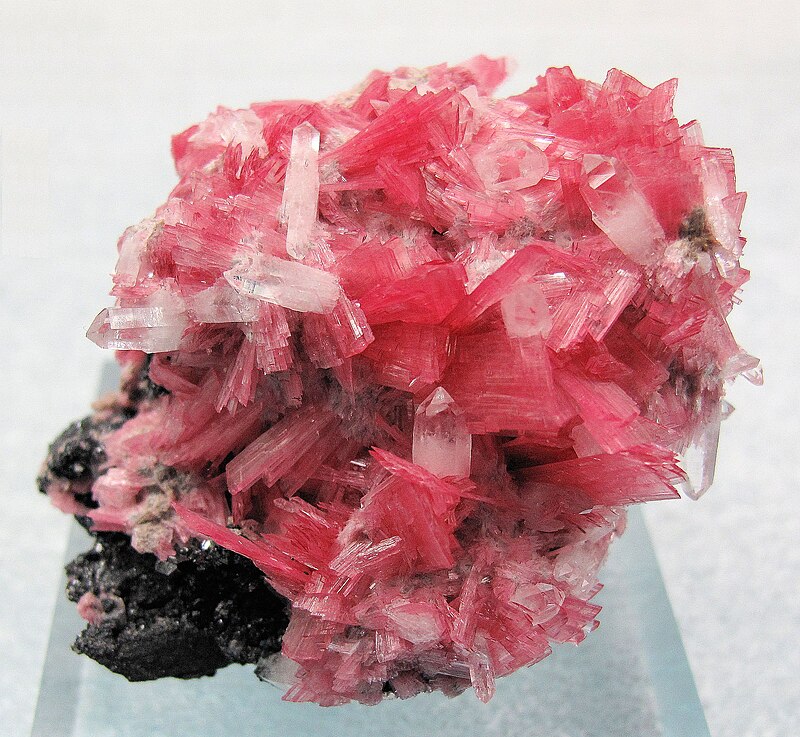
File:8224M-rhodonite3.jpg · Wikimedia Commons · See Wikimedia Commons
rhodonite
Sign in to saveRhodonite is a manganese inosilicate, with the formula (Mn, Fe, Mg, Ca)SiO3, and member of the pyroxenoid group of minerals, crystallizing in the triclinic system. The term rhodonite was first introduced by Germar. . It commonly occurs as cleavable to compact masses with a rose-red color often tending to brown due to surface oxidation. The rose-red hue is caused by the manganese cation (Mn). thumb|left|Pink rhodonite contrasting with black manganese oxides is sometimes used as gemstone material as seen in this specimen from Humboldt County, [[Nevada.]] Rhodonite crystals often have a thick tab
Key facts
- Mineral.name
- Rhodonite
- Mineral.category
- Inosilicate minerals (single chain)
- Mineral.group
- Pyroxene group
- Mineral.image
- 8224M-rhodonite3.jpg
- Mineral.boxbgcolor
- pink
- Mineral.boxtextcolor
- black
- Mineral.caption
- Rhodonite from San Martín Mine, Chiurucu, Huallanca District, Bolognesi Province, Ancash, PeruSpecimen size:
- Mineral.formula
- (Mn2+, Fe2+, Mg, Ca)SiO3
- Mineral.IMAsymbol
- Rdn
- Mineral.color
- Pink, rose-pink to brownish red, red, gray and yellow
- Mineral.habit
- Tabular crystals, massive, granular
- Mineral.twinning
- Lamellar, composition plane {010}
- Mineral.cleavage
- Perfect on {110} and {10}, (110) ^ (10) = 92.5°; good on {001}
- Mineral.fracture
- Conchoidal to uneven
- Mineral.mohs
- 5.5–6.5
- Mineral.luster
- Vitreous to pearly
- Mineral.streak
- White
- Mineral.diaphaneity
- Transparent to translucent
via Wikipedia infobox
Wikidata facts
- Subclass of
- inosilicate
- Image
- 8224M-rhodonite3.jpg
Show 9 more facts
- Nickel-Strunz 9th edition (updated 2009)
- 9.DK.05
- Commons category
- Rhodonite
- Nickel-Strunz '10th ed', review of (9th ed/ 2009 update)
- 9.DK.05
- described by source
- Encyclopædia Britannica 11th edition
- streak color
- white
- crystal system
- triclinic crystal system
- chemical formula
- Mn²⁺SiO₃
- IMA Mineral Symbol
- Rdn
- Strunz 8th edition (series ID, updated)
- VIII/D.13
Sources (2)
via Wikidata · CC0
~4 min read
Encyclopedic overview
2 sectionsContents
- See also
- References
{{infobox mineral | name = Rhodonite | category = Inosilicate minerals (single chain) | group = Pyroxene group | image = 8224M-rhodonite3.jpg | boxbgcolor = pink | boxtextcolor = black | caption = Rhodonite from San Martín Mine, Chiurucu, Huallanca District, Bolognesi Province, Ancash, PeruSpecimen size: | formula = (Mn2+, Fe2+, Mg, Ca)SiO3 | IMAsymbol = Rdn | molweight = | strunz = 9.DK.05 | dana = 65.04.01.01 | system = Triclinic | class = Pinacoidal () (same H–M symbol) | symmetry = P | unit cell = , , ; , , ; | color = Pink, rose-pink to brownish red, red, gray and yellow | colour = | habit = Tabular crystals, massive, granular | twinning = Lamellar, composition plane {010} | cleavage = Perfect on {110} and {10}, (110) ^ (10) = 92.5°; good on {001} | fracture = Conchoidal to uneven | tenacity = | mohs = 5.5–6.5 | luster = Vitreous to pearly | streak = White | diaphaneity = Transparent to translucent | gravity = 3.57–3.76 | density = | polish = | opticalprop = Biaxial (+) | refractive = , , | birefringence = δ = 0.013 | pleochroism = Weak | 2V = 58° to 73° (measured), 58° (calculated) | dispersion = | extinction = | length fast/slow = | fluorescence= | absorption = | melt = | fusibility = | diagnostic = | solubility = | other = | alteration = Exterior commonly black from manganese oxides | references = }}
Rhodonite is a manganese inosilicate, with the formula (Mn, Fe, Mg, Ca)SiO3, and member of the pyroxenoid group of minerals, crystallizing in the triclinic system. The term rhodonite was first introduced by Germar. . It commonly occurs as cleavable to compact masses with a rose-red color often tending to brown due to surface oxidation. The rose-red hue is caused by the manganese cation (Mn). thumb|left|Pink rhodonite contrasting with black manganese oxides is sometimes used as gemstone material as seen in this specimen from Humboldt County, [[Nevada.]] Rhodonite crystals often have a thick tabular habit, but are rare. It has a perfect, prismatic cleavage, almost at right angles. The hardness is 5.5–6.5, and the specific gravity is 3.4–3.7; luster is vitreous, being less frequently pearly on cleavage surfaces. The manganese is often partly replaced by iron, magnesium, calcium, and sometimes zinc, which may sometimes be present in considerable amounts; a greyish-brown variety containing as much as 20% of calcium oxide is called bustamite; fowlerite is a zinciferous variety containing 7% of zinc oxide.
Excerpted from Wikipedia’s “rhodonite” article, available under the CC BY-SA 4.0 licence.