Category
page 1Cellular respiration

photosynthesis
thumb|upright=1.5|Schematic of photosynthesis in plants. The carbohydrates produced are stored in or used by the plant.
upright=1.5|thumb|right|Composite image showing the global distribution of photosynthesis, including both oceanic phytoplankton and terrestrial [[vegetation. Dark red and blue-green indicate regions of high photosynthetic activity in the ocean and on land, respectively.]]

mitochondrion
A mitochondrion () is an organelle found in the cells of most eukaryotes, such as animals, plants and fungi. Mitochondria have a double membrane structure and use aerobic respiration to generate adenosine triphosphate (ATP), which is used throughout the cell as a source of chemical energy. They were discovered by Albert von Kölliker in 1857 in the voluntary muscles of insects. The term mitochondrion, meaning a thread-like granule, was coined by Carl Benda in 1898. The mitochondrion is popularly nicknamed the "powerhouse of the cell", a phrase popularized by Philip Siekevitz in a 1957 Scientifi
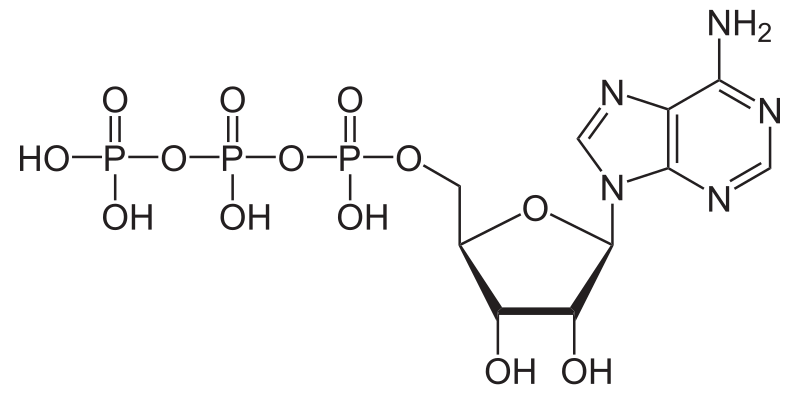
adenosine triphosphate
the energy-carrying molecule in living cells

glycolytic process
thumb|400px|class=skin-invert-image|Summary of aerobic respirationGlycolysis is the metabolic pathway that converts glucose () into pyruvate and, in most organisms, occurs in the liquid part of cells (the cytosol). The free energy released in this process is used to form the high-energy molecules adenosine triphosphate (ATP) and reduced nicotinamide adenine dinucleotide (NADH). Glycolysis is a sequence of ten reactions catalyzed by enzymes.
thumb|375x375px|Summary of the 10 reactions of the glycolysis pathway

tricarboxylic acid cycle
metabolic pathway

cellular respiration
enzymatic release of energy from inorganic and organic compounds

pyruvic acid
simplest of the alpha-keto acids

aerobic organism
organism that thrives in an oxygenated environment

DL-malic acid
group of stereoisomers

adenosine diphosphate
chemical compound

nicotinamide adenine dinucleotide
coenzyme NAD in any of its oxidation states

oxidative phosphorylation
phosphorylation of ADP to ATP that accompanies the oxidation of a metabolite through the operation of the respiratory chain

proton-transporting ATP synthase complex
complex that catalyzes the phosphorylation of ADP to ATP, during oxidative phosphorylation
beta oxidation
catabolic process by which fatty acids are broken down in the cytosol (in prokaryotes)/mitochondria (in eukaryotes) to generate acetyl-CoA (which enters the citric acid cycle) and NADH and FADH₂ (used in the electron transport chain)
electron transport chain
process in which a series of electron carriers operate together to transfer electrons from donors to any of several different terminal electron acceptors to generate a transmembrane electrochemical gradient
ubidecarenone
chemical compound
anaerobic respiration
The enzymatic release of energy from inorganic and organic compounds (especially carbohydrates and fats) which uses compounds other than oxygen (e.g. nitrate, sulfate) as the terminal electron acceptor.

chemiosmosis
Chemiosmosis is the movement of ions across a semipermeable membrane through an integral membrane protein, down their electrochemical gradient. An important example is the formation of adenosine triphosphate (ATP) by the movement of hydrogen ions (H+) through ATP synthase during cellular respiration or photophosphorylation.
cytochrome c, somatic
mammalian protein found in Homo sapiens
facultative anaerobic organism
organism that makes ATP by aerobic respiration if oxygen is present. They carryout aerobic respiration when oxygen is available but switch to anaerobic catabolism (e.g. alcoholic fermentation) when deprived of oxygen.
cytochrome c oxidase
complex enzyme found in bacteria, archaea, and mitochondria of eukaryotes

methemoglobin
thumbnail|right|The structure of cytochrome b5 reductase, the enzyme that converts methemoglobin to hemoglobin.
flavin
group of chemical compounds
coenzyme Q – cytochrome c reductase
class of enzymes
electrochemical gradient
gradient of electrochemical potential, usually for an ion that can move across a membrane
DL-glyceric acid 1,3-biphosphate
group of stereoisomers
L-Malate dehydrogenase
class of enzymes
pyruvate dehydrogenase complex
Complex that carries out the oxidative decarboxylation of pyruvate to form acetyl-CoA; comprises subunits possessing three catalytic activities: pyruvate dehydrogenase (E1), dihydrolipoamide S-acetyltransferase (E2), and dihydrolipoamide dehydrogenas

mitochondrial crista
A crista (; : cristae) is a fold in the inner membrane of a mitochondrion. The name is from the Latin for crest or plume, and it gives the inner membrane its characteristic wrinkled shape, providing a large amount of surface area for chemical reactions to occur on. This aids aerobic cellular respiration, because the mitochondrion requires oxygen. Cristae are studded with proteins, including ATP synthase and a variety of cytochromes.
pyruvate decarboxylation
Conversion of pyruvate into acetyl-CoA
adenylate kinase
class of enzymes

uncoupling protein 1
Thermogenin (called uncoupling protein by its discoverers and now known as uncoupling protein 1, or UCP1) is a mitochondrial carrier protein found in brown adipose tissue (BAT). It is used to generate heat by non-shivering thermogenesis, and makes a quantitatively important contribution to countering heat loss in babies which would otherwise occur due to their high surface area-volume ratio. Recent findings indicate that the UCP1 protein plays a crucial role in thermogenesis by catalyzing the dissipative production of heat through protons derived from NADH and FADH2. These electron carriers ar
malate-aspartate shuttle
biochemical system for transporting electrons produced during glycolysis

semiquinone
thumb|right|350px|Resonance (chemistry)|Resonance structures of a semiquinone
Semiquinones (or ubisemiquinones, if their origin is ubiquinone) are free radicals resulting from the removal of one hydrogen atom with its electron during the process of dehydrogenation of a hydroquinone, such as hydroquinone itself or catechol, to a quinone or alternatively the addition of a single hydrogen atom with its electron to a quinone. Semiquinones are highly unstable.
Mitochondrial carrier UCP-like
Mitochondrial protein
anaplerotic reaction
chemical reaction
respiratory chain complex I
enzyme of the respiratory chain consisting of several polypeptide chains; L-shaped with a horizontal arm lying in the membrane, and a vertical arm that projects into the cytoplasm of prokaryotes, or the matrix of mitochondria.
glycerophosphate shuttle
class of enzymes
Q cycle
series of reactions in cellular respiration
Electron transfer flavoprotein-ubiquinone oxidoreductase
protein family
alternative oxidase
InterPro Family
formate dehydrogenase
class of enzymes
Adenine nucleotide translocator
class of transport proteins
Trimethylamine N-oxide reductase
microbial enzyme

Mitochondrial shuttle
biochemical system that transports reducing agents across mitochondrial membranes
NADK
protein-coding gene in the species Homo sapiens
ATP hydrolysis
catabolism of ATP into ADP
D-amino acid dehydrogenase
class of enzymes
Fructolysis
Fructolysis refers to the metabolism of fructose from dietary sources. Though the metabolism of glucose through glycolysis uses many of the same enzymes and intermediate structures as those in fructolysis, the two sugars have very different metabolic fates in human metabolism. Under one percent of ingested fructose is directly converted to plasma triglyceride. 29% - 54% of fructose is converted in the liver to glucose, and about a quarter of fructose is converted to lactate. 15% - 18% is converted to glycogen. Glucose and lactate are then used normally as energy to fuel cells all over the body
glycine cleavage complex
protein complex that catalyzes the reversible oxidation of glycine. In E. coli, it has four components: dihydrolipoamide dehydrogenase, glycine dehydrogenase (decarboxylating), lipoyl-GcvH-protein and aminomethyltransferase
Nanaerobe
Nanaerobes are organisms that cannot grow in the presence of micromolar concentrations of oxygen, but can grow with and benefit from the presence of nanomolar concentrations of oxygen (e.g. Bacteroides fragilis). Like other anaerobes, these organisms do not require oxygen for growth. This growth benefit requires the expression of an oxygen respiratory chain that is typically associated with microaerophilic respiration. Recent studies suggest that respiration in low concentrations of oxygen is an ancient process which predates the emergence of oxygenic photosynthesis.
mitochondrial permeability transition pore
multiprotein inner mitochondrial complex which opens only under certain pathological conditions
mitochondrial respirasome
thumb|400px|I/III/IV Supercomplex. Complex I in yellow, [[Complex III in green, and Complex IV in purple. A, B, and E are side views of the complexes as they are oriented upright in the membrane. Horizontal lines on E indicate the position of the membrane. D is a view from the intermembrane space. C and F are viewed from inside the matrix.]]