Category
page 1Extant Pennsylvanian first appearances

Araneae
Spiders (order Araneae) are air-breathing arthropods that have eight limbs, chelicerae with fangs generally able to inject venom, and spinnerets that extrude silk. They are the largest order of arachnids and rank seventh in total species diversity among all orders of organisms. Spiders are found worldwide on every continent except Antarctica, and have become established in nearly every land habitat. , 53,680 spider species in 139 families have been recorded by taxonomists. However, there has been debate among scientists about how families should be classified, with over 20 different classifica

Reptilia
Reptiles, as commonly defined, are tetrapod vertebrate animals with an ectothermic metabolism and amniotic development. Reptiles traditionally comprise four orders: Testudines (turtles), Crocodilia (crocodiles, alligators and gharials), Squamata (lizards and snakes) and Rhynchocephalia (tuatara), with about 12,000 extant species listed in the Reptile Database. The study of the traditional reptile orders, customarily in combination with the study of modern amphibians, is called herpetology.

beetles
Beetles are insects that form the order Coleoptera (), in the superorder Holometabola. Their front pair of wings are hardened into wing-cases, elytra, distinguishing them from most other insects. The Coleoptera, with about 400,000 described species, is the largest of all orders, constituting almost 40% of described arthropods and 25% of all known animal species; new species are discovered frequently, with estimates suggesting that there are between 0.9 and 2.1 million total species.

Octopoda

conifer
Conifers () are a group of vascular plants and a subset of gymnosperms. They are primarily perennial, woody trees and shrubs, mostly evergreen with a regular branching pattern, reproducing with male and female cones, usually on the same tree. They are wind-pollinated and the seeds are usually dispersed by the wind. Taxonomically, they make up the division Pinophyta, also known as Coniferae. All extant conifers, except for the gnetophytes, are perennial woody plants with secondary growth. There are over 600 living species.

Ephemeroptera
Mayflies (also up-winged flies or up-wing flies, or drake-flies in the UK; shadflies or fishflies in Canada) are aquatic insects belonging to the order Ephemeroptera. This order is part of an ancient group of insects termed the Palaeoptera, which also contains dragonflies and damselflies. Over 3,000 species of mayfly are known worldwide, grouped into over 400 genera in 42 families.

Hemiptera
Hemiptera (; ) is an order of insects, commonly called true bugs, comprising more than 80,000 species within groups such as the cicadas, aphids, planthoppers, leafhoppers, assassin bugs, bed bugs, and shield bugs. They range in size from to around , and share a common arrangement of piercing-sucking mouthparts. The name "true bugs" is sometimes limited to the suborder Heteroptera.

amniote
Amniotes are tetrapod vertebrate animals belonging to the clade Amniota, a large group that comprises the vast majority of living terrestrial and semiaquatic vertebrates. Amniotes evolved from amphibious stem tetrapod ancestors during the Carboniferous period. Amniota is defined as the smallest crown clade (the group including all descendants of the last common ancestor) containing humans, the Greek tortoise, and the Nile crocodile. Amniotes represent a crucial evolutionary step in vertebrate history, marking the transition from aquatic to fully terrestrial life.

silverfish
The silverfish (Lepisma saccharinum) is a species of small, primitive, wingless insect in the order Zygentoma (formerly Thysanura). Its common name derives from the insect's silvery light grey colour, combined with the fish-like appearance of its movements. The scientific name (L. saccharinum) indicates that the silverfish's diet consists of carbohydrates such as sugar or starches. While the common name silverfish is used throughout the global literature to refer to various species of Zygentoma, the Entomological Society of America restricts use of the term solely for Lepisma saccharinum.
.jpg)
Isopoda
Isopoda is an order of crustaceans. Members of this group are collectively called isopods and include both aquatic species such as gribbles and terrestrial species such as woodlice. All have rigid, segmented exoskeletons, two pairs of antennae, seven pairs of jointed limbs on the thorax, and five pairs of branching appendages on the abdomen that are used in respiration. Females brood their young in a pouch under their thorax called the marsupium.

Solifugae
Solifugae is an order of arachnids known variously as solifuges, sun spiders, camel spiders, and wind scorpions. The order includes more than 1,000 described species in about 147 genera. Despite their common names, they differ from both order Araneae (spiders) and order Scorpiones (scorpions). Most species of solifuges live in dry climates and feed opportunistically on ground-dwelling arthropods and other small animals. The largest species grow to a length of , including legs. A number of urban legends exaggerate the size and speed of solifuges, and their potential danger to humans, which is n

Pterygota
Pterygota ( ) is a subclass of insects that includes all winged insects and groups which lost them secondarily.

Synapsida
Synapsida is a diverse group of tetrapod vertebrates that includes all mammals and their extinct relatives. It is one of the two major clades of the group Amniota, the other being the more diverse group Sauropsida (which includes all extant reptiles and, therefore, birds). Unlike other amniotes, synapsids have a single temporal fenestra, an opening low in the skull roof behind each eye socket, leaving a bony arch beneath each; this accounts for the name "synapsid". The distinctive temporal fenestra developed about 318 million years ago during the Late Carboniferous period, when synapsids

Priapulida
Priapulida (priapulid worms, from Gr. πριάπος, priāpos 'Priapus' + Lat. -ul-, diminutive), sometimes referred to as penis worms, is a phylum of unsegmented marine worms. The name of the phylum relates to the Greek god of fertility, because their general shape and their extensible spiny introvert (eversible) proboscis may resemble the shape of a human penis.

Echiura
thumb|right|120px|Echiurus
.jpg)
Neoptera
Neoptera (Ancient Greek néos ("new") + pterón ("wing")) is a classification group that includes most orders of the winged insects, specifically those that can flex their wings over their abdomens. This is in contrast with the more basal orders of winged insects (the "Palaeoptera" assemblage), which are unable to flex their wings in this way.

Diapsid
Diapsids ("two arches") are a clade of sauropsids, distinguished from more primitive eureptiles by the presence of two holes, known as temporal fenestrae, in each side of their skulls. The earliest traditionally identified diapsids, the araeoscelidians, appeared about three hundred million years ago during the late Carboniferous period. All diapsids other than the most primitive ones in the clade Araeoscelidia are often placed into the clade Neodiapsida. The diapsids are extremely diverse, and include birds and all modern reptile groups, including turtles, which were historically thought to li

Amblypygi
Amblypygi is an order of arachnids also known as whip-spiders or tailless whip-scorpions, not to be confused with whip-scorpions or vinegaroons that belong to the related order Uropygi. The name "amblypygid" means "blunt tail", a reference to a lack of the flagellum that is otherwise seen in whip-scorpions. Amblypygids possess no silk glands or venom. They rarely bite if threatened but can grab fingers with their pedipalps, resulting in thorn-like puncture-injuries.
.jpg)
Diplura
The order Diplura ("two-pronged bristletails") is one of three orders of non-insect hexapods within the class Entognatha (alongside Collembola (springtails) and Protura). The name "diplura", or "double tail", refers to the characteristic pair of caudal appendages or filaments at the terminal end of the body.

Uropygi
Uropygi is an arachnid order comprising invertebrates commonly known as whip scorpions or vinegaroons (also spelled vinegarroons and vinegarones). They are often called uropygids. The name "whip scorpion" refers to their resemblance to true scorpions and possession of a whiplike tail, and "vinegaroon" refers to their ability when attacked to discharge an offensive, vinegar-smelling liquid, which contains acetic acid. The order may also be called Thelyphonida. Both names, Uropygi and Thelyphonida, may be used either in a narrow sense for the order of whip scorpions, or in a broad sense which in
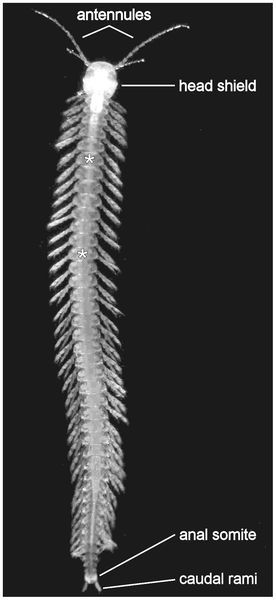
Remipedia
Remipedia is a class of blind crustacean-like animals, closely related to hexapods. They are found in coastal aquifers which contain saline groundwater, with populations identified in almost every ocean basin so far explored, including in Australia, the Caribbean Sea, and the Atlantic Ocean. The first described remipede was the fossil Tesnusocaris goldichi (Lower Pennsylvanian). Since 1979, at least seventeen living species have been identified in subtropical regions around the world.

Zygentoma
Zygentoma are an order in the class Insecta, and consist of about 550 known species. The Zygentoma include the silverfishes or fishmoths, and the firebrats. A conspicuous feature of the order are the three long caudal filaments. The two lateral filaments are cerci, and the medial one is an epiproct or appendix dorsalis. In this they resemble the Archaeognatha, although the cerci of Zygentoma, unlike in the latter order, are nearly as long as the epiproct.
%20(cropped).jpg)
Ricinulei
Ricinulei is a small order of arachnids. Like most arachnids, they are predatory; eating small arthropods. They occur today in west-central Africa (Ricinoides) and the Americas (Cryptocellus and Pseudocellus) from Brazil to southern Texas, where they inhabit either leaf-litter or caves. As of 2022, 103 extant species of ricinuleids have been described worldwide, all in the single family Ricinoididae. Due to their obscurity they do not have a proper common-name, though in academic literature they are occasionally referred to as hooded tickspiders.

Octopodiformes
Octopodiformes is a superorder of the subclass Coleoidea, comprising the octopuses and the vampire squid. All living members of Octopodiformes have eight arms, either lacking the two tentacles of squid (as is the case in octopuses) or modifying the tentacles into thin filaments (as in vampire squid). Octopodiformes is often considered the crown group of octopuses and vampire squids, including all descendants of their common ancestor. Some authors use the term Vampyropoda for the same general category, though others use "Vampyropoda" to refer to the total group (all cephalopods closer to octopo
Eureptilia
REDIRECT Sauropsida#Subdivisions
Category:Reptile taxonomy
Category:Tetrapod unranked clades
Category:Extant Pennsylvanian first appearances
Category:Taxa named by Everett C. Olson
Category:Polyphyletic groups

Sphenacodontia
Sphenacodontia is a stem-based clade of derived synapsids. It was defined by Amson and Laurin (2011) as "the largest clade that includes Haptodus baylei, Haptodus garnettensis and Sphenacodon ferox, but not Edaphosaurus pogonias". They first appear during the Late Pennsylvanian (Upper Carboniferous) epoch. From the end of the Carboniferous to the end of the Permian, most of them remained large, with only some secondarily becoming small in size.

Eupelycosauria
Eupelycosauria is a large clade of animals characterized by the unique shape of their skull, encompassing all mammals and their closest extinct relatives. They first appeared 308million years ago during the Early Pennsylvanian epoch, with the fossils of Echinerpeton and perhaps an even earlier genus, Protoclepsydrops, representing just one of the many stages in the evolution of mammals, in contrast to their earlier amniote ancestors.
Sphenacodontoidea
Sphenacodontoidea is a node-based clade that is defined to include the most recent common ancestor of Sphenacodontidae and Therapsida and its descendants (including mammals). Sphenacodontoids are characterised by a number of synapomorphies concerning proportions of the bones of the skull and the teeth.
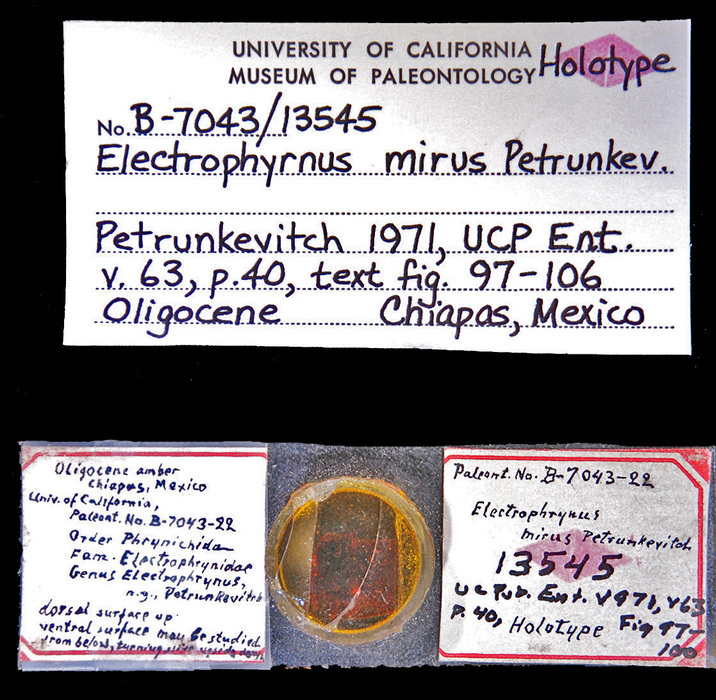
Phrynidae
Phrynidae is a family of amblypygid arachnida arthropods also known as whip spiders and tailless whip scorpions. Phrynidae species are found in tropical and subtropical regions in North and South America. Some species are subterranean; all are nocturnal. At least some species of Phrynidae hold territories that they defend from other individuals.

Holometabola
Holometabola (from Ancient Greek "complete" + "change"), also known as Endopterygota (from "inner" + "wing" + Neo-Latin "-having"), is a supra-ordinal clade of insects within the infraclass Neoptera that go through distinctive larval, pupal, and adult stages. They undergo a radical metamorphosis, with the larval and adult stages differing considerably in their structure and behaviour. This is called holometabolism, or complete metamorphism.
Ceratodontiformes
Ceratodontiformes is the only extant order of lungfish, containing the families Neoceratodontidae, Lepidosirenidae, and Protopteridae as well as many other extinct groups. Members of this group are the only lungfish known to have survived the Permian-Triassic extinction event. Although lungfish originated in marine environments, the Ceratodontiformes have been an exclusively freshwater group since the Carboniferous. This order was formerly considered the suborder Ceratodontoidei.

Tetrapulmonata
Tetrapulmonata is a non-ranked supra-ordinal clade of arachnids. It is composed of the extant orders Uropygi (whip scorpions), Schizomida (short-tailed whip scorpions), Amblypygi (tail-less whip scorpions) and Araneae (spiders). It is the only supra-ordinal group of arachnids that is strongly supported in molecular phylogenetic studies. Two extinct orders are also placed in this clade, Haptopoda and Uraraneida. In 2016, a newly described fossil arachnid, Idmonarachne, was also included in the Tetrapulmonata; it has not been assigned to an order.
_Figure_11.jpg)
Chiridotidae
Chiridotidae is a family of sea cucumbers found in the order Apodida. Within the family, there are 16 recognized genera all with different ranges of body types and functions. Sea cucumbers play a fundamental role in many marine ecosystems.
Phreatoicidea
Phreatoicidea is a suborder of isopod crustaceans. Extant species are confined to freshwater environments in South Africa, India, and Oceania. This seemingly Gondwana-derived distribution belies the fact that the group once had a cosmopolitan distribution; fossils which can be assigned to the Phreatoicidea are the oldest isopod fossils, and are found throughout the world. In the intervening 325 million years, phreatoicideans have changed little, and are thus considered living fossils.
Priapulimorphida
Priapulimorphida is the sole order within the Priapulimorpha, one of the three extant priapulid classes.