Category
page 1Iranian inventions

kerosene
right|thumb|upright|A kerosene bottle, containing blue-dyed kerosene

crucifixion
thumb|A 15th-century depiction of Jesus crucified between [[the two thieves]]

satrap
thumb|The Herakleia head, probable portrait of a Persian (Achaemenid) Empire Satrap of [[Asia Minor, end of 6th century BCE, probably under Darius I]]
A satrap () was a governor of the provinces of the ancient Median and Persian (Achaemenid) Empires and in several of their successors, such as in the Sasanian Empire and the Hellenistic empires. A satrapy is the territory governed by a satrap.
lute
thumb|start=7|thumbtime=12|Playing a lute made
A lute ( or ) is any plucked string instrument with a neck and a deep round back enclosing a hollow cavity, usually with a sound hole or opening in the body. It may be either fretted or unfretted.

hookah
thumb|A Rajput man smoking through a hookah, [[Rajasthan, India.]]

tile
Tiles are usually thin, square or rectangular coverings manufactured from hard-wearing material such as ceramic, stone, metal, baked clay, or even glass. They are generally fixed in place in an array to cover roofs, floors, walls, edges, or other objects such as tabletops. Alternatively, tile can sometimes refer to similar units made from lightweight materials such as perlite, wood, and mineral wool, typically used for wall and ceiling applications. In another sense, a tile is a construction tile or similar object, such as rectangular counters used in playing games (see tile-based game). The w

oud
The oud ( ; , ) is a Middle Eastern short-neck lute-type, pear-shaped, fretless stringed instrument (a chordophone in the Hornbostel–Sachs classification of instruments), usually with 11 strings grouped in six courses, but some models have five or seven courses, with 10 or 13 strings respectively.

prosthesis
thumb|A person with a running prosthesis
In medicine, a prosthesis (: prostheses; from ), or a prosthetic implant, is an artificial device that replaces a missing body part, which may be lost through physical trauma, disease, or a condition present at birth (congenital disorder). Prostheses may restore the normal functions of the missing body part, or may perform a cosmetic function.

qanat
thumb|Channel of the Qanats of Ghasabeh in Iran's Razavi Khorasan Province, 2015.
Iranian calendar
calendars used in Iran

Ruba'i
thumb|Calligraphic rendition of a ''ruba'i'' attributed to Omar Khayyam from
Bodleian MS. Ouseley 140 (one of the sources of FitzGerald's [[Rubaiyat of Omar Khayyam).]]
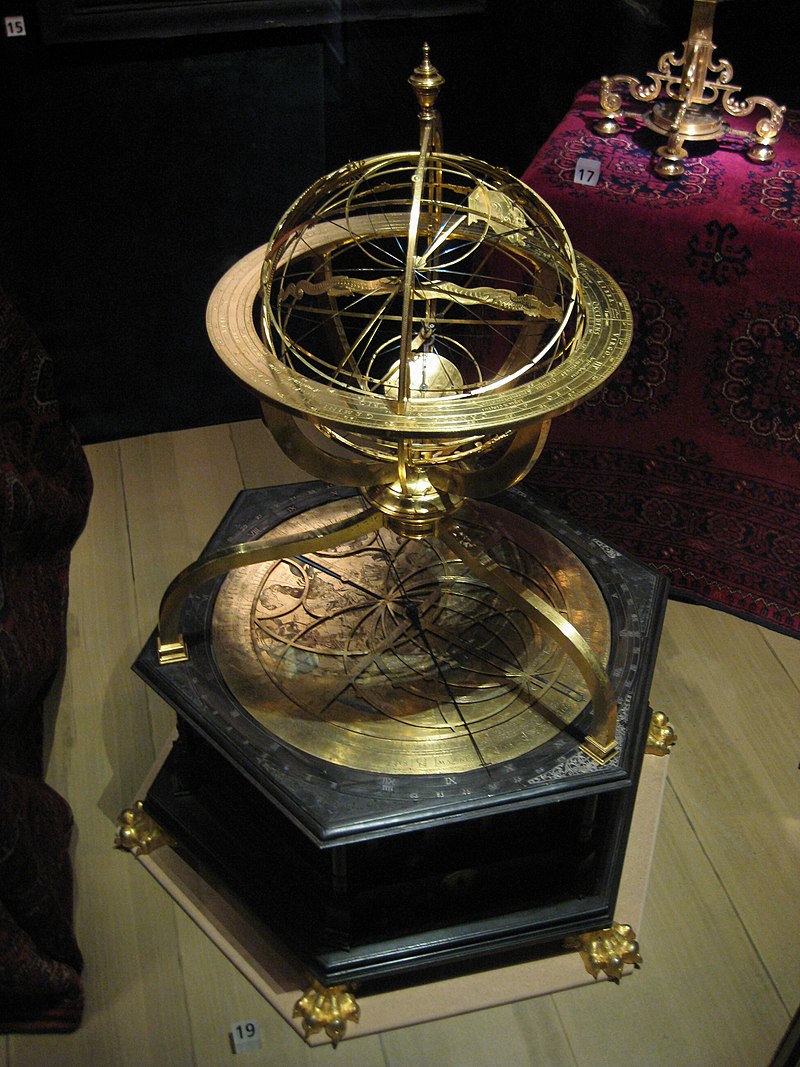
armillary sphere
model of objects in the sky

Nastaʿlīq
thumb|right|
Example reading ("Nastaliq script") in Nastaliq.
The dotted form is used in place of .

music sequencer
device or application software that can record, edit, or play back music

santur
The santur ( ; ) is a hammered dulcimer of Iranian origin.

dutar
The dutar (also dotar; ; ; ; ; ; ; ) is a traditional Iranian long-necked two-stringed lute found in Iran and Central Asia.

shatranj
thumb|Two shatranj players in a detail from a Persian miniature painting of Bayasanghori Shahname made in 1430
Persian carpet
handmade carpet from Iran

ney
The ney ( ; ) is an end-blown flute that figures prominently in traditional Kurdish, Persian, Turkish, Jewish, Arab, and Egyptian music. In some of these musical traditions, it is the only wind instrument used. The ney has been played for over 4,500 years, dating back to ancient Egypt, making it one of the oldest musical instruments still in use.

daf
Daf (), also known as dâyere and riq, is an Iranian frame drum musical instrument, also used in popular and classical music in Persian-influenced South and Central Asia, such as in Afghanistan, Azerbaijan, Tajikistan, Iran, Uzbekistan, Turkey many regions of Georgia, Armenia, Pakistan as well as in parts of India and Russian polar regions. It is also popular among Balkans, Caucasians, Bukharan Jews, Kurds, and Macedonians.
high heels
footwear that raises the heel of the wearer's foot significantly higher than the toes, long unisex but now predominently associated with women's fashion
masnavi
Mathnawi ( ), also spelled masnavi, mesnevi or masnawi, is a kind of poem written in rhyming couplets, or more specifically "a poem based on independent, internally rhyming lines". Most mathnawi poems follow a meter of eleven, or occasionally ten, syllables, but had no limit in their length. Typical mathnawi poems consist of an indefinite number of couplets, with the rhyme scheme aa/bb/cc.
tar
Middle Eastern and Central Asian long-necked, waisted string instrument

kamancheh
thumb|upright|Kamancheh
The kamancheh is an Iranian bowed string instrument used in Persian, Azerbaijani, Armenian, Kurdish, Georgian, Turkmen, and Uzbek music with slight variations in the structure of the instrument.
quadrant
navigation instrument
balaban
double reed wind instrument of the duduk family
acinaces
The acinaces, also transliterated as akinakes (Greek ) or akinaka (unattested Old Persian *akīnakah, Sogdian kynʼk) is a type of dagger or xiphos (short sword) used mainly in the first millennium BCE in the eastern Mediterranean Basin, especially by the Medes, Scythians, Persians and Caspians, then by the Greeks.
rubab
lute-like musical instrument

setar
A setar (, ) (lit: "Three Strings") is a stringed instrument, a type of lute used in Persian traditional music, played solo or accompanying voice. It is a member of the tanbur family of long-necked lutes with a range of more than two and a half octaves. Originally a three stringed instrument, a fourth string was added by Mushtaq Ali Shah by the mid 19th century. It is played with the index finger of the right hand.

chovgan
Chovgan () is a team sport with horses that originated in ancient Iran (Persia). It was considered an aristocratic game and held in a separate field, on specially trained horses. The game was widespread among the Asian peoples. It is played in Iran, Azerbaijan, Tajikistan, and Uzbekistan. It was later adopted in the Western World, known today as polo.
shamshir
thumb|upright=0.6|Syrian shamshir from the Royal Armoury, Stockholm
A shamshir () is a type of Iranian sword with a radical curve. The name is derived from the Persian word shamshīr, which is made of two words sham ("fang") and shir ("lion"). The curved "scimitar" sword family includes the shamshir, kilij, talwar, pulwar, and nimcha.

yakhchal
thumb|right|300px|Yakhchāl of Moayedi, Iran
A yakhchāl (; yakh meaning 'ice' and chāl meaning 'pit') is an ancient type of ice house, which also made ice. They are primarily found in the Dasht-e Lut and Dasht-e-Kavir deserts, whose climates range from cold (BWk) to hot (BWh) desert regions.
Maragheh Observatory
medieval Iranian astronomical observatory
pigeon post
use of homing pigeons to carry messages
Faloodeh
Faloodeh (, ), or paloodeh (, ), is a traditional Iranian cold dessert similar to a sorbet. It consists of thin vermicelli-sized noodles made from starch in a semi-frozen syrup containing sugar and rose water. Faloodeh is often served with lime juice and sometimes ground pistachios.
howz
In traditional Persian architecture, a howz () is a centrally positioned symmetrical axis pool. If in a traditional house or private courtyard, it is used for bathing, aesthetics or both. If in a sahn of a mosque, it is used for performing ablutions. A howz is usually around deep. It may be used as a "theatre" for people to sit on all sides of the pool while others entertain.

Bimarestan
300px|thumb|upright=1.35|Reconstruction of the Maristan of Granada|Nasrid Bimaristan of [[Granada, in Spain (former al-Andalus)|alt=]]
A bimaristan (; ), or simply maristan, known in Arabic as ("house of healing"; in Turkish), is a hospital in the historic Islamic world.

karnay
The karnay or kerana is a metal natural trumpet. The name is first mentioned in the biblical book of Daniel, used in the Middle Ages to the Persian military bands and in the Indian Mughal Empire to the representative orchestra naqqāra-khāna and which is still used by this name in ceremonial music in Central Asia and northern India.

shabestan
thumb|right|Shabestan of the Jameh Mosque of Tabriz; as Tabriz does not have a hot climate, the Shabestan here was not built underground.
A shabestan or shabistan (; is an underground space that can be usually found in traditional architecture of mosques, houses, and schools in ancient Iran.
ghaychak
The ghaychak or gheychak () is a bowed lute used in Iran, Afghanistan, Pakistan, and Tajikistan. The name is similar to the Central Asian ghijak, but that instrument is more closely related to the kamancheh.
chahartaq
structure in medieval Iranian architecture consisted of four barrel vaults and a dome
ab anbar
traditional Iranian water reservoir

tonbak
The tombak (), tonbak () or zarb () is an Iranian goblet drum. It is considered the principal percussion instrument of Persian music. The tombak is normally positioned diagonally across the torso, while the player uses one or more fingers and/or the palm(s) of the hand(s) on the drumhead, often (for a ringing timbre) near the drumhead's edge. Sometimes, tombak players wear metal finger rings for an extra-percussive "click" on the drum's shell. Tombak virtuosi often perform solos lasting ten minutes or more.
sorna
The sornā or sornāy (, also surnā, surnāy and also Zurna) is an ancient Iranian woodwind instrument.
clamshell grab
mechanical device

Andaruni
thumb|262px|Andaruni of Golestan Palace, Tehran
Persian traditional music
music's characteristics developed through the country's classical, medieval, and contemporary eras
chapar khaneh
traditional Iranian postal system
ancient Iranian medicine
study and practice of medicine in ancient Iran/Persia
reduction
rewriting of an expression into a simpler form
sextant
astronomical device
muraqqa
thumb|Youth kneeling and holding out a wine-cup. Safavid period, early 17th century. Isfahan School. Ink and color wash on paper. Freer Sackler Gallery F1928.10.
thumb|Some verses in Persian nasta'liq script, probably always a single page meant for a muraqqa; 16–17th century.
kus
A Kus (Persian کوس kūs) is an ancient Persian musical instrument, a large kettledrum similar to timpani.
dohol
A dohol () is a large cylindrical drum with two skinheads. It is generally struck on one side with a wooden stick bowed at the end, and with a large thin stick on the other side, though it is also played with the bare hands. It is the principal accompaniment for the Sorna. A similar instrument, the Dhol, is used in traditional Egyptian, Pakistani and Indian music.
Iranian traditional medicine
Fajr-27
The Fajr-27 system is an Iranian unlicensed copy of the Italian OTO Melara 76mm naval gun.
Panemone windmill
type of vertical axis wind turbine
Pasur
Fishing card game of Persian origin
talar
thumb|The talar of the Chehel Sotoun palace in [[Isfahan]]
A talar or talaar () is a type of porch or hall in Iranian architecture. It generally refers to a porch fronting a building, supported by columns, and open on one or three sides. The term is also applied more widely to denote a throne hall or audience hall with some of these features.
Persian musical instrument
musical instruments that originated from Persia