Category
page 3Lichen genera

Catapyrenium
Catapyrenium is a genus of squamulose lichens in the family Verrucariaceae. These small lichens grow as clusters of tiny scales ( that lie flat against rocks and soil, often in dry or disturbed habitats. The genus includes about 18 species found worldwide, particularly in arid and semi-arid regions where they help stabilize soil surfaces.

Sarcogyne
Sarcogyne is a genus of crustose lichen-forming fungi in the family Acarosporaceae. It was circumscribed by German botanist Julius von Flotow in 1850. A proposal has been put forth in 2021 to assign Sarcogyne clavus as the type species of the genus, "as it represents the original concept of Sarcogyne as having melanized apothecia without algae in the margin".

Thelotrema
Thelotrema is a genus of lichen-forming fungi in the family Graphidaceae, the family to which all taxa in the former Thelotremataceae now belong.

Polyblastia
Polyblastia is a genus of lichenized fungi in the family Verrucariaceae. As of 2020, it consists of about 40 species combined with about 50 orphaned species.
The main difference with the genus Verrucaria is related to spores, which are muriform in Polyblastia.

Dendrographa
Dendrographa is a genus of lichen-forming fungi in the family Roccellaceae. It has seven species. These lichens form small, shrubby tufts that cling to bark or coastal rocks along the Pacific seaboard, with brown-grey main branches and paler, pencil-thin tips that lack a protective outer skin. The genus was originally established in 1895 for a single Pacific coast species, but molecular studies in the 2010s expanded it by transferring four additional species from other genera and led to the discovery of a seventh species in Brazil.

Staurothele
Staurothele is a genus of saxicolous (rock-dwelling), crustose lichens in the family Verrucariaceae. It has about 40 species. When the fungus is part of a lichen, the genus of lichen is commonly called rock pimples.

Allocetraria
Allocetraria is a genus of lichenized fungi in the family Parmeliaceae. It consists of 12 species, with a center of distribution in China.

Thelidium
Thelidium is a genus of lichen-forming fungi in the family Verrucariaceae. The genus was established in 1855 by the Italian lichenologist Abramo Bartolommeo Massalongo, who distinguished it from related genera by its point-like fruiting bodies with distinctive double walls and granular spores. These lichens form thin crusts on rock surfaces and reproduce through tiny, black, flask-shaped structures that contain spores. The genus includes about 27 species found worldwide, ranging from common European species to more recently discovered ones from Asia and Australia.

Placynthiella
Placynthiella is a genus of lichen-forming fungi in the family Trapeliaceae. The genus has a complex naming history involving multiple independent descriptions by different scientists between 1909 and 1939, with the current accepted name dating to the earliest valid publication by Alexander Elenkin. These lichens form thin, dark green-brown crusts that blend closely with their growing surfaces, making them challenging to spot in the field on acidic soils, decaying wood, and bark. The genus is distinguished from similar lichen groups by its distinctive brown, brick-like fruiting body margins an

Porpidia
Porpidia is a genus of crustose lichens in the family Lecideaceae. Porpidia species primarily inhabit siliceous rocks, pebbles, and stonework, with rare occurrences on bark, wood, and compacted soil. The thallus, or body of the lichen, varies in appearance from thick and crusty to barely visible. It may form a continuous layer or develop cracks resulting in a segmented, structure. The colour of the thallus ranges from grey and white to orange.
Calvitimela
Calvitimela is a fungal genus in the family Tephromelataceae, comprising 11 species of lichen. These lichens grow tightly attached to rocks, appearing as thin, crust-like layers on their surface. They are primarily found in alpine and arctic regions around the world. Calvitimela species are characterised by their (segmented) thallus and black, shiny, convex apothecia (fruiting bodies). The genus currently includes eleven recognised species, though recent genetic studies have revealed unexpected diversity within this group. Calvitimela lichens are known for their varied secondary metabolites, w

Phaeophyscia
Phaeophyscia is a genus of lichen-forming fungi in the family Physciaceae. These lichens typically appear as leaf-like (foliose) growths that spread across tree bark, rocks, or other surfaces, usually in well-lit, nutrient-rich environments. Their structure consists of short or long that range in colour from pale grey to dark brown, becoming dark green when wet, and they often have dark undersides with root-like attachments (rhizines). The genus is distinguished from its relatives by its unique chemical composition and reproductive features, lacking a substance called atranorin and producing e

Pseudevernia
Pseudevernia is a genus of foliose lichens in the family Parmeliaceae. The type species of the genus, Pseudevernia furfuracea (commonly known as tree moss), has substantial commercial value in the perfume industry.
Catillaria
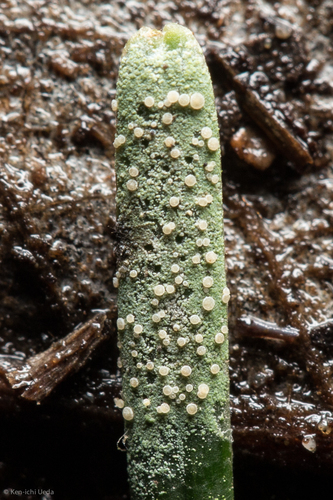
Catillaria is a genus of crustose lichens in the family Catillariaceae. The genus was circumscribed by Italian lichenologist Abramo Bartolommeo Massalongo in 1852. It is the type genus of Catillariaceae, which was circumscribed by Austrian lichenologist Josef Hafellner in 1984.

Acrocordia
Acrocordia is a genus of lichen-forming fungi in the family Monoblastiaceae. These lichens form thin, whitish to pale grey crusts on tree bark and rocks, appearing as scattered black dots where their tiny flask-shaped reproductive structures emerge from the surface. The genus includes nine species found in various parts of the world, typically growing in mildly alkaline environments on broad-leaved trees or damp, mineral-rich rock faces.

Sulcaria
Sulcaria is a genus of three species of fruticose lichens in the family Parmeliaceae. Sulcaria was circumscribed by lichenologist Jan Bystrek in 1971. These lichens form hair-like or rope-like structures that hang from or grow upright on tree bark, with branches that develop distinctive lengthwise grooves as they age. They reproduce through disc-shaped fruiting bodies that contain large, dark brown spores with two unequal cells.

Nephromopsis
Nephromopsis is a genus of lichenized fungi within the Parmeliaceae family.

Thelomma
Thelomma is a genus of lichenized fungi in the family Caliciaceae. The genus is widely distributed and contains seven species. Thelomma was circumscribed by Italian lichenologist Abramo Bartolommeo Massalongo in 1860.

Ainoa
Ainoa is a genus of lichens in the family Baeomycetaceae. It was named in honour of the German lichenologist Aino Henssen. These rock-dwelling lichens form thin crusts that break into small flakes and are distinguished by their abundant dark brown to black button-like fruiting bodies that sit on short stalks. The genus includes three species found in cool mountainous regions, where they grow on hard siliceous rocks and can withstand repeated cycles of wetting and drying.

Physciella
Physciella is a genus of lichen-forming fungi in the family Physciaceae. Circumscribed by the lichenologist Ted Esslinger in 1986, it is distinguished from the similar genera Physcia and Phaeophyscia by its (comprising long, narrow, wavy, parallel hyphae) lower cortex, the lack of the secondary metabolite (lichen product) atranorin in the upper cortex, and short, ellipsoid-shaped conidia.

Erioderma
Erioderma is a genus of lichen-forming fungi in the family Pannariaceae. They are commonly called mouse ears or felt lichens, and are small, pale brown to olive-brown foliose cyanolichens with a fuzzy upper surface that have the cyanobacteria Scytonema as their photobiont. Most species are found in the tropics of Central and South America, although three species are found in coastal regions of North America where they generally grow on mossy branches in humid sites. All North American species are rare. Species of Erioderma can resemble Pannaria, Leioderma, or small Peltigera, but their fuzzy u

Sagiolechia
Sagiolechia is a genus of lichen-forming fungi in the family Sagiolechiaceae. These lichens form either extremely thin crusts within their substrate or live parasitically on other lichens without forming their own thallus. The genus is characterised by distinctive black, glossy fruiting bodies that begin embedded within the host material and later erupt to the surface, often developing elaborate folded or star-like forms. Sagiolechia contains six species found in diverse locations including Alaska, Greenland, Norway, and Madeira, with most species being quite rare and relatively recently disco

Pleopsidium
Pleopsidium is a genus of lichen-forming fungi in the family Acarosporaceae (order Acarosporales). The widespread genus was circumscribed by lichenologist Gustav Wilhelm Körber in 1855. After a 2025 revision of the genus, it comprises eight species.
Placopsis
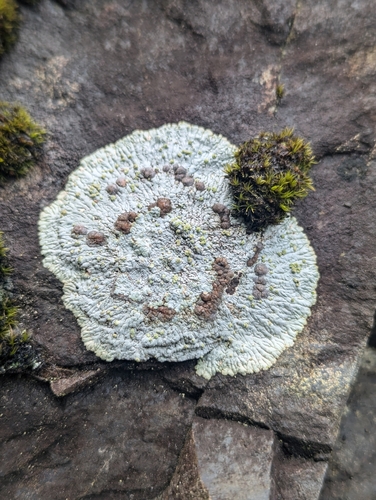
Placopsis is a genus of lichen-forming fungi in the family Trapeliaceae. First introduced as a subgenus in 1861 by William Nylander, the genus now comprises about 50 named species worldwide and shows its greatest diversity in the Southern Hemisphere. These lichens are conspicuous crustose to forms that typically grow on rock or soil, characterised by orbicular or irregularly spreading patches with lobed margins. A defining feature of the genus is the presence of cephalodia, which are nodules containing cyanobacteria that are often centrally placed on the thallus. This distinctive appearance in

Pilophorus
genus of fungi

Strigula
Strigula is a genus of lichen-forming fungi in the family Strigulaceae.

Polysporina
Polysporina is a genus of fungi in the family Acarosporaceae. The genus was circumscribed by the Czech lichenologist Antonín Vězda in 1978. Some of the species form lichens, while others are species of lichenicolous (lichen-dwelling) fungi.

Flavopunctelia
Flavopunctelia is a genus of foliose lichens in the family Parmeliaceae. The genus contains species that are widespread in temperate and tropical areas. The genus is characterised by broad, yellow-green lobes, point-like (punctiform) pseudocyphellae on the thallus surface, and bifusiform conidia (i.e., threadlike with a swelling at both ends). All species contain usnic acid as a major secondary chemical in the cortex. Flavopunctelia was originally conceived as a subgenus of Punctelia by Hildur Krog in 1982; Mason Hale promoted it to generic status in 1984.
Immersaria
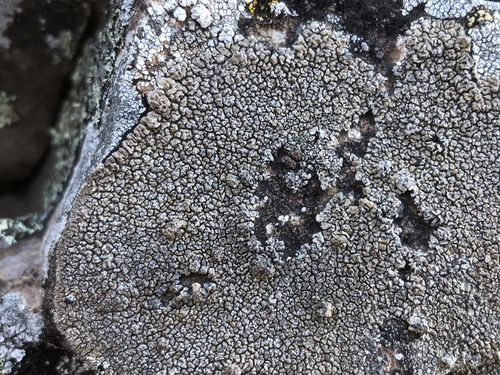
Immersaria is a genus of lichen-forming fungi in the family Lecideaceae. Species in the genus form brown to orange-brown crusts on rock, often with a waxy or glossy surface. They are characterised by dark, sunken fruiting bodies that lack the prominent rim seen in some related genera. The genus occurs in Europe, Asia, and the Southern Hemisphere, typically in alpine or montane habitats.
Atla
genus of fungi

Gyalectidium
Gyalectidium is a genus of lichen-forming fungi in the family Gomphillaceae. Established in 1881 by Swiss lichenologist Johannes Müller Argoviensis, the genus comprises about 50 species of predominantly leaf-dwelling lichens that form small, pale greenish to whitish-grey patches typically only a few millimetres across. Members are characterised by specialised asexual reproductive structures called , which are small scale-like outgrowths that produce propagules containing both fungal and algal partners, and by fruiting bodies that contain single, large, multi-chambered ascospores. The genus has

Psoroma
Psoroma is a genus of lichen-forming fungi in the family Pannariaceae. The widespread genus contains about 30 species, most of which are found in south temperate regions.

Megalospora
Megalospora is a genus of lichen-forming fungi in the family Megalosporaceae.

Fuscidea
Fuscidea is a genus of crustose lichens in the family Fuscideaceae. It has about 40 species. The genus was established in 1972 by Volkmar Wirth and Antonín Vězda, with its name derived from the Latin for 'brown', referring to the typical colouration of these lichens. Species of Fuscidea grow almost exclusively on acidic, silica-rich rocks, favouring steep faces in humid, high-rainfall regions such as Atlantic coastlines and mountain ranges. They form cracked or patchy crusts that spread over a characteristically dark underlying margin, often creating mosaic-like patterns where neighbouring col

Thelocarpon
Thelocarpon is a genus of lichen-forming fungi in the family Thelocarpaceae. The genus was established in 1853 by the Finnish lichenologist William Nylander, who distinguished it from related genera by its warted thallus structure, many-spored asci, and the distinctive violet-blue staining reaction of its fruiting body gel when treated with iodine. These tiny lichens form small, wart-like bumps on soil, wood, and plant debris, often covered with a distinctive bright yellow powdery coating. The genus includes about 30 species found worldwide, many of which produce unusually large numbers of asc

Dirinaria
Dirinaria is a genus of lichenized fungi in the family Caliciaceae. The genus has a widespread distribution, especially in tropical regions, and contains about 35 species.

Cliostomum
Cliostomum is a genus of lichen-forming fungi in the family Ramalinaceae. It has about 20 species. The genus was established in 1825 by Elias Magnus Fries, who characterized it by its rounded fruiting bodies that are integrated into the lichen's crust with distinctive folded or corrugated openings. These lichens form tight crusts on various surfaces, ranging in colour from whitish to pale grey or yellowish, and reproduce primarily through conspicuous flask-shaped structures that release spores rather than through sexual fruiting bodies.

Japewia
Japewia is a genus of lichen-forming fungi in the family Lecanoraceae. The genus was circumscribed in 1990 by the Norwegian lichenologist Tor Tønsberg, who assigned J. tornoënsis as the type species. The new genus is named in honour of Peter Wilfred James, a notable lichenologist, with Japewia being derived from the first letters of his initials (Ja) and his surname (Pe) followed by a typical Latin suffix (-wia).
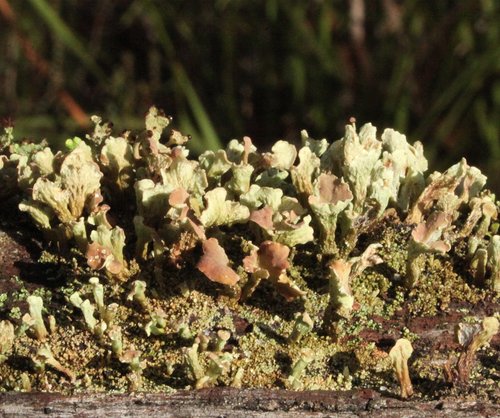
Thysanothecium
Thysanothecium is a genus of three species of lichenized fungi in the family Cladoniaceae. The genus was circumscribed by Camille Montagne and Miles Joseph Berkeley in 1846. The original specimens of the type species, T. hookeri, were collected from the area of Swan River (Australia) by James Drummond, who sent them for to William Jackson Hooker for further analysis.
Dictyonema
Dictyonema is a genus of mainly tropical basidiolichens in the family Hygrophoraceae. Unlike most lichens, which contain fungi related to yeasts and molds, Dictyonema species contain fungi more closely related to mushrooms. The genus includes about 40 recognized species found mainly in tropical regions, ranging from lowland forests to high mountain elevations up to 4,300 meters in the Andes. These lichens come in various forms, from crusty patches to leaf-like structures to thread-like mats, and most grow on soil, rocks, moss, or rotting logs. One species from the Amazon rainforest has traditi
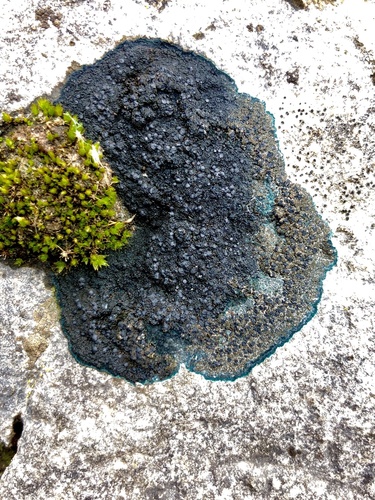
Placynthium
Placynthium is a genus of lichen-forming fungi in the family Placynthiaceae. Members of this genus are commonly called blackthread lichens.
Involucropyrenium
Involucropyrenium is a genus of lichens in the family Verrucariaceae. It has 10 species. Species in this genus are characterised by their minute, scale-like growth form and distinctive reproductive structures capped with dark sheaths. Most of the ten recognised species were described relatively recently, with several new species added as recently as 2021.
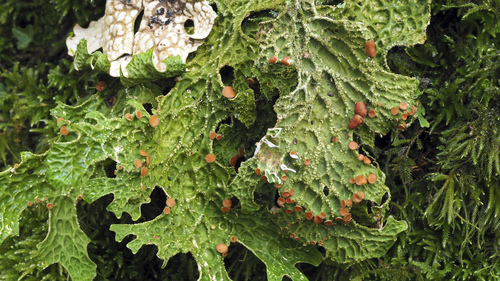
Sticta
Sticta is a genus of lichens in the family Peltigeraceae. The genus has a widespread distribution, especially in tropical areas, and includes about 114 species. These lichens have a leafy appearance, and are colored brown or black. Sticta species with cyanobacteria as photobionts can fix nitrogen from the atmosphere, and due to their relative abundance and high turnover, they contribute appreciably to the rainforest ecosystem. They are commonly called spotted felt lichens.

Diploicia
Diploicia is a genus of lichen-forming fungi in the family Caliciaceae. The genus has a widespread distribution, especially in temperate regions, and contains seven species. These lichens form small, tightly attached rosettes with a distinctive pale grey-green colour and a fine, powdery coating that becomes more noticeable when dry. They reproduce through tiny black, pin-prick fruiting bodies that emerge from the crust surface and through powdery outgrowths that can break off and spread the lichen to new locations.

Amandinea
Amandinea is a genus of lichenized fungi in the family Caliciaceae. Genetic studies indicates that the genus Amandinea and Buellia are the same, although this is not widely accepted.
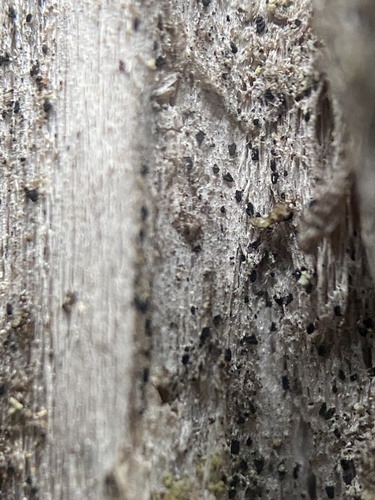
Elixia
genus of fungi
Seirophora
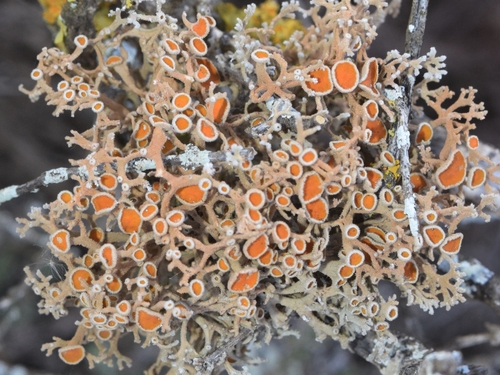
Seirophora is a genus of lichen-forming fungi in the family Teloschistaceae. It comprises nine species. The genus was erected in 1983, with Seirophora magara assigned as the type species. These lichens form small, shrubby growths with firm, cartilage-like branches that are stiffened by internal cord-like structures and covered with complex surface hairs rather than the simple root-like attachments found in related genera. Several species were transferred to Seirophora in 2004 when the genus was emended by Patrik Frödén and Per Lassen to include some species segregated from Teloschistes.
Letharia
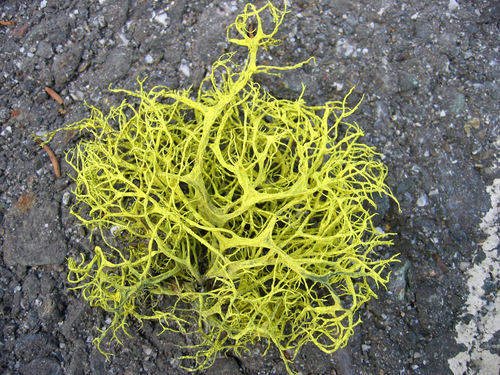
Letharia is a genus of fruticose lichens belonging to the family Parmeliaceae. Molecular phylogenetics studies have revealed that what were once considered just two species actually represent at least several distinct evolutionary lineages, with western North America serving as the centre of diversity for the group. These lichens typically grow on sun-exposed wood and bark of coniferous trees, growing in dry habitats where they receive moisture from dew or fog.
Gyalideopsis
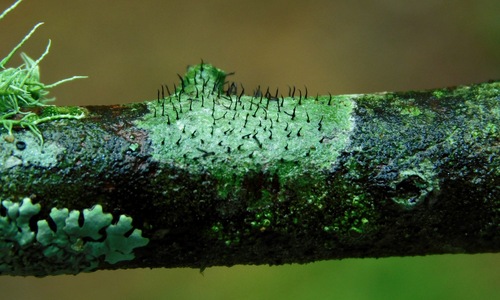
Gyalideopsis is a genus of lichen-forming fungi in the family Gomphillaceae. Gyalideopsis species form delicate, film-like crusts on a wide variety of surfaces including tree bark, rocks, and mosses, often in tropical and temperate forests worldwide. Species in the genus produce distinctive small, scale-like structures called , which are thought to aid in asexual reproduction where ascospore-producing structures are absent or uncommon. Members of this genus lack the distinctive chemical compounds found in many other lichens, making them reliant on microscopic features and spore characteristics

Pseudocyphellaria
Pseudocyphellaria is a genus of large, leafy lichens that are sometimes referred to as "specklebelly" lichens. The genus has a widespread distribution, especially in south temperate regions, and contains about 170 species. They resemble Lobaria, except that most species of Pseudocyphellaria have conspicuous pseudocyphellae on their lower surface, a characteristic that was once considered unique to this genus. Some species contain pulvinic acid-related pigments; in these species the soredia and pseudocyphellae can be bright yellow.

Psilolechia
Psilolechia is a genus of four species of crustose lichens. It is the only member of Psilolechiaceae, a family that was created in 2014 to contain this genus.
Frutidella
Frutidella is a genus of lichen-forming fungi in the family Lecanoraceae. It contains three species. The genus was established in 1994 by Klaus Kalb to accommodate a species previously classified in the genus Lecidea. These lichens form thin crusts that often develop distinctive wart-like swellings packed with tiny granules, and they produce small, dome-shaped fruiting bodies with a characteristic blue-green sheen. Species of Frutidella typically grow on acidic substrates, including nutrient-poor soils in upland areas and the bark of trees.
Gymnographa
Gymnographa is a genus of lichen-forming fungi in the family Graphidaceae. It contains two species.

Circinaria
Circinaria is a genus of lichen-forming fungi in the family Megasporaceae. It was circumscribed by Johann Heinrich Friedrich Link in 1809.

Asterothyrium
Asterothyrium is a genus of leaf-dwelling lichens in the family Gomphillaceae. These tiny lichens form small, star-shaped fruiting bodies on the surface of leaves in tropical and subtropical forests. They are most commonly found in humid, shaded environments where leaves remain moist and clean. The genus includes 19 recognised species distributed primarily throughout Central and South America.

Dimelaena
Dimelaena is a genus of lichenized fungi in the family Caliciaceae. Members of the genus are commonly called mountain lichens, or moonglow lichens. They are placodioid crustose lichens, ranging in form from rimose to areolate. The genus has a widespread distribution and contains eight species.

Pycnora
Pycnora is a small genus of lichen-forming fungi in the monotypic family Pycnoraceae. The genus was established in 2001 by the Austrian lichenologist Josef Hafellner, who named it by combining references to its conspicuous black reproductive structures and its relationship to the lichen genus Lecanora. These wood-dwelling lichens form thin grey crusts on the smooth surfaces of dead wood in cool northern and mountain forests, where they colonise fallen tree trunks and branches that have lost their bark. The genus contains three species and is distinguished by its readily visible black fruiting

Brodoa
Brodoa is a genus of three species of foliose lichens in the family Parmeliaceae. The genus, circumscribed in 1986 by Trevor Goward, is named in honour of the lichenologist Irwin Brodo.

Tephromela
Tephromela is a genus of lichens in the family Tephromelataceae. There are about 50 species in this widespread genus. The genus was established in 1929 by the French lichenologist Maurice Choisy, who separated these species from the broader genus Lecanora based on their distinctive straight asexual spores and dark violet spore-bearing layers. These rock and bark-dwelling lichens are characterized by their white to pale grey crusty growth and black -shaped reproductive structures with purple-tinted interiors.
Jamesiella
Jamesiella is a genus of lichen-forming fungi in the family Gomphillaceae. Members of Jamesiella form thin, delicate crusts on tree bark, rocks, and mosses in humid tropical and temperate forests, distributed across North and South America and Europe. The genus is distinguished from its close relative Gyalideopsis by a unique type of asexual reproductive structure called , which are specialized stalks containing both fungal filaments and algal cells that detach and disperse as complete units capable of establishing new lichens.