Category
page 1Materials science

metal
thumb|right|alt=refer to caption|Iron, shown here as fragments and a 1 cm3 cube, is an example of a [[chemical element that is a metal.]]
thumb|right|alt=A metal gravy boat|Metal in the form of a gravy boat made from [[stainless steel, an alloy largely composed of iron, chromium and nickel]]
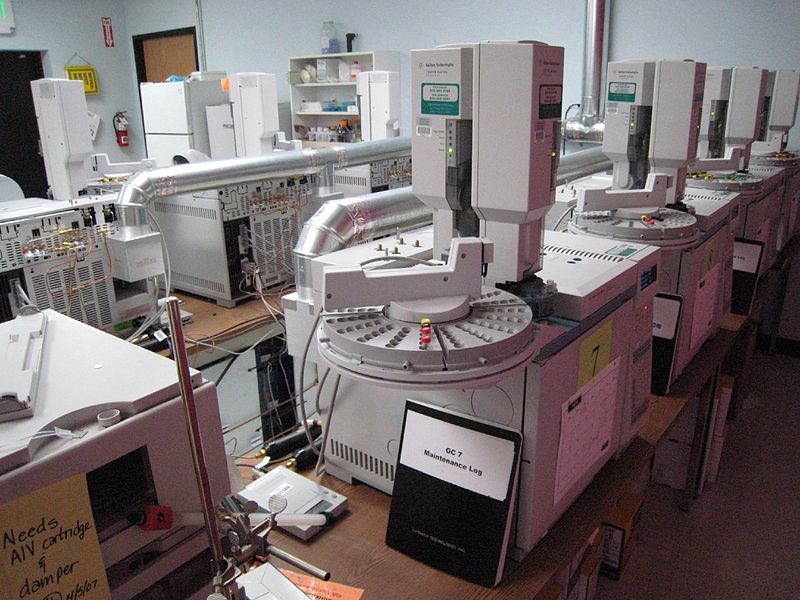
analytical chemistry
study of the separation, identification, and quantification of the chemical components of materials

polymer
thumb|upright=0.8|Appearance of real linear polymer chains as recorded using an atomic force microscope on a surface, under liquid medium. Chain [[contour length for this polymer is ~204 nm; thickness is ~0.4 nm.]]

evaporation
thumb|right|Aerosol of microscopic water droplets suspended in the air above a cup of hot tea after the water vapor has sufficiently cooled and condensed. Water vapor is an invisible gas, but the clouds of condensed droplets refract and scatter the sunlight and are thus visible.
thumb|Droplets of water vapor in a pan.
thumb|right|280px|Demonstration of evaporative cooling. When the sensor is dipped in ethanol and then taken out to evaporate, the instrument shows progressively lower temperature as the ethanol evaporates.
thumb|Rain evaporating after falling on hot pavement

crystallography
thumb|A crystalline solid: atomic resolution image of strontium titanate. Brighter spots are columns of [[strontium atoms and darker ones are titanium-oxygen columns.]]
thumb|Octahedral and tetrahedral interstitial sites in a face centered cubic structure
thumb|Kikuchi lines (physics)|Kikuchi lines in an [[electron backscatter diffraction pattern of monocrystalline silicon, taken at 20 kV with a field-emission electron source]]

materials science
research, discovery and design of physical materials (especially solids)

melting
thumb|Melting ice cubes illustrate the process of fusion.|321x321px

reinforced concrete
composite building material

Mohs scale of mineral hardness
qualitative ordinal scale characterizing scratch resistance of various minerals

material
A material is a substance or mixture of substances that constitutes an object. Materials can be pure or impure, living or non-living matter. Materials can be classified on the basis of their physical and chemical properties, or on their geological origin or biological function. Materials science is the study of materials, their properties, and their applications.

hardness
In materials science, hardness (antonym: softness) is a measure of the resistance to plastic deformation, such as an indentation (over an area) or a scratch (linear), induced mechanically either by pressing or abrasion. In general, different materials differ in their hardness; for example hard metals such as titanium and beryllium are harder than soft metals such as sodium and metallic tin, or wood and common plastics. Macroscopic hardness is generally characterized by strong intermolecular bonds, but the behavior of solid materials under force is complex; therefore, hardness can be measured i

crystal structure
unique arrangement of atoms or molecules in a crystalline liquid or solid

adsorption
thumb|Brunauer, Emmett, and Teller's #BET|model of multilayer adsorption is a random distribution of molecules on the material surface.

mechanics of materials
methods of calculating displacements, stresses, and strains in deformable bodies

adhesion
thumb|Dew drops adhering to a [[spider web]]
thumb|thumbtime=7|Adhesion of a frog on a wet vertical glass surface.
thumb|Concave meniscus (liquid)|meniscus is caused due to adhesion.
thumb|

Poisson's ratio
parameter of elastic materials: ratio of transverse strain to axial strain

condensed matter physics
branch of physics dealing with a property of matter

X-ray crystallography
technique used for determining the atomic or molecular structure of a crystal, in which the ordered atoms cause a beam of incident X-rays to diffract into specific directions

phase diagram
chart used to show conditions at which physical phases of a substance occur

hysteresis
thumb|right|Electric displacement field of a ferroelectric material as the [[electric field is first decreased, then increased. The curves form a hysteresis loop.]]
Hysteresis is the dependence of the state of a system on its history. For example, a magnet may have more than one possible magnetic moment in a given magnetic field, depending on how the field changed in the past. Such a system is called hysteretic. Plots of a single component of the moment often form a loop or hysteresis curve, where there are different values of one variable depending on the direction of change of another variab
eutectic mixture
homogeneous mixture of substances that melts or solidifies at a single temperature that is lower than the melting point of either of the constituents

tribology
Tribology is the science and engineering of understanding friction, lubrication and wear phenomena for interacting surfaces in relative motion. It is highly interdisciplinary, drawing on many academic fields, including physics, chemistry, materials science, mathematics, biology and engineering. The fundamental objects of study in tribology are tribosystems, which are physical systems of contacting surfaces. Subfields of tribology include biotribology, nanotribology and space tribology. It is also related to other areas such as the coupling of corrosion and tribology in tribocorrosion and the c
zero-point energy
lowest possible energy of a quantum system or field

ultimate tensile strength
capacity of a material or structure to withstand loads tending to elongate; resists tension (being pulled apart); measured by the maximum stress that a material can withstand while being stretched or pulled before breaking

elastomer
thumb|upright|(A) is an unstressed polymer; (B) is the same polymer under stress. When the stress is removed, it will return to the A configuration. (The dots represent cross-links)
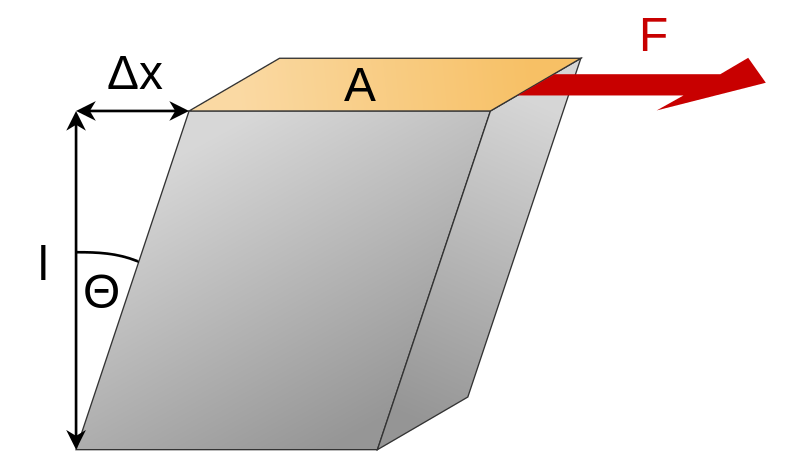
shear modulus
ratio of shear stress to the shear strain
crystal twinning
two separate crystals sharing some of the same crystal lattice points in a symmetrical manner

fracture
thumb|Ductile failure of a metallic specimen strained axially
annealing
heat treatment that alters the properties of a material

brittleness
thumb|Brittle fracture in glass
thumb|Brittle fracture in cast iron tensile testpieces
A material is brittle if, when subjected to stress, it fractures with little elastic deformation and without significant plastic deformation. Brittle materials absorb relatively little energy prior to fracture, even those of high strength. Breaking is often accompanied by a sharp snapping sound.
coordination number
number of atoms, molecules or ions bonded to in a molecule or crystal

toughness
thumb|Toughness as defined by the area under the stress–strain curve for one unit volume of the material.
In materials science and metallurgy, toughness is the ability of a material to absorb energy and plastically deform without fracturing. Toughness is the strength with which the material opposes rupture. One definition of material toughness is the amount of energy per unit volume that a material can absorb before rupturing. This measure of toughness is different from that used for fracture toughness, which describes the capacity of materials to resist fracture.
Toughness requires a balance

buckling
thumb|Buckled skin panels on a Boeing B-52 Stratofortress|B-52 aircraft. Thin skin panels buckle at very low loads. In the case shown here, the weight of the forward fuselage structure ahead of the nose undercarriage is sufficient to cause the panels to buckle. Buckled panels are still effective in carrying shear by diagonal tension.
thumb|On the front of a new Siemens Venture railway coach made of stainless steel, unevenness caused by buckling becomes apparent because of the reflection on the polished surface.
In structural engineering, buckling is the sudden change in shape (deformation) of
solid solution
chemical solution in solid form; whose solvent's crystal structure is not altered by solute
solid-state chemistry
study of the synthesis, structure, and properties of solid phase materials
spider silk
filament material produced by spiders
nondestructive testing
group of analysis techniques to evaluate properties of something without causing damage
Gorilla Glass
trademark for an alkali-aluminosilicate sheet glass
touchstone
small tablet of dark stone used for assaying precious metal alloys
Electron diffraction
Bending of electron beams due to electrostatic interactions with matter
ceramic engineering
branch of engineering concerned with the development, production, and application of ceramic and ceramic products
combinatorial chemistry
chemical methods designed to rapidly synthesize large numbers of chemical compounds

coating
thumb|Lacquer being sprayed onto a cabinet
A coating is a covering that is applied to the surface of an object, or substrate. The purpose of applying the coating may be decorative, functional, or both. Coatings may be applied as liquids, gases or solids e.g. powder coatings.

viscoelasticity
Viscoelasticity is a material property that combines both viscous and elastic characteristics. Many materials have such viscoelastic properties, especially materials that consist of large molecules. Polymers are viscoelastic because their macromolecules can make temporary entanglements with neighbouring molecules which causes elastic properties. After some time these entanglements will disappear again and the macromolecules will flow into other positions where new entanglements will be made (viscous properties).
compressive strength
capacity of a material or structure to withstand loads tending to reduce size, which withstands loads tending to elongate
thin film
a layer of material ranging from fractions of a nanometer to several micrometers in thickness
fibre-reinforced plastic
composite material made of a polymer matrix reinforced with fibres
thermal analysis
analysis of material by examining how it responds to heat
thermogravimetric analysis
method of thermal analysis in which the mass of a sample is measured over time as the temperature changes
grain boundary
concept in materials science: the interface between two grains, or crystallites, in a polycrystalline material

sputtering
thumb|250px|A commercial AJA Orion sputtering system at Cornell NanoScale Science and Technology Facility
thumb|Ion thruster operating on iodine (yellow) using a xenon (blue) hollow cathode. High-energy ions emitted from Spacecraft electric propulsion|plasma thrusters sputter material off the surrounding test chamber, causing problems for ground testing of high-power thrusters.
In physics, sputtering is a phenomenon in which microscopic particles of a solid material are ejected from its surface, after the material is itself bombarded by energetic particles of a plasma or gas. It occurs natural

photoresist
A photoresist (also known simply as a resist) is a light-sensitive material used in several processes, such as photolithography and photoengraving, to form a patterned coating on a surface. This process is crucial in the electronics industry.
electrical resistivity and conductivity
measure of a substance's ability to resist or conduct electric current
elemental analysis
process of analytical chemistry
reliability engineering
sub-discipline of systems engineering that emphasizes dependability in the lifecycle management of a product or a system
Kroll process
Pyrometallurgical industrial process
nucleation
In thermodynamics, nucleation is the first step in the formation of either a new thermodynamic phase or structure via self-assembly or self-organization within a substance or mixture. Nucleation is typically defined to be the process that determines how long an observer has to wait before the new phase or self-organized structure appears. For example, if a volume of water is cooled (at atmospheric pressure) significantly below 0°C, it will tend to freeze into ice, but volumes of water cooled only a few degrees below 0°C often stay completely free of ice for long periods (supercooling). At thes
thermal spraying
materials processing technology
Ion implantation
material and chemical process
differential scanning calorimetry
thermoanalytical technique in which the difference in the amount of heat required to increase the temperature of a sample and reference is measured as a function of temperature