Category
page 1Mujaddid

Ibn Khaldun
Arab historiographer and historian
.jpg)
Saladin
Salah ad-Din Yusuf ibn Ayyub ( – 4 March 1193), commonly known as Saladin, was a Kurdish commander and political leader. He was the founder of the Ayyubid dynasty and the first sultan of both Egypt and Syria. An important figure of the Third Crusade, he spearheaded the Muslim military effort against the Crusader states in the Levant. At the height of his power, the Ayyubid realm spanned Egypt, Syria, Upper Mesopotamia, the Hejaz, Yemen, and Nubia.

Al-Ghazali
Al-Ghazali, ( ( – 19 December 1111), Latinized as Algazelus, was a Shafi'i Sunni Muslim Iranian scholar and polymath. He is known as one of the most prominent and influential jurisconsults, legal theoreticians, muftis, philosophers, theologians, logicians and mystics in Islamic history.

Mehmed II
seventh Sultan of the Ottoman Empire (1444–1446, 1451–1481)

Aurangzeb
Alamgir I (Muhi al-Din Muhammad; 3 November 1618 – 3 March 1707), commonly known by the title Aurangzeb, was the sixth Mughal emperor, reigning from 1658 until his death in 1707. Under his reign, the Mughal Empire reached its greatest extent, with territory spanning nearly the entirety of the Indian subcontinent.

Abū Ḥanīfa
8th-century Sunni theologian and jurist

Ahmad ibn Hanbal
Muslim jurist and theologian (780–855)

Al-Shafi'i
'''Al-Shafi'i''' (; ;767–820 CE) was a Muslim scholar, jurist, muhaddith, traditionist, theologian, ascetic, and eponym of the Shafi'i school of Sunni Islamic jurisprudence. He is known to be the first to write a book upon the principles of Islamic jurisprudence, having authored one of the earliest work on the subject: al-Risala. His legacy and teaching on the matter provided it with a systematic form, thereby "fundamentally influencing the succeeding generations which are under his direct and obvious impact," and "beginning a new phase of the development of legal theory."

Malik ibn Anas
Arab Islamic jurist, theologian and hadith traditionist (711–795)

Umar II
Umayyad caliph from 717 to 720

Muhammad ibn Abd al-Wahhab
Islamic Saudi scholar, jurist and eponym of Wahhabi movement (1703–1792)

Muhammad Abduh
Egyptian Islamic jurist, religious scholar and liberal reformer (1849-1905)

Ibn Hazm
Andalusian Muslim polymath, historian, jurist, philosopher and theologian (994–1064)

Abu al-Hasan al-Ash'ari
Muslim theologian (874–936)
Said Nursî
Turkish Sunni Muslim theologian of Kurdish origin (1876-1960)

Hasan al-Basri
Arab Muslim scholar, theologian, preacher and judge (c.642–728)

Fakhr al-Din al-Razi
12th-century Sunni Muslim theologian and philosopher

Syed Abul Ala Maududi
South Asian Islamic scholar, Founder of Jamaat-e-Islami (1903–1979)
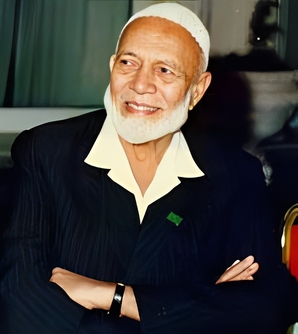
Ahmed Deedat
South African writer and orator (1918–2005)

Rida Muhammad Rashid
Syrian Muslim scholar and reformer (1865-1935)

Jalal al-Din al-Suyuti
Jalal al-Din al-Suyuti (; 1445–1505), or al-Suyuti, was an Egyptian Sunni Muslim polymath of Persian descent. Considered the mujtahid and mujaddid of the Islamic 10th century, he was a leading muhaddith (hadith master), mufassir (Qu'ran exegete), faqīh (jurist), usuli (legal theorist), sufi (mystic), theologian, grammarian, linguist, rhetorician, philologist, lexicographer and historian, who authored works in virtually every Islamic science. For this reason, he was honoured one of the most prestigious and rarest titles: Shaykh al-Islām.

Abu Mansur al-Maturidi
Persian Muslim theologian (853–944)

Shah Waliullah Dehlawi
Indian muslim scholar

Ahmad Sirhindi
Philosopher (1564-1624)

Ahmed Raza Khan Barelvi
Indian Islamic scholar and reformer, regarded as a founder of the Barelvi movement (1856–1921)
Ibn Sirin
8th-century Muslim scholar and dreams interpreter

Ahmad ibn Muhammad al-Tahawi
Abū Jaʿfar Aḥmad aṭ-Ṭaḥāwī () (853 – 5 November 933), commonly known as at-Tahawi (), was an Egyptian Arab Hanafi jurist and Traditionalist theologian. He studied with his uncle al-Muzani and was a Shafi'i jurist, before then changing to the Hanafi school. He is known for his work al-'Aqidah al-Tahawiyyah, a summary of Sunni Islamic creed which influenced Hanafis in Egypt.
Al-Juwayni
'''Dhia' ul-Dīn 'Abd al-Malik ibn Yūsuf al-Juwaynī al-Shafi'ī (Arabic إمام الحرمين ضياء الدين عبدالملك بن يوسف الجويني, 17 February 102820 August 1085; 419–478 AH) was a Persian Sunni scholar famous for being the foremost leading jurisconsult, legal theoretician and Islamic theologian of his time. His name is commonly abbreviated as al-Juwayni'; he is also commonly referred to as Imam al-Haramayn'' meaning "leading master of the two holy cities", that is, Mecca and Medina. He acquired the status of a mujtahid in the field of fiqh and usul al-fiqh. Highly celebrated as one of the most important
Hakim al-Nishaburi
Iranian historian
Abbas el-Akkad
Egyptian writer (1889-1964)
Mujaddid
A mujaddid () is an Islamic term for one who brings "renewal" () to the religion. According to the popular Muslim tradition, it refers to a person who appears at the turn of every century of the Islamic calendar to revitalize Islam, cleansing it of extraneous elements and restoring it to its pristine purity. In contemporary times, a mujaddid is looked upon as the greatest Muslim of a century.
Al-Baydawi
Persian Islamic scholar (died 1319)
Dawud al-Zahiri
Islamic scholar
Al-Baqillani
Abū Bakr Muḥammad ibn al-Ṭayyib al-Bāqillānī (; 950 – 5 June 1013), was a Sunni Muslim scholar and polymath who specialized in speculative Islamic theology, jurisprudence, logic, and hadith. He spent much of his life defending and strengthening the Ash'ari school of theology within Islam. An accomplished rhetorical stylist and orator, al-Baqillani was held in high regard by his contemporaries for his expertise in debating theological and jurisprudential issues. Al-Dhahabi referred to him as "the learned imam, incomparable master, foremost of the scholars, author of many books, and example of a
Mustafa Mahmoud
Egyptian scientist and Muslm and author (1921–2009)
Ashraf Ali Thanwi
Indian Muslim scholar (1863–1943)
Abd al-Rahman al-Kawakibi
Syrian theologian and philosopher (1855–1902)
Shibli Nomani
Indian Islamic Scholar (1857–1914)
Muḥammad Mutawallī al-Shaʻrāwī
Islamic scholar (1911–1998)
Taftazani
'''Sa'ad al-Din Massud b. Fahruddin Omar b. Burhanaddin Abdullah al-Haravi al-Khorasani at-Taftazani ash-Shafi'i )also known as Al-Taftazani and Teftazani'''(1322–1390) was a Muslim Persian polymath. A sh'ari theologian and Shafi'i jurist.
Ahmed ar-Rifa'i
6th-century founder of Rifa'i Sufi Order
Abul Hasan Ali Hasani Nadwi
Indian Islamic scholar, thinker, author, orator and critic of Arab Nationalist (1913–1999)
Abu Ishaq al-Shatibi
Moorish scholar
Ibn 'Ata Allah
3rd sheikh of the Shadhili Sufi
Al-Daraqutni
Ali ibn Umar al-Daraqutni (; 918–995 CE / 306–385 AH), was a Sunni Muslim scholar and traditionist best known for compiling the hadith collection Sunan al-Daraqutni. He is commonly celebrated in Sunni tradition with titles such as "Imam" and "Amir al-Mu'minin fi al-Hadith".
Taj al-Din al-Subki
Islamic theologian and historian
Izz al-Din ibn 'Abd al-Salam
theologian
Shah Abdul Aziz Dehlavi
Indian Islamic scholar (1746–1824)
Muhammad Alawi al-Maliki
prominent Sunni Islamic scholar from Saudi Arabia
Zakariyya al-Ansari
Islamic scholar
Ibn Daqiq al-Eid
Muslim scholar of medieval period
Muhammad Al-Tahir Ibn 'Ashur
Tunisian theologian, professor and rector of the University of Ez-Zitouna (1879-1973)
Muhammad Qasim Nanautawi
Indian scholar and activist
Muhammad Abu Zahra
Scholar of Islamic law (1898–1974)
Abu Al - Moin Al - Nasafi
Central Asian Hanafi theologian (1027–1115)
Imam Birgivi
Islamic scholar
Abdel-Halim Mahmoud
Egyptian Sufi and Sheikh (1910–1978)
Abdullah al-Harari
Harari Islamic scholar
Şaranî
'''Abd al-Wahhab al-Sha'rani (1492/3–1565, AH 898–973, full name ') was a highly influential Egyptian scholar. He was an eminent jurist, traditionist, historian, mystic and theologian. He was one of the Islamic revivalists and scholastic saints of the sixteenth century. He is credited for reviving Islam and is one of the most prolific writers of the early Egyptian-Ottoman period. His legal, spiritual, and theological writings are still widely read in the Muslim world today. He is regarded as "one of the last original thinkers in Islam." He was the founder of an Egyptian order of Su
Muhammad Hayat al-Sindi
18th-century Islamic scholar