Category
page 1Nomadic groups in Eurasia
Romani people
Indo-Aryan ethnic group

Mongol Empire
13th- and 14th-century empire originating in Mongolia

Mongols
Mongols are an East Asian ethnic group native to Mongolia and China (Inner Mongolia and other 11 autonomous territories), as well as the republics of Buryatia and Kalmykia in Russia. The Mongols are the principal member of the large family of Mongolic peoples. The Oirats and the Buryats are classified either as distinct ethno-linguistic groups or as subgroups of Mongols.

Kazakhs
The Kazakhs are a Turkic ethnic group native to Central Asia and Eastern Europe. They share a common culture, language and history that is closely related to those of other Turkic peoples. The majority of ethnic Kazakhs live in their transcontinental nation state of Kazakhstan.

Sámi people
Finno-Ugric peoples

Huns
The Huns were a nomadic people who lived in Central Asia, the Caucasus, and Eastern Europe between the 4th and 6th centuries CE. According to European tradition, they were first reported living east of the Volga River, in an area that was part of Scythia at the time. By 370 CE, the Huns had arrived on the Volga, causing the westwards movement of Goths and Alans. By 430, they had established a vast, but short-lived, empire on the Danubian frontier of the Roman empire in Europe. Either under Hunnic hegemony, or fleeing from it, several central and eastern European peoples established kingdoms in
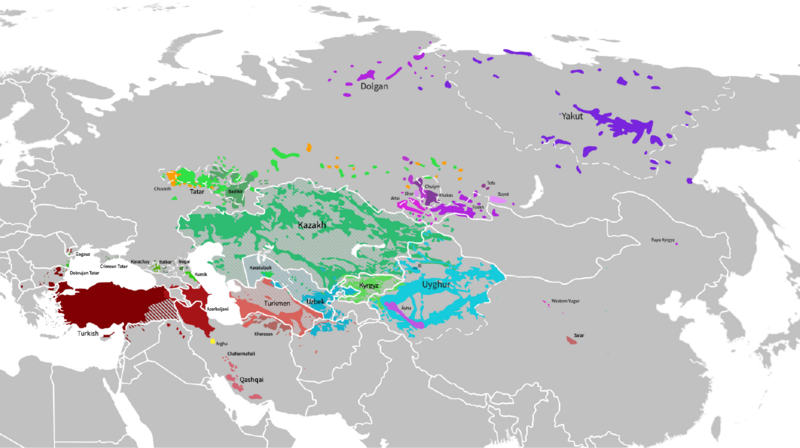
Turkic peoples
family of ethnic groups of Eurasia
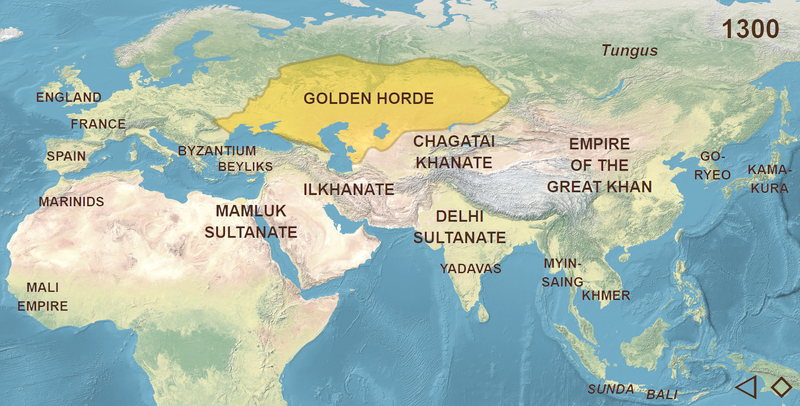
Golden Horde
medieval state in Eurasia

Kushan Empire
empire in Central and South Asia (30–375 AD)

Kyrgyz people
Turkic ethnic group native to Central Asia, primarily Kyrgyzstan

Bashkir people
The Bashkirs ( , ) or Bashkorts (, ; , ) are a Turkic ethnic group indigenous to Russia. They are concentrated in Bashkortostan, a republic of the Russian Federation and in the broader historical region of Badzhgard, which spans both sides of the Ural Mountains, where Eastern Europe meets North Asia. Smaller communities of Bashkirs also live in the Republic of Tatarstan, Perm Krai the oblasts of Chelyabinsk, Orenburg, Tyumen, Sverdlovsk, Kurgan and other regions in Russia; sizeable minorities exist in Kazakhstan.
.jpg)
Turkmens
Turkmens (, , , ) are a Turkic ethnic group native to Central Asia, living mainly in Turkmenistan, northern and northeastern regions of Iran and north-western Afghanistan. Sizeable groups of Turkmens are found also in Uzbekistan, Kazakhstan, and the North Caucasus (Stavropol Krai). They speak the Turkmen language, which is classified as a part of the Eastern Oghuz branch of the Turkic languages.

Alans
The Alans () were an ancient and medieval Iranic nomadic pastoral people who migrated to what is today the North Caucasus; some continued on to Europe and later North Africa. They are generally regarded as part of the Sarmatians, and possibly related to the Massagetae. Modern historians have connected the Alans with the Central Asian Yancai of Chinese sources and with the Aorsi of Roman sources. Having migrated westwards and becoming dominant among the Sarmatians on the Pontic–Caspian steppe, the Alans are mentioned by Roman sources in the . At that time they had settled in the region north of

Bedoui
thumb|alt=Bedouins in Sinai, 1967|Bedouins in the Sinai Peninsula|Sinai Region, 1967

Yakuts
The Yakuts or Sakha (, ; , ) are a Turkic ethnic group native to North Siberia, primarily the Republic of Sakha (Yakutia) in the Russian Federation. They also inhabit some districts of the Krasnoyarsk Krai. They speak Yakut, which belongs to the Siberian branch of the Turkic languages.

Chagatai
extinct Turkic language of Central Asia

Pechenegs
The Pechenegs () or Patzinaks, also known as Pecheneg Turks,'''''' were a semi-nomadic Turkic people from Central Asia who spoke the Pecheneg language. In the 9th and 10th centuries, the Pechenegs controlled much of the steppes of southeast Europe and the Crimean Peninsula. In the 9th century, the Pechenegs began a period of wars against Rus', and for more than two centuries launched raids into the lands of Rus', which sometimes escalated into full-scale wars.

Cumans
The Cumans or Kumans were a Turkic nomadic people from Central Asia comprising the western branch of the Cuman–Kipchak confederation who spoke the Cuman language. They are referred to as Polovtsians (Polovtsy) in Rus' chronicles, as "Cumans" in Western sources, and as "Kipchaks" in Eastern sources.

Tuvans
The Tuvans (from Russian ) or Tyvans (from Tuvan ) are a Turkic ethnic group indigenous to Siberia that live in Tuva, Mongolia, and China. They speak the Tuvan language, a Siberian Turkic language. In Mongolia, they are regarded as one of the Uriankhai peoples. In China, they are considered Mongols, even though Tuvans are Turkic, not Mongolic.

Chukchis
ethnic group
.jpg)
Hephthalites
The Hephthalites or Ephthalites (), sometimes called the White Huns (also known as the White Hunas, in Iranian as the Spet Xyon and in Sanskrit and Prakrit as the Sveta-huna), were a people who lived in Central Asia during the 5th to 8th centuries CE, part of the larger group of Eastern Iranian Huns. They formed an empire, the Imperial Hephthalites, and were militarily important from 450 CE, when they defeated the Kidarites, to 560 CE, when combined forces from the First Turkic Khaganate and the Sasanian Empire defeated them. After 560 CE, they established "principalities" in the area of Tokha

Komi people
ethnic group
%20kvinner%20og%20barn%20foran%20inngangen%20til%20teltet%20sitt.%20(6435260555).jpg)
Nenets
The Nenets (; ), in the past also called 'Samoyeds' or 'Yuraks', are a Samoyedic ethnic group native to the Russian Arctic, in the Russian Far North. According to the latest census in 2021, there were 49,646 Nenets in the Russian Federation, most of them living in the Yamalo-Nenets Autonomous Okrug, Nenets Autonomous Okrug and Taymyrsky Dolgano-Nenetsky District stretching along the coastline of the Arctic Ocean near the Arctic Circle between Kola and Taymyr peninsulas. The Nenets people speak either the Tundra or Forest Nenets languages. In the Russian Federation they have a status of Indigen

Khitan people
nomadic people originally from Mongolia and Manchuria

Mansi people
ethnic group
.jpg)
Saka
thumb|200px|Cataphract-style parade-armour of a Saka royal, also known as "The Golden Warrior", from the [[Issyk kurgan, a historical burial site near Almaty, Kazakhstan, 400–200 BC.]]

Liao dynasty
Khitan imperial dynasty in East Asia (916-1125), controlling northern and northeastern China, Mongolia, Russian Far East and North Korea

Khanty people
thumb|200px|right|Khanty family standing in front of a chum (tent)|chum, their traditional tent
thumb|200px|Most Khanty people live in the Khanty–Mansi Autonomous Okrug in western [[Siberia]]
The Khanty (), also known in older literature as Ostyaks (), are a Ugric Indigenous people, living in Khanty–Mansi Autonomous Okrug, a region historically known as "Yugra" in Russia, together with the Mansi. In the autonomous okrug, the Khanty and Mansi languages are given co-official status with Russian. In the 2021 Census, 31,467 persons identified themselves as Khanty. Of those, 30,242 were resident in

Göktürks
The Göktürks (; ), also known as Türks, Celestial Turks or Blue Turks, were a Turkic people in medieval Inner Asia. The Göktürks, under the leadership of Bumin Qaghan (d. 552) and his sons, succeeded the Rouran Khaganate as the main power in the region and established the First Turkic Khaganate, one of several nomadic dynasties that would shape the future geolocation, culture, and dominant beliefs of Turkic peoples.

Massagetae
The Massagetae or Massageteans, also known as Sakā Tigraxaudā or Orthocorybantians, were an ancient Eastern Iranian Saka people who inhabited the steppes of Central Asia and were part of the wider Scythian cultures. The Massagetae rose to power between the 8th and 7th centuries BCE, expelling the Scythians out of Central Asia and into the Caucasian and Pontic Steppes, an event which was to have wide-reaching consequences. The Massagetae are most famous for their queen Tomyris and her alleged defeat and killing of Cyrus the Great, the founder of the Persian Achaemenid Empire.

Rouran Khaganate
state established by proto-Mongols, from the late 4th century until the middle 6th century

Dzungar Khanate
Oirat Mongolian Khanate based in Dzungaria from 1634–1758, referred as the Last great Nomadic empire
%20of%20Dast-i%20Qipchaq%22.%20Tabriz%20or%20Qavin%2C%20circa%201550.%20British%20Museum%2C%201948-10-9-056.jpg)
Kipchaks
thumb|A Safavid Iran|Safavid depiction of the [[Padishah (Emperor) of Dast-i Qipchaq ("Steppe of the Kipchaks"). Tabriz or Qavin, circa 1550. British Museum, Padishah (Emperor) of Dast-i Qipchaq, (1550). Possible portrait of Kazakh khan]]
thumb|The Cumania in Eurasia, 1200|alt=The Desht-i Kipchak in Eurasia, 1200

Proto-Indo-Europeans
The Proto-Indo-Europeans are a postulated prehistoric ethnolinguistic group of Eurasia who spoke Proto-Indo-European (PIE), the reconstructed common ancestor of the Indo-European language family.

Yuezhi
The Yuezhi were an ancient people first described in Chinese histories as nomadic pastoralists living in an arid grassland area in the western part of the modern Chinese province of Gansu, during the 1st millennium BC. After a major defeat at the hands of the Xiongnu in 176 BC, the Yuezhi split into two groups migrating in different directions: the Greater Yuezhi and Lesser Yuezhi. This started a complex domino effect that radiated in all directions and, in the process, set the course of history for much of Asia for centuries to come.

Koryaks
thumb|300px|Settlement of Koryaks in the Far Eastern Federal District by urban and rural settlements in %, 2010 census
Koryaks () are an Indigenous people of the Russian Far East who live immediately north of the Kamchatka Peninsula in Kamchatka Krai and inhabit the coastlands of the Bering Sea. The cultural borders of the Koryaks include Tigilsk in the south and the Anadyr basin in the north.

Kurgan hypothesis
theory of Indo-European origin

Xianbei
The Xianbei (Mongolian:Сүнбэ; ; ) were an ancient nomadic people in northern East Asia who developed a distinct cultural and political identity by the 1st century BC. They inhabited regions spanning parts of present-day northeastern China, Inner Mongolia, and the eastern Eurasian steppe. Several Xianbei groups formed ruling regimes, with early political center around present-day Datong in Shanxi. The Xianbei were likely not of a single ethnicity, but rather a multilingual, multi-ethnic confederation consisting of mainly Proto-Mongols (who spoke either pre-Proto-Mongolic, or Para-Mongolic langu

Karluks
The Karluks (also Qarluqs, Qarluks, Karluqs, , Qarluq, Para-Mongol: Harluut, Géluólù ; customary phonetic: Gelu, Khololo, Khorlo, , Khallokh, Qarluq) were a prominent nomadic Turkic tribal confederacy residing in the regions of Kara-Irtysh (Black Irtysh) and the Tarbagatai Mountains west of the Altay Mountains in Central Asia around the 5th-8th centuries, CE.
Pontic-Caspian steppe
ecoregion of grasslands that encompass most of the western segment of the Eurasian steppe
Yukaghir people
ethnic group
Afanasevo culture
archaeological culture
Western Turkic Khaganate
former Khaganate
horde
nomad tribal confederation, particularly those of the Mongols and Turks
Merkit people
The Merkit (; ; ) was one of the five major tribal confederations of Mongol or Turkic origin in the 12th-century Mongolian Plateau.
Irish Travellers
traditionally nomadic people of ethnic Irish origin

tamga
thumb|Tamgha of the Bayundur, which represents a [[falcon according to Mahmud al-Kashgari]]
A tamga, or tamgha (from ), was an abstract seal or brand used by Eurasian nomads and cultures influenced by them, initially as a livestock branding. The tamga was used as a livestock branding for a particular tribe, clan or family. They were common among the Eurasian nomads throughout Classical Antiquity and the Middle Ages. As clan and family identifiers, the collection and systematic comparison of tamgas is regarded to provide insights into relations between families, individuals and ethnic groups in

Wusun
The Wusun ( ) were an ancient semi-nomadic steppe people mentioned in Chinese records from the 2nd century BC to the 5th century AD.

Roxolani
thumb|upright=1.5|The Roman empire under Hadrian (ruled 117–138), showing the location of the Roxolani Sarmatians in the [[Wallachian plain (Romania)]]
The Roxolani or Rhoxolāni ( , ; ) were a Sarmatian people documented between the 2nd century BC and the 4th century AD, first east of the Borysthenes (Dnieper) on the coast of Lake Maeotis (Sea of Azov), and later near the borders of Roman Dacia and Moesia. They are believed to be an offshoot of the Alans.
Selkup people
people

Arkaim
Arkaim () is a fortified archaeological site, dated to 2150-1650 BCE, belonging to the Sintashta culture, situated in the steppe of the Southern Urals, north-northwest of the village of Amursky and east-southeast of the village of Alexandrovsky in the Chelyabinsk Oblast of Russia, just north of the border with Kazakhstan. It was discovered in 1987 by a team of archaeologists which later came under the leadership of Gennady Zdanovich. The realization of its importance unprecedentedly forestalled the planned flooding of the area for a reservoir. The construction of Arkaim is attributed to the ea

Indo-Iranians
thumb|Map displaying the origins of the Proto-Indo-Iranian (Ā́rya/Aryan) Sintashta culture as a migration of peoples from the Bronze Age European [[Corded Ware culture through the Fatyanovo-Balanovo culture]]
thumb|The Sintashta-Petrovka culture (red) expanded into the [[Andronovo culture (orange) in the 2nd millennium BC, overlapping the Oxus civilization (green) in the south; it includes the area of the earliest chariots (pink).]]
White Horde
Mongol horde of the 13th-15th century, controlling the eastern territory of the Golden Horde
Ashina
Turkic royal clan
Pazyryk culture
archaeological civilization of nomad horsemen called Pazyryk

Moken people
thumb|300px|Regions inhabited by peoples usually known as "Sea Nomads".
The Moken (also Mawken or Morgan; ; ) are an Austronesian people of the Mergui Archipelago, a group of approximately 800 islands claimed by both Myanmar and Thailand, and the Surin Islands. Most of the Moken live a semi-nomadic hunter-gatherer lifestyle heavily based on the sea, though this lifestyle is increasingly under threat.
.png)
Kumandins
thumb|Primarily region of the Kumandins in Siberia.
Indo-Aryan migrations
theory of migrations of Indo-Aryan peoples into the Indian subcontinent

Drangiana Satrapy
thumb|upright=.5|
Drangiana or Zarangiana (, Drangianē; also attested in Old Western Iranian as 𐏀𐎼𐎣, Zraka or Zranka, was a historical region and administrative division of the Achaemenid Empire. This region comprised territory around Hamun Lake, wetlands in endorheic Sistan Basin on the Iran-Afghan border, and its primary watershed Helmand river in what is nowadays southwestern region of Afghanistan. The historic Drangiana roughly corresponds with the modern Sistan region.
Blue Horde
Mongol horde of the 13th-14th centuries, controlling the western territories of the Golden Horde