Category
page 1Periodic table

Periodic table
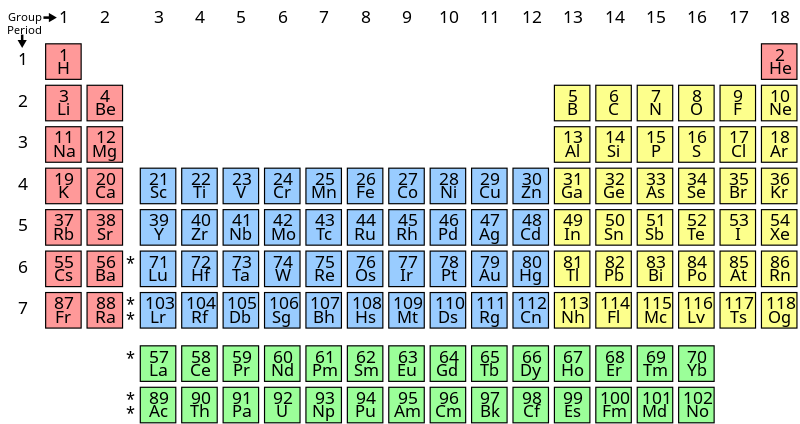
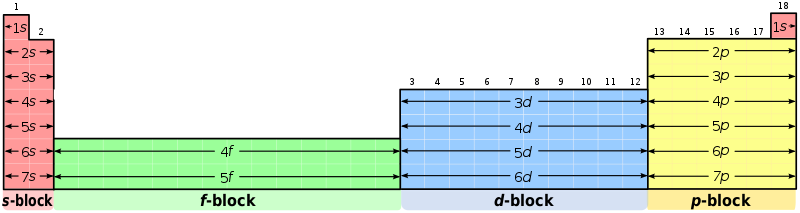
The periodic table, also known as the periodic table of the elements, is an ordered arrangement of the chemical elements into rows ("periods") and columns ("groups"). An icon of chemistry, the periodic table is widely used in physics and other sciences. It is a depiction of the periodic law, which states that when the elements are arranged in order of their atomic numbers an approximate recurrence of their properties is evident. The table is divided into four roughly rectangular areas called blocks. Elements in the same group tend to show similar chemical characteristics.

alkali metal
group of chemical elements

alkaline earth metal
group of chemical elements

lanthanide
A lanthanide () is any of the 15 metallic chemical elements with atomic numbers 57–71, from lanthanum through lutetium.
In the periodic table, the first fourteen (up to ytterbium) fill the 4f orbitals. Lutetium (element 71) is also often considered a lanthanide, despite being a d-block element and a transition metal. The IUPAC lists the 15 elements La, Ce, Pr, Nd, Pm, Sm, Eu, Gd, Tb, Dy, Ho, Er, Tm, Yb, Lu, under the collective name lanthanoid (), which it recommends as chemically more correct for this series.

nonmetal
{| style="float:right; margin-left:2.5em; margin-bottom:1.2em; font-size:95%; max-width: 450px; border:1px solid grey"
| style=text-align:center|A periodic table extract
|-
| 450px| alt=A grid with 7 rows labeled periods "1" to "7" and 10 columns labeled as groups "1", "2", "3–11", and "12" to "18".
¶ Most cells represent one chemical element and are labeled with its 1 or 2 letter symbol in a large font above its name. Cells in column 3 (labeled "3–11") represent a series of elements and are labeled with the first and last element's symbol.
¶ Row 1 has cells in the first and last columns, wi

actinide
The actinide () or actinoid () series encompasses at least the 14 metallic chemical elements in the 5f series, with atomic numbers from 89 to 102, actinium through nobelium. Number 103, lawrencium, is also generally included despite being part of the 6d transition series. The actinide series derives its name from the first element in the series, actinium. The informal chemical symbol An is used in general discussions of actinide chemistry to refer to any actinide.

metalloid
The word metalloid comes from the Latin metallum ("metal") and the Greek oeidḗs ("resembling in form or appearance"). However, there is no standard definition of a metalloid and no complete agreement on which elements are metalloids. Despite the lack of specificity, the term remains in use in the literature.
transition metal
series of chemical elements
period
row in the periodic table: repetition of properties in chemical elements when ordered by atomic number:
group
set of chemical elements with common periodic properties, appearing as column in the periodic table
.png)
group 16
{| class="floatright"
! colspan=2 style="text-align:left;" | ↓ Period
|-
| 2
|
|-
! 3
|
|-
! 4
|
|-
! 5
|
|-
! 6
|
|-
! 7
|
|-
| colspan="2"|
----
Legend
{| style="text-align:center; border:0; margin: 0 auto"
|-
| style="border:; background:;" | primordial element
|-
| style="border:; background:; padding:0 2px;" | naturally occurring by radioactive decay
|-
| style="border:; background:;" | synthetic element
|}
|}

group 15
{| class="floatright"
! colspan=2 style="text-align:left;" | ↓ Period
|-
! 2
|
|-
! 3
|
|-
! 4
|
|-
! 5
|
|-
! 6
|
|-
! 7
|
|-
| colspan="2"|
----
Legend
{| style="text-align:center; border:0; margin: 0 auto"
|-
| style="border:; background:; padding:0 2px;" | primordial element
|-
| style="border:; background:; padding:0 2px;" | synthetic element
|-
| Atomic number color:red=gas, black=solid
|}
|}
block
a set of elements in the periodic table of elements, defined by shape of an orbital—s, p, d, or f—where the valence electron lies

group 13
group of chemical elements

plum pudding model
scientific model of the atom first proposed by J. J. Thomson in 1904
relative atomic mass
dimensionless physical quantity: ratio of the average mass of atoms of an element to one unified atomic mass unit
extended periodic table
refers to the extension on the periodic table beyond its current 7 periods including additional periods
island of stability
region of the chart of the nuclides containing isotopes of super-heavy elements theorized to be much more stable than others
magic number
number of protons or neutrons that make a nucleus particularly stable
systematic element name
temporary name assigned to newly synthesized or not yet synthesized chemical elements
Goldschmidt classification
geochemical classification grouping the chemical elements according to their preferred host phases
history of the periodic table
history of the periodic table of the elements
Alternative periodic tables
tabulations of chemical elements differing from the traditional layout of the periodic system
standard atomic weight
relative atomic mass, in samples by standard, as published by IUPAC (CIAAW)
diagonal relationship
relationship between elements on the periodic table
list of places used in the names of chemical elements
Wikimedia list article
Whole number rule
Physical law for the masses of isotopes
dividing line between metals and nonmetals
Feature of some periodic tables of the elements
periodic table
electron configurations of the neutral gaseous atoms in the ground state
IUPAC/IUPAP Joint Working Party
Group which considers claims for discovery and naming of new chemical elements
Chemical elements in East Asian languages
chemical element nomenclature in East Asia
Actinide concept
Proposal of a a a second inner transition series in the periodic table