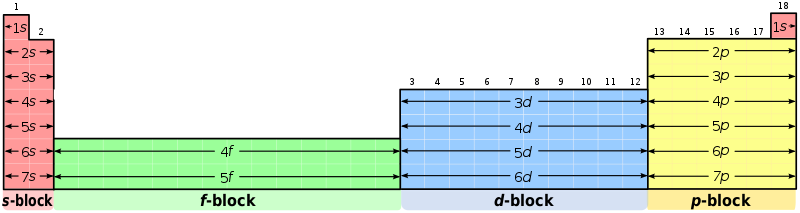
File:Periodic_table_blocks_spdf_(32_column).svg · Wikimedia Commons · See Wikimedia Commons
block
Sign in to savea set of elements in the periodic table of elements, defined by shape of an orbital—s, p, d, or f—where the valence electron lies
A block is a group of elements on the periodic table organized by the shape of the outermost electron's orbital around the nucleus. This organization matters because elements in the same block tend to have similar chemical properties and behavior, making it easier to predict how they'll react with other elements.
AI-generated from the Wikipedia summary — may contain errors.
Wikidata facts
- Subclass of
- categorization
- Part of
- Periodic table
- Image
- Periodic table blocks spdf (32 column).svg
Show 1 more fact
- topic's main category
- Category:Blocks in the periodic table
via Wikidata · CC0
~13 min read
Encyclopedic overview
Blocks s, f, d, and p in the periodic table
A block of the periodic table is a set of elements unified by the atomic orbitals their valence electrons or vacancies lie in. The term seems to have been first used by Charles Janet. Each block is named after its characteristic orbital: s-block, p-block, d-block, f-block and g-block.
Excerpted from Wikipedia’s “block” article, available under the CC BY-SA 4.0 licence.
Gallery (5)
Available in 62 languages
- Español
- Français
- Deutsch
- 中文
- 日本語
- Русский
- Português
- Italiano
- العربية
- हिन्दी
- Afrikaans
- Aragonese
- Armenian
- Asturian
- Azerbaijani
- Bahasa Indonesia
- Balinese
- Bangla
Show 43 more
- Basque
- Bosnian
- Breton
- Bulgarian
- Catalan
- Croatian
- Czech
- Danish
- Esperanto
- Finnish
- Galician
- Greek
- Hebrew
- Icelandic
- Inari Sami
- Interlingua
- Javanese
- Latin
- Lombard
- Macedonian
- Malay
- Nederlands
- Norwegian
- Norwegian Nynorsk
- Romanian
- Serbian
- Serbian (Latin)
- simple
- Sinhala
- Slovak
- Slovenian
- Svenska
- Tamil
- Telugu
- Tiếng Việt
- Türkçe
- Ukrainian
- West Flemish
- Western Frisian
- zh_yue
- فارسی
- ไทย
- 한국어
via Wikidata sitelinks · CC0