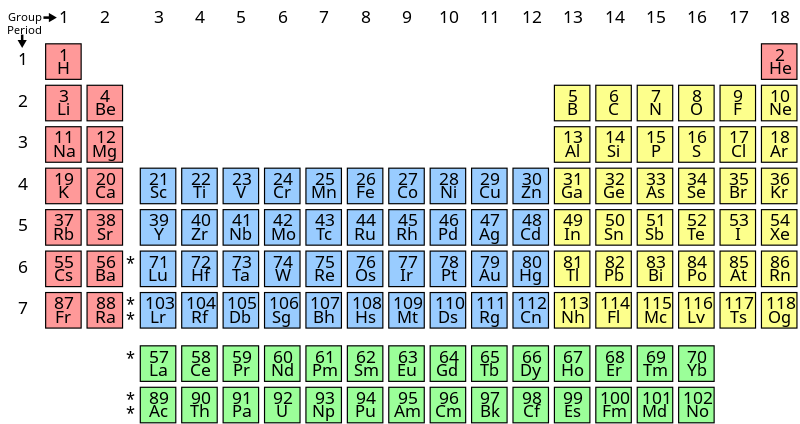
File:Simple_Periodic_Table_Chart-blocks.svg · Wikimedia Commons · See Wikimedia Commons
metalloid
Sign in to saveAlso known as semimetal, metalloids
The word metalloid comes from the Latin metallum ("metal") and the Greek oeidḗs ("resembling in form or appearance"). However, there is no standard definition of a metalloid and no complete agreement on which elements are metalloids. Despite the lack of specificity, the term remains in use in the literature.
A metalloid is an element that has properties resembling those of metals, though the term lacks a precise scientific definition and experts don't agree on which elements qualify as metalloids. Despite this uncertainty, scientists continue to use the term in their work and publications.
AI-generated from the Wikipedia summary — may contain errors.
Research
59,303 papers- Metalloid transporters and their regulation in plants.ReviewPlant physiology · 2021Yamaji N, Ma JFDOI: 10.1093/plphys/kiab326
- Aquaporin-mediated transport: Insights into metalloid trafficking.ReviewPhysiologia plantarum · 2022Handa N, Gupta P, Khanna K et al.DOI: 10.1111/ppl.13687
- Polyamines: Rising stars against metal and metalloid toxicity.ReviewPlant physiology and biochemistry : PPB · 2024Gupta S, Kant K, Kaur N et al.DOI: 10.1016/j.plaphy.2024.109030
- Versatile Reactivity of Metalloid-Substituted π-Allylpalladium Species.ReviewChemical record (New York, N.Y.) · 2021Horino Y, Korenaga TDOI: 10.1002/tcr.202100203
- Metal/Metalloid Levels in Electronic Cigarette Liquids, Aerosols, and Human Biosamples: A Systematic Review.Environmental health perspectives · 2020Zhao D, Aravindakshan A, Hilpert M et al.DOI: 10.1289/EHP5686
- Inorganometallics (Transition Metal-Metalloid Complexes) and Catalysis.ReviewChemical reviews · 2022Marciniec B, Pietraszuk C, Pawluć P et al.DOI: 10.1021/acs.chemrev.1c00417
- Heavy metal and metalloid - induced reproductive toxicity.ReviewEnvironmental toxicology and pharmacology · 2022Goutam Mukherjee A, Ramesh Wanjari U, Renu K et al.DOI: 10.1016/j.etap.2022.103859
- Metal- and metalloid-based compounds to target and reverse cancer multidrug resistance.ReviewDrug resistance updates : reviews and commentaries in antimicrobial and anticancer chemotherapy · 2021Valente A, Podolski-Renić A, Poetsch I et al.DOI: 10.1016/j.drup.2021.100778
via PubMed
Wikidata facts
- Subclass of
- chemical element
- Image
- Polycrystalline-germanium.jpg
Show 4 more facts
- Commons category
- Metalloids
- topic's main category
- Category:Metalloids
- different from
- semimetal
- on focus list of Wikimedia project
- Wikipedia:Vital articles/Level/4
Sources (3)
via Wikidata · CC0
~144 min read
Encyclopedic overview
44 sectionsContents
- Definitions
- Judgment-based
- Criteria-based
- Periodic table territory
- Location
- Alternative treatments
- Properties
- Compared to metals and nonmetals
- Common applications
- Alloys
- Biological agents
- Catalysts
- Flame retardants
- Glass formation
- Optical storage and optoelectronics
- Pyrotechnics
- Semiconductors and electronics
- Nomenclature and history
- Derivation and other names
- Origin and usage
- Elements commonly recognised as metalloids
- Boron
- Silicon
- Germanium
- Arsenic
- Antimony
- Tellurium
- Elements less commonly recognised as metalloids
- Carbon
- Aluminium
- Selenium
- Polonium
- Astatine
- Related concepts
- Near metalloids
- Allotropes
- Abundance, extraction, and cost
- Abundance
- Extraction
- Cost
- Notes
- References
- Sources
- Further reading
The word metalloid comes from the Latin metallum ("metal") and the Greek oeidḗs ("resembling in form or appearance"). However, there is no standard definition of a metalloid and no complete agreement on which elements are metalloids. Despite the lack of specificity, the term remains in use in the literature.
The six commonly recognised metalloids are boron, silicon, germanium, arsenic, antimony and tellurium. Five elements are less frequently so classified: carbon, aluminium, selenium, polonium and astatine. On a standard periodic table, all eleven elements are in a diagonal region of the p-block extending from boron at the upper left to astatine at lower right. Some periodic tables include a dividing line between metals and nonmetals, and the metalloids may be found close to this line.
Excerpted from Wikipedia’s “metalloid” article, available under the CC BY-SA 4.0 licence.
Gallery (44)
Available in 98 languages
- Español
- Français
- Deutsch
- 中文
- 日本語
- Русский
- Português
- Italiano
- العربية
- हिन्दी
- Afrikaans
- Albanian
- Aragonese
- Asturian
- Azerbaijani
- Bahasa Indonesia
- Bangla
- Basque
Show 79 more
- be_x_old
- Belarusian
- Bosnian
- Bulgarian
- Burmese
- Catalan
- cdo
- Chuvash
- Croatian
- Czech
- Danish
- Esperanto
- Estonian
- Fiji Hindi
- Finnish
- Galician
- Greek
- Guarani
- Gujarati
- Haitian Creole
- Hakka Chinese
- Hebrew
- Hungarian
- Icelandic
- Ido
- Interlingua
- Irish
- Javanese
- Kabyle
- Kannada
- Kyrgyz
- Latin
- Latvian
- Limburgish
- Lithuanian
- Lombard
- Low German
- Luxembourgish
- Macedonian
- Madurese
- Malay
- Malayalam
- Nederlands
- Northern Frisian
- Norwegian
- Norwegian Nynorsk
- Occitan
- olo
- Oromo
- Ossetic
- Polski
- Punjabi
- Quechua
- Romanian
- Scots
- Serbian
- Serbian (Latin)
- simple
- Slovak
- Slovenian
- Somali
- Svenska
- Tamil
- Tiếng Việt
- Tulu
- Türkçe
- Ukrainian
- Waray
- Welsh
- Wu Chinese
- Yakut
- Yiddish
- Yoruba
- zh_classical
- zh_min_nan
- zh_yue
- فارسی
- ไทย
- 한국어
via Wikidata sitelinks · CC0