Category
page 1Phylogenetics

Wikispecies
Wikispecies is a wiki-based online project supported by the Wikimedia Foundation. Its aim is to create a comprehensive open content catalog of all species; the project is directed at scientists, rather than at the general public. Jimmy Wales stated that editors are not required to fax in their degrees, but that submissions will have to pass muster with a technical audience. Wikispecies is available under the GNU Free Documentation License and CC BY-SA 4.0.

phylogenetics
right|thumb|One small clade of fish, showing how venom has evolved multiple times.

clade
thumb|400px| Cladogram (a branching tree diagram) illustrating the relationships of organisms within groups of taxa known as clades. The vertical line (stem) at the base (bottom) represents the [[last common ancestor. The blue and red subgroups are clades, each defined by a common ancestor stem at the base of its respective subgroup (branch). The green subgroup alone, however, is not a clade; it is a paraphyletic group relative to the blue subgroup because it excludes the blue branch, which shares the same common ancestor. Together, the green and blue subgroups form a clade.]]

cladistics
Cladistics ( ; from Ancient Greek 'branch') is an approach to biological classification in which organisms are categorized in groups ("clades") based on hypotheses of most recent common ancestry. The evidence for hypothesized relationships is typically shared derived characteristics (synapomorphies) that are not present in more distant groups and ancestors. However, from an empirical perspective, common ancestors are inferences based on a cladistic hypothesis of relationships of taxa whose character states can be observed. Theoretically, a last common ancestor and all its descendants constitut

Encyclopedia of Life
collaborative project intended to create an encyclopedia documenting all living species known to science
paraphyly
thumb|300px|In this phylogenetic tree, the green group is paraphyletic; it is composed of a common ancestor (the lowest green vertical stem) and some of its descendants, but it excludes the blue group (a monophyletic group) which diverged from the green group.
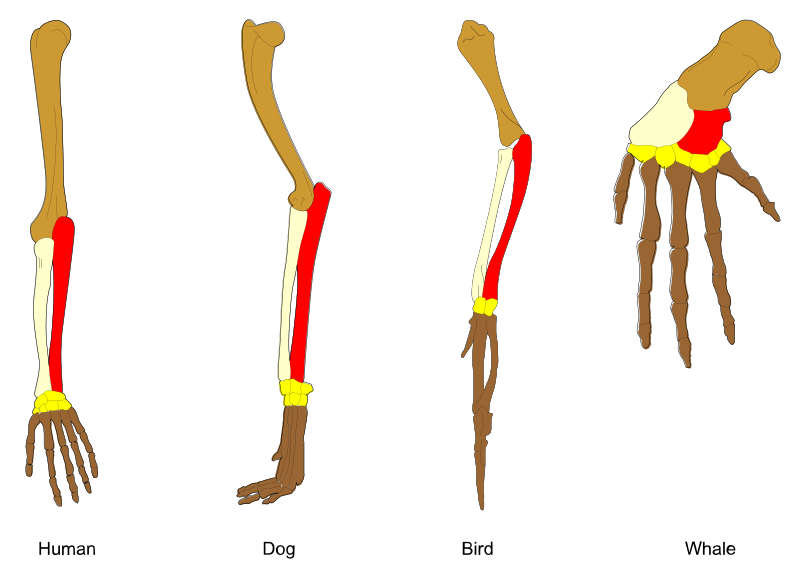
homology
existence of shared ancestry between a pair of structures, or genes, in different taxa
monophyly
thumb|300x300px|A phylogenetic tree: both blue and red groups are monophyletic. The green group is paraphyletic: it is missing a monophyletic subgroup – the blue group – that shares a common ancestor with itself. In this form, monophyletic means "no sideways stems leaving the group".
thumb|300px|A cladogram of the primates, showing a monophyletic taxon: the [[simians (in yellow); a paraphyletic taxon: the prosimians (in cyan, including the red patch); and a polyphyletic group: the night-active primates, i.e., the lorises and the tarsiers (in red).]]
thumbnail|300px|A cladogram of the vertebrat

haplogroup
A haplotype is a group of alleles in an organism that are inherited together from a single parent, and a haplogroup (haploid from the , haploûs, "onefold, simple" and ) is a group of similar haplotypes that share a common ancestor with a single-nucleotide polymorphism mutation. More specifically, a haplotype is a combination of alleles at different chromosomal regions that are closely linked and tend to be inherited together. As a haplogroup consists of similar haplotypes, it is usually possible to predict a haplogroup from haplotypes. Haplogroups pertain to a single line of descent. Such as t
polyphyly
thumb|300px|In this phylogenetic tree, the blue and red groups (which are both monophyletic) do not share an immediate common ancestor. If they are grouped together because they share characteristics which appear to be similar, then their combination forms a polyphyletic group.
thumb|300px|Cladogram of the [[primates, showing a monophyly (the simians, in yellow), a paraphyly (the prosimians, in cyan, including the red patch), and a polyphyly (the night-active primates, the lorises and the tarsiers, in red).]]
thumbnail|300px|Phylogenetic groups: A monophyletic taxon (in yellow, the clade Sauro

phylogenetic tree
branching diagram of evolutionary relationships between organisms
last universal common ancestor
most recent common ancestor of all current life on Earth
Catalogue of Life
online database of taxa
molecular clock
technique to deduce the time in prehistory when two or more life forms diverged
transitional fossil
fossilized remains of a life form that exhibits traits common to both an ancestral group and its derived descendant group
sister group
closest relative(s) of another given taxon in a phylogenetic tree
most recent common ancestor
most recent individual from which all organisms in a group are directly descended

cladogram
thumb|250px|A horizontal cladogram, with the root to the left
thumb|250px|Two vertical cladograms, the root at the bottom
molecular phylogenetics
branch of phylogeny that analyzes genetic, hereditary molecular differences
Lazarus taxon
taxon that disappears for one or more periods from the fossil record, only to appear again later;likewise in conservation biology and ecology, it can refer to species or populations that were thought to be extinct, and are rediscovered
.png)
Cetruminantia
The Cetruminantia are a clade made up of the Cetancodontamorpha (or Whippomorpha) and their closest living relatives, the Ruminantia.
crown group
monophyletic closure of a set of living species
Neomura
Neomura (from Ancient Greek neo- "new", and Latin -murus "wall") is a proposed clade of life composed of the two domains Archaea and Eukaryota, coined by Thomas Cavalier-Smith in 2002. Its name reflects the hypothesis that both archaea and eukaryotes evolved out of the domain Bacteria, and one of the major changes was the replacement of the bacterial peptidoglycan cell walls with other glycoproteins.
synapomorphy
heritable trait shared by two or more taxa and thus thought to have evolved in their most recent common ancestor
genetic distance
measure between populations of divergence

cladogenesis
thumb|right|260px|An example of cladogenesis today is the Hawaiian Islands|Hawaiian archipelago, to which stray organisms traveled across the ocean via ocean currents and winds. Most of the species on the islands are not found anywhere else on Earth due to evolutionary divergence.

phylogenesis
thumb|right|250px|Phylogenetic divergence (phyletic gradualism) (above) shows relatively slow changes during geologic epoch: the broken balance (below) illustrates morphological stability and (rarely) the relatively rapid evolutionary change.
basal clade
root of a phylogenetic tree

Toxicofera
Toxicofera (Latin for "toxin-bearers") is a clade of scaled reptiles (squamates) that includes the Serpentes (snakes), Anguimorpha (monitor lizards, beaded lizards, and alligator lizards) and Iguania (iguanas, agamas, and chameleons). Toxicofera contains about 4,600 species (nearly 60%) of extant Squamata. It encompasses all venomous reptile species, as well as numerous related non-venomous species. There is little morphological evidence to support this grouping; however, it has been recovered by all molecular analyses as of 2012.

homoplasy
Homoplasy, in biology and phylogenetics, is the term used to describe a feature that has been gained or lost independently in separate lineages over the course of evolution. This is different from homology, which is the term used to characterize the similarity of features that can be parsimoniously explained by common ancestry. Homoplasy can arise from both similar selection pressures acting on adapting species, and the effects of genetic drift. thumb|Homoplasy is the similarity in a feature that is not parsimoniously explained by descent from a common ancestor.
gene family
set of several similar genes
lineage
sequence of species that form a line of descent
Artiofabula
Artiofabula is a clade made up of the Suina and the Cetruminantia. The clade was found in molecular phylogenetic analyses and contradicted traditional relationships based on morphological analyses.
Cetancodontamorpha
Cetancodontamorpha is a total clade of artiodactyls defined, according to Spaulding et al., as Whippomorpha "plus all extinct taxa more closely related to extant members of Whippomorpha than to any other living species".
phylogenetic nomenclature
phylogenetic method in taxonomy
evolutionary taxonomy
branch of biological classification

autapomorphy
thumb|279px|Phylogenies showing the terminology used to describe different patterns of ancestral and derived character or trait states (such as the evolution of a [[flatfish).]]
In phylogenetics, an autapomorphy is a distinctive feature, known as a derived trait, that is unique to a given taxon. That is, it is found only in one taxon, but not found in any others or outgroup taxa, not even those most closely related to the focal taxon (which may be a species, family or in general any clade). It can therefore be considered as an apomorphy in relation to a single taxon. The word autapomorphy, int
symplesiomorphy
ancestral character or trait state (plesiomorphy) shared by two or more taxa

chronospecies
thumb|In palaeontology, the evidence for [[species and evolution comes mainly from the comparative anatomy of fossils. A chronospecies is defined in a single lineage (solid line) whose morphology changes with time. At some point, palaeontologists judge that enough change has occurred that two forms (A and B), separated in time and anatomy, once existed. If only sporadic examples of each survive in the fossil record, the forms will appear sharply distinct.]]
A chronospecies is a species derived from a sequential development pattern that involves continual and uniform changes from an extinct anc
sequence homology
biological homology between protein or DNA sequences resulting from shared evolutionary ancestry
Tree of Life Web Project
provides information about biodiversity, the characteristics of different groups of organisms, and their evolutionary history
alloenzyme
Alloenzymes (or also called allozymes) are variant forms of an enzyme which differ structurally but not functionally from other allozymes coded for by different alleles at the same locus. These are opposed to isozymes, which are enzymes that perform the same function, but which are coded by genes located at different loci.
outgroup
a more distantly related group of organisms that serves as a reference group when determining the evolutionary relationships of the ingroup, the set of organisms under study
Eocyte hypothesis
Hypothesis in evolutionary biology
neighbor joining
clustering method in bioinformatics
Long branch attraction
form of systematic error whereby distantly related lineages are incorrectly inferred to be closely related

UPGMA
UPGMA (unweighted pair group method with arithmetic mean) is a simple agglomerative (bottom-up) hierarchical clustering method. It also has a weighted variant, WPGMA, and they are generally attributed to Sokal and Michener.
Molecular Phylogenetics and Evolution
scientific journal
chemotaxonomy
Merriam-Webster defines chemotaxonomy as the method of biological classification based on similarities and dissimilarity in the structure of certain compounds among the organisms being classified. Advocates argue that, as proteins are more closely controlled by genes and less subjected to natural selection than the anatomical features, they are more reliable indicators of genetic relationships. The compounds studied most are proteins, amino acids, nucleic acids, peptides etc.

Articulata hypothesis
the grouping in a higher taxon of animals with segmented bodies, consisting of Annelida and Panarthropoda – this theory states that these groups are descended from a common segmented ancestor
maximum parsimony
optimality criterion under which the phylogenetic tree that minimizes the total number of character-state changes is to be preferred; under this criterion, the shortest possible tree that explains the data is considered best
first universal common ancestor
possible earliest ancestor of the LUCA ancestral cell
zombie taxon
type of fossil
ghost lineage
phylogenetic lineage that is inferred to exist but has no fossil record
ghost population
inferred statistical population
dichotomous key
method used for categorizing species using logical choices
deep homology
control of growth and differentiation by deeply conserved genetic mechanisms
Elvis taxon
taxon that seems to resemble another taxon that has disappeared from the fossil record
Template:Phylogenetics
Wikimedia template
phylogenomics
Phylogenomics is the intersection of the fields of evolution and genomics. The term has been used in multiple ways to refer to analysis that involves genome data and evolutionary reconstructions. It is a group of techniques within the larger fields of phylogenetics and genomics. Phylogenomics draws information by comparing entire genomes, or at least large portions of genomes. Phylogenetics compares and analyzes the sequences of single genes, or a small number of genes, as well as many other types of data. Four major areas fall under phylogenomics:
Prediction of gene function
Establishment a