File:Clade-grade_II.svg · Wikimedia Commons · See Wikimedia Commons
monophyly
Sign in to saveAlso known as monophyletic, monophyleticity, monophyletism
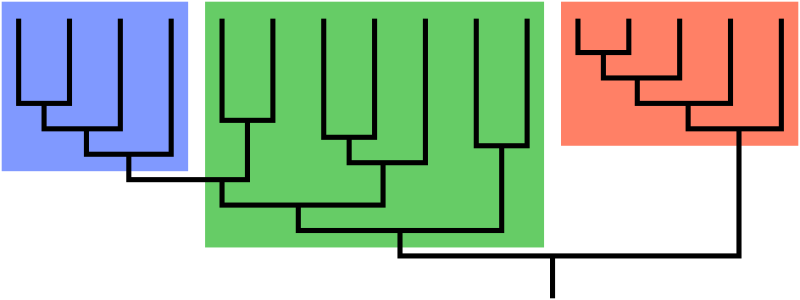
thumb|300x300px|A phylogenetic tree: both blue and red groups are monophyletic. The green group is paraphyletic: it is missing a monophyletic subgroup – the blue group – that shares a common ancestor with itself. In this form, monophyletic means "no sideways stems leaving the group". thumb|300px|A cladogram of the primates, showing a monophyletic taxon: the [[simians (in yellow); a paraphyletic taxon: the prosimians (in cyan, including the red patch); and a polyphyletic group: the night-active primates, i.e., the lorises and the tarsiers (in red).]] thumbnail|300px|A cladogram of the vertebrat
Wikidata facts
- Subclass of
- taxon
Show 5 more facts
- Commons category
- Monophyly
- facet of
- phylogenetics
- opposite of
- paraphyly
- described by source
- Azerbaijani Soviet Encyclopedia
- has characteristic
- most recent common ancestor
Sources (3)
via Wikidata · CC0
~6 min read
Encyclopedic overview
5 sectionsContents
- Etymology
- Definitions
- See also
- References
- External links
thumb|300x300px|A phylogenetic tree: both blue and red groups are monophyletic. The green group is paraphyletic: it is missing a monophyletic subgroup – the blue group – that shares a common ancestor with itself. In this form, monophyletic means "no sideways stems leaving the group". thumb|300px|A cladogram of the primates, showing a monophyletic taxon: the [[simians (in yellow); a paraphyletic taxon: the prosimians (in cyan, including the red patch); and a polyphyletic group: the night-active primates, i.e., the lorises and the tarsiers (in red).]] thumbnail|300px|A cladogram of the vertebrates showing phylogenetic groups. A monophyletic taxon (in yellow): the group of "reptiles and birds", contains its most recent common ancestor and all descendants of that ancestor. A paraphyletic taxon (in cyan): the group of reptiles, contains its most recent common ancestor, but does not contain all the descendants (namely Aves) of that ancestor. A polyphyletic "group" (in red): the group of all warm-blooded amniotes (Aves and Mammalia), does not contain the most recent common ancestor of all its members; this group is not seen as a taxonomic unit and is not considered a taxon by modern systematists.
In biological cladistics for the classification of organisms, monophyly is the condition of a taxonomic grouping being a clade – that is, a grouping of organisms which meets these criteria: the grouping contains its own most recent common ancestor (or more precisely an ancestral population), i.e. excludes non-descendants of that common ancestor the grouping contains all the descendants of that common ancestor, without exception
Excerpted from Wikipedia’s “monophyly” article, available under the CC BY-SA 4.0 licence.