Category
page 1Soviet inventions

artificial satellite
300px|thumb|upright=1.5|alt=Two 3U CubeSats|Two CubeSats orbiting around [[Earth after being deployed from the ISS Kibō module's Small Satellite Orbital Deployer]]
.jpg)
laser
thumb|upright=1.5|A telescope in the Very Large Telescope system producing four orange [[laser guide stars |alt=A telescope emitting four orange laser beams]]

postal code
series of letters and digits for sorting mail

space station
spacecraft designed to remain in space for an extended period with a crew

Tetris
Tetris () is a puzzle video game created by Alexey Pajitnov, a Soviet software engineer, in the mid-1980s. In Tetris, falling pieces consisting of four connected blocks, known as tetrominoes, must be sorted into a pile. Once a horizontal line of the playfield is filled with blocks, the line disappears, granting points and preventing the pile from reaching the top. This gameplay has been used in approximately 220 versions across at least 70 platforms. Newer versions frequently add game mechanics, some of which have become standard. , Tetris is the second-best-selling video game series, with ove

Sputnik 1
first artificial Earth satellite

intercontinental ballistic missile
ballistic missile with a range of more than 5,500 kilometres
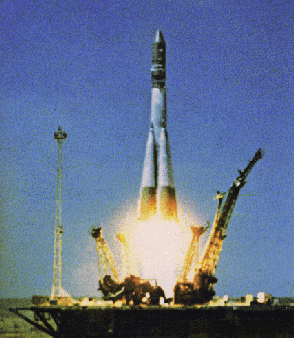
Vostok 1
spaceflight of the Vostok programme

Sputnik 2
Soviet artificial satellite that took the dog Laika to the space

Tsar Bomba
hydrogen aerial bomb tested in 1961 by the Soviet Union; most powerful nuclear weapon ever created

space suit
gas-tight protective suit for astronauts who are in the vacuum of space

tokamak
A tokamak (; ) is a machine which uses a powerful magnetic field generated by external magnets to confine plasma in the shape of an axially symmetrical torus. The tokamak is the leading candidate of magnetic confinement fusion designs being developed to produce controlled thermonuclear fusion power.

Katyusha
Soviet/Russian multiple launch rocket system

GLONASS
The Global Navigation Satellite System (), usually referred to by the acronym GLONASS (, ), is a Russian satellite navigation system operating as part of a radionavigation-satellite service. It provides an alternative to the Global Positioning System (GPS) and was the second navigational system in operation with global coverage and of comparable precision.
theremin
The theremin (; originally known as the ætherphone, etherphone, thereminophone or termenvox/thereminvox) is an electronic musical instrument controlled without physical contact by the performer (who is known as a thereminist). It is named after its inventor, Leon Theremin, who patented the device in 1928.

Buran
first and only operational spaceplane in the Soviet Buran programme

Proton
family of Soviet/Russian launch vehicles

gravity assist
space-navigation technique

novichok
Novichok () is a family of nerve agents, some of which are binary chemical weapons. The agents were developed at the GosNIIOKhT state chemical research institute by the Soviet Union and Russia between 1971 and 1993. Some Novichok agents are solids at standard temperature and pressure, while others are liquids. Dispersal of solid form agents is thought possible if in ultrafine powder state.
rocket-propelled grenade
man-portable weapon designed to attack tanks and armored targets firing an unguided rocket
lander
spacecraft which descends toward and comes to rest on the surface of an astronomical body

Salyut 1
first space station launched by the Soviet Union

7.62×39mm
The 7.62×39 mm (also called 7.62 Soviet, formerly .30 Russian Short) round is a rimless bottlenecked intermediate cartridge of Soviet origin. The cartridge is widely used due to the global proliferation of the AK-47 rifle and related Kalashnikov-pattern rifles, the SKS semi-automatic rifle, and the RPD/RPK light machine guns.
R-7 Semyorka
intercontinental ballistic missile

ground-effect vehicle
machine to fly in air just above sea or ground using air-surfice reaction
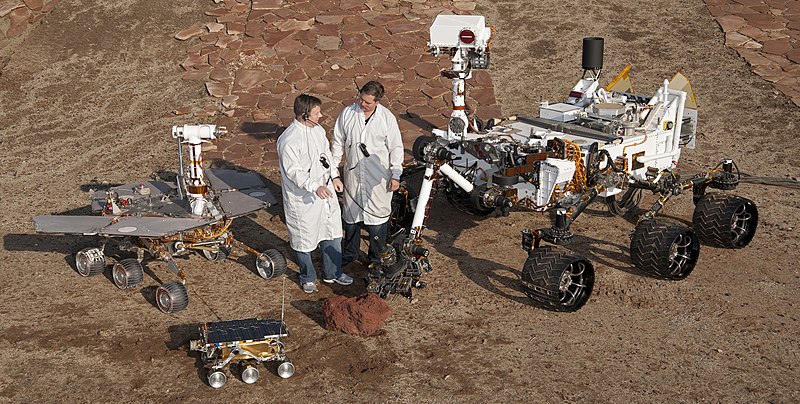
rover
space exploration vehicle designed to move across the surface of a planet or other celestial body
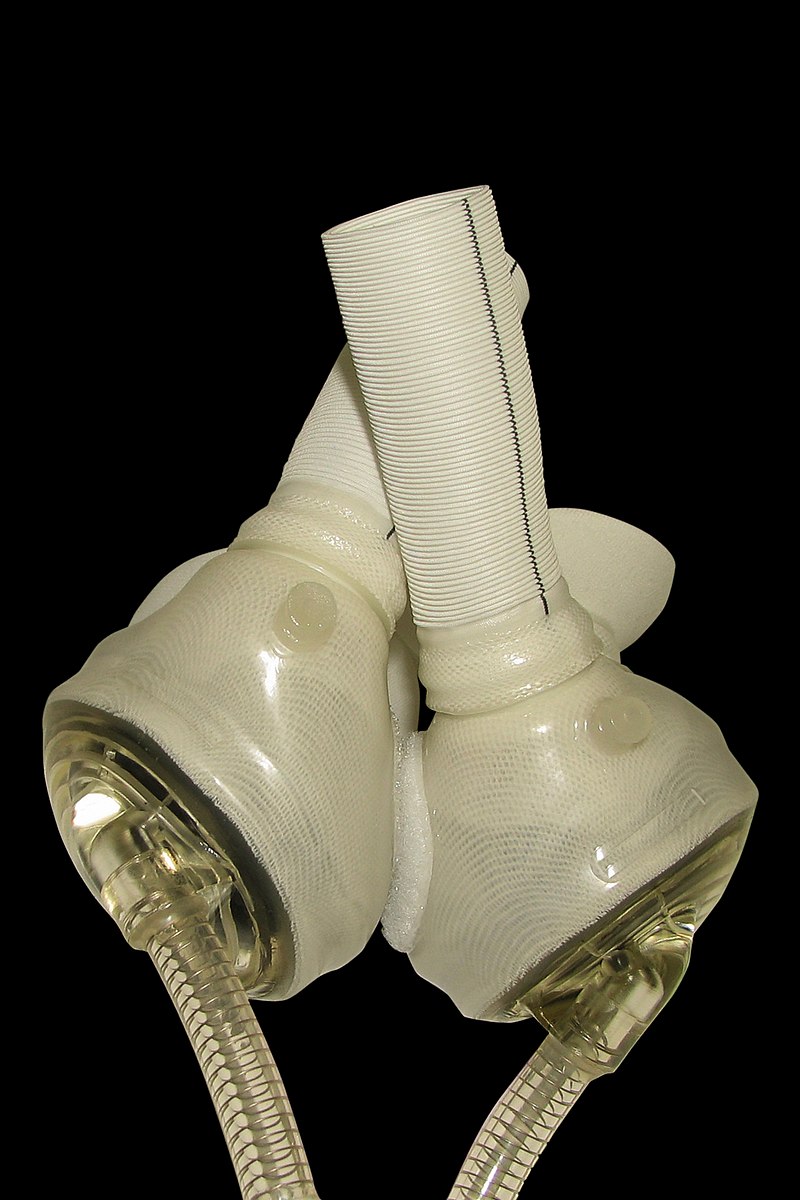
artificial heart
implanted medical device that pumps blood
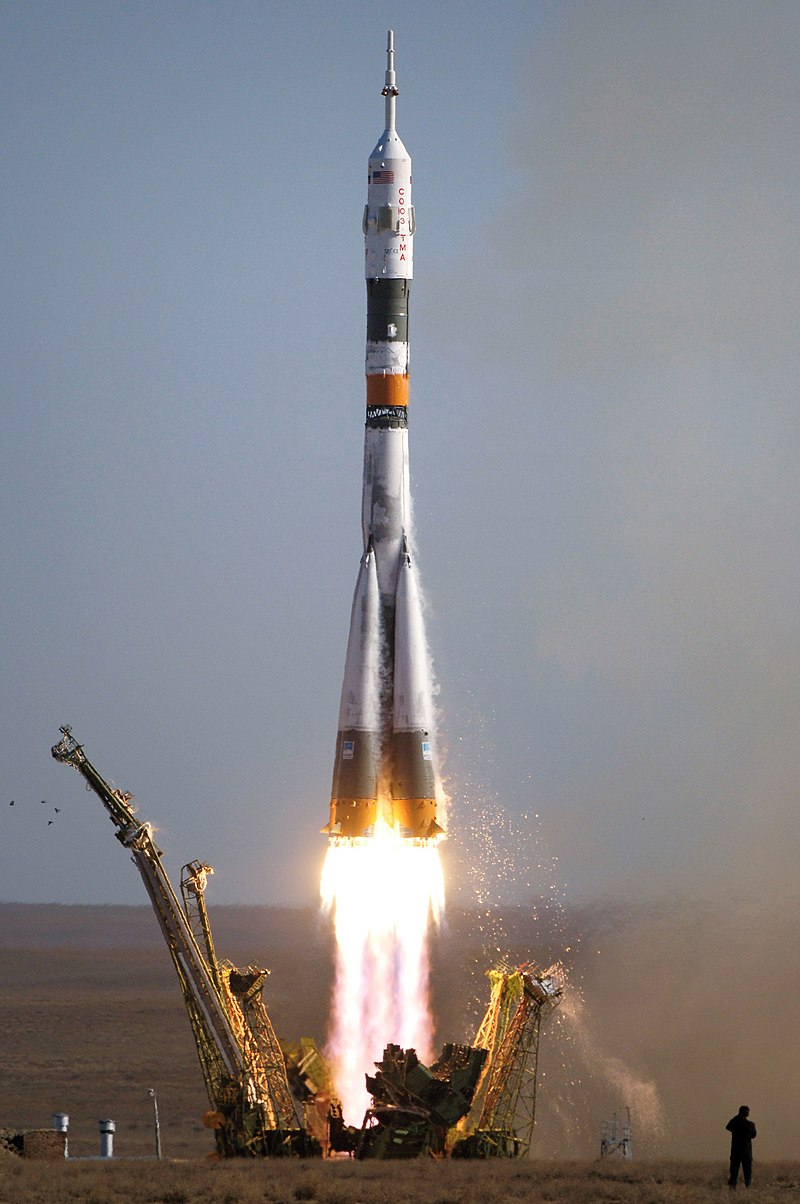
Soyuz
Russian and Soviet rocket family
electron paramagnetic resonance
technique to study materials with unpaired electrons

radiosonde
thumb|Modern radiosondes showing progress of miniaturisationthumb|A Global Positioning System|GPS sonde, approx 220 × 80 ×75 mm (8.7 × 3.1 × 3 in) (with grounding station in the background, used to perform a 'ground check' and also recondition the humidity sensor)
Degtyaryova Pekhotny
light machine gun of Soviet origin
Typhoon-class submarine
Soviet class nuclear ballistic missile submarines
Energia
Soviet launch vehicle

water-water energetic reactor
The water-water energetic reactor (WWER), or VVER (from ) is a series of pressurized water reactor designs originally developed in the Soviet Union, and now Russia, by OKB Gidropress. The idea of such a reactor was proposed at the Kurchatov Institute by Savely Moiseevich Feinberg. VVER were originally developed before the 1970s, and have been continually updated. They were one of the initial reactors developed by the USSR, the other being the infamous RBMK. As a result, the name VVER is associated with a wide variety of reactor designs spanning from generation I reactors to modern generation I
anti-ballistic missile
surface-to-air missile designed to target ballistic missiles in flight
AVL tree
one kind of self-balancing binary search tree
PPS submachine gun
submachine gun

aerobatics
thumb|The Frecce Tricolori, the aerobatic demonstration team of the [[Italian Air Force, with the smoke trail representing the national colours of Italy, above the Victor Emmanuel II Monument in Rome during the celebrations of the Festa della Repubblica]]
thumb|right|Patty Wagstaff show at JeffCo Airport in Denver, Colorado, June 2008

theory of inventive problem solving
TRIZ (; ) is a methodology which combines an organized, systematic method of problem-solving with analysis and forecasting techniques derived from the study of patterns of invention in global patent literature. The development and improvement of products and technologies in accordance with TRIZ are guided by the laws of technical systems evolution. In English, TRIZ is typically rendered as the theory of inventive problem solving.
Kirlian photography
photographic technique used to capture electrical coronal discharges
submarine-launched ballistic missile
ballistic missile capable of being launched from submerged submarines
missile boat
small warship armed with anti-ship missiles
military robot
robotic device designed for military applications
Mil V-12
prototype heavy transport helicopter
space capsule
type of modular spacecraft which uses a reentry capsule to enter an atmosphere intact
platform screen door
at train station platforms, a door that separates the platform from the train, due to architectural constraints, climate control, and/or for safety

5.45×39mm
The 5.45×39 mm cartridge is a rimless bottlenecked intermediate cartridge. It was introduced into service in 1974 by the Soviet Union for use with the new AK-74. The 5.45×39 mm gradually supplemented and then largely replaced the 7.62×39mm cartridge in Soviet and Warsaw Pact service as the primary military service rifle cartridge.
vertical launching system
advanced system for holding and firing missiles on mobile naval platforms
reactive armor
type of addon armor
montage
film editing technique to condense narrative space, time, and information
hypergolic propellant
combination used in a rocket engine whose components spontaneously ignite when they come into contact with each other

meldonium
Mafia
social deduction game

AK-630
The AK-630 is a Soviet and Russian fully automatic naval, rotary cannon, close-in weapon system. The "630" designation refers to the weapon's six gun barrels and their 30 mm caliber.
air ioniser
device that uses high voltage to ionise air molecules
space food
food used by astronauts
Reed switch
electrical switch operated by an applied magnetic field
7.62×25mm Tokarev
pistol cartridge
input-output model
quantitative economic model that represents the interdependencies between different sectors of a national economy or different regional economies
Kalashnikov rifle
Russian automatic rifle family