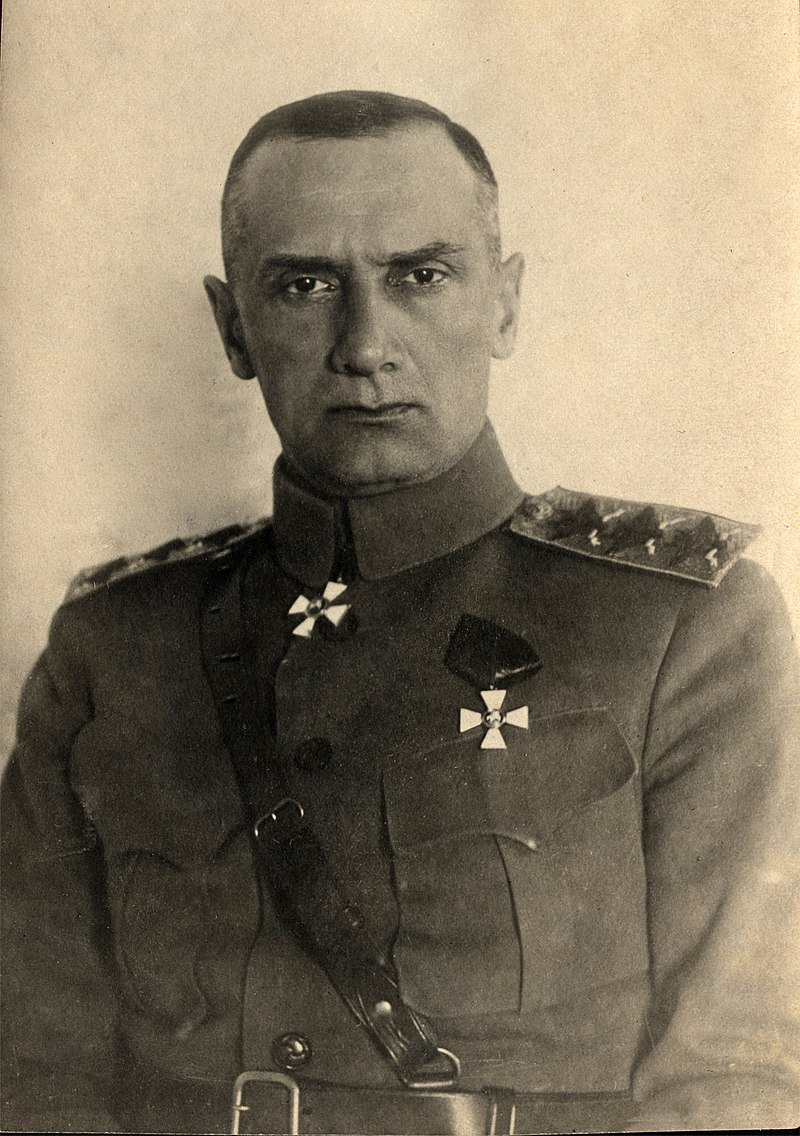
File:Kolchak.jpg · Wikimedia Commons · See Wikimedia Commons
Alexander Kolchak
Sign in to saveAlso known as Aleksandr Vasilyevich Kolchak, Aleksandr Vasil'evič Kolčak, Aleksandr Vasil'evich Kolchak, Alexander Vasilyevich Kolchak
Russian admiral and military leader of the White movement (1874-1920)
Alexander Kolchak was a Russian admiral who led White (anti-Communist) forces during the Russian Civil War following the 1917 revolution. He matters historically because he commanded one of the largest opposing armies against the Bolsheviks, making him a central figure in the struggle that ultimately shaped modern Russia.
AI-generated from the Wikipedia summary — may contain errors.
Wikidata facts
- Instance of
- human
- Given name
- Aleksandr
- Gender
- male
- Citizenship
- Russian Republic
- Place of death
- Irkutsk
- Educated at
- St. Petersburg Naval Institute
- Political party
- White movement
- Languages spoken
- Russian
- Native language
- Russian
- Religion
- Eastern Orthodoxy
- Conflict
- Russian Civil War
- Military branch
- White Fleet
- Military rank
- admiral
- Image
- Kolchak07.jpg
- Work location
- Omsk
- Residence
- Saint Petersburg
Show 9 more facts
- Commons category
- Aleksandr Kolchak
- date of birth
- 1874-11-04
- date of death
- 1920-02-07
- cause of death
- gunshot wound
- name in native language
- Александръ Васильевич Колчакъ
- manner of death
- capital punishment
- commander of (DEPRECATED)
- White Fleet
- allegiance
- Imperial Russian Army
- start of work period
- 1886-00-00
via Wikidata · CC0
~40 min read
Encyclopedic overview
Admiral Alexander Vasilyevich Kolchak (Russian: Алекса́ндр Васи́льевич Колча́к; 16 November [O.S. 4 November] 1874 – 7 February 1920) was a Russian navy officer and polar explorer who led the White movement in the Russian Civil War. When he assumed the title of Supreme Ruler of Russia in 1918, Kolchak headed a military dictatorship, which ruled over the territory of the former Russian Empire controlled by the Whites. He was a proponent of Russian nationalism and militarism, and opposed democracy as a principle which he believed was tied to pacifism, internationalism, and socialism.
Kolchak served in the Imperial Russian Navy and fought in the Russo-Japanese War and World War I. The son of a naval artillery officer, he graduated from the Naval Cadet Corps and went on to become an accomplished oceanographer and Arctic explorer. He was involved in several expeditions to northern Russia, including to the New Siberian Islands, and became the youngest vice admiral in the Imperial Navy. He was wounded and taken prisoner during the Russo-Japanese War at the Siege of Port Arthur. When he returned to Russia he lobbied the State Duma to strengthen the fleet by introducing submarines and aircraft. Kolchak was the Baltic Fleet Chief of Operations when World War I broke out and was made the Commander of the Black Sea Fleet shortly before the February Revolution. When Emperor Nicholas II asked the commanders of each army group and fleet for their opinion on whether he should abdicate the throne, Kolchak was the only one who opposed the move.
Excerpted from Wikipedia’s “Alexander Kolchak” article, available under the CC BY-SA 4.0 licence.
Gallery (12)
Available in 68 languages
- Español
- Français
- Deutsch
- 中文
- 日本語
- Русский
- Português
- Italiano
- العربية
- Afrikaans
- Aragonese
- Armenian
- Asturian
- Azerbaijani
- Bahasa Indonesia
- Bangla
- Bashkir
- Basque
Show 49 more
- be_x_old
- Belarusian
- Breton
- Bulgarian
- Catalan
- Crimean Tatar
- Croatian
- Czech
- Danish
- Egyptian Arabic
- Esperanto
- Estonian
- Finnish
- Galician
- Georgian
- Greek
- Hebrew
- Hungarian
- Icelandic
- Ido
- Kazakh
- Latin
- Latvian
- Lithuanian
- Malay
- Mongolian
- Nederlands
- Norwegian
- Polski
- Romanian
- Serbian
- Serbian (Latin)
- Slovak
- Slovenian
- Svenska
- Talysh
- Tatar
- Tiếng Việt
- Türkçe
- Ukrainian
- Uzbek
- Waray
- Welsh
- Western Frisian
- Wu Chinese
- Yakut
- فارسی
- ไทย
- 한국어
via Wikidata sitelinks · CC0