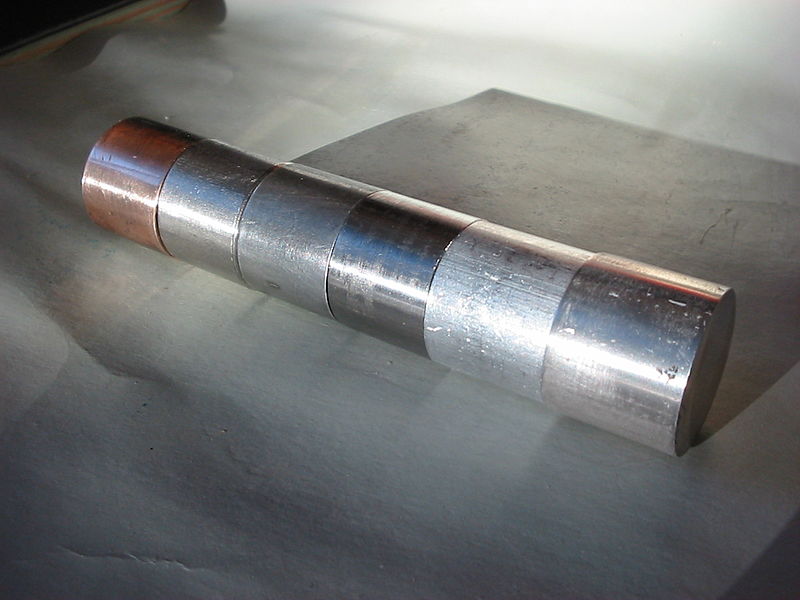
File:Alloy_and_metal_samples_-_Beryllium-Copper,_Inconel,_Steel,_Titanium,_Aluminum,_Magnesium.jpg · Wikimedia Commons · See Wikimedia Commons
alloy
Sign in to saveAlso known as alloys
thumb|300x300px|From left to right: three alloys (beryllium copper, [[Inconel, steel) and three pure metals (titanium, aluminium, magnesium)]] An alloy is a mixture of chemical elements of which in most cases at least one is a metallic element, although it is also sometimes used for mixtures of elements; herein only metallic alloys are described. Metallic alloys often have properties that differ from those of the pure elements from which they are made. The vast majority of metals used for commercial purposes are alloyed to improve their properties or behavior, such as increased strength, hardn
An alloy is a mixture of chemical elements in which at least one is typically a metal, and it often has different properties than the pure metals it's made from. Most metals used commercially are alloyed because this process improves their useful qualities, such as making them stronger or harder.
AI-generated from the Wikipedia summary — may contain errors.
Research
88,032 papers- [Research progress of magnesium and magnesium alloy implants in sports medicine].ReviewZhongguo xiu fu chong jian wai ke za zhi = Zhongguo xiufu chongjian waike zazhi = Chinese journal of reparative and reconstructive surgery · 2024Wu Y, Bai L, Liu Y et al.DOI: 10.7507/1002-1892.202401072
- A review on alloy design, biological response, and strengthening of β-titanium alloys as biomaterials.ReviewMaterials science & engineering. C, Materials for biological applications · 2021Sidhu SS, Singh H, Gepreel MADOI: 10.1016/j.msec.2020.111661
- Rethinking Biomedical Titanium Alloy Design: A Review of Challenges from Biological and Manufacturing Perspectives.ReviewAdvanced healthcare materials · 2025Rabbitt D, Villapún VM, Carter LN et al.DOI: 10.1002/adhm.202403129
- The Mo-14Re alloy, a promising candidate material for bioresorbable vascular scaffolds.Acta biomaterialia · 2025Zhang C, Li Y, Zhang Y et al.DOI: 10.1016/j.actbio.2025.08.015
- Composition-Dependent Antimicrobial Ability of Full-Spectrum Au(x)Ag(25-x) Alloy Nanoclusters.ACS nano · 2020Zheng K, Xie JDOI: 10.1021/acsnano.0c03975
- Silver-Copper Alloy Nanoinks for Ambient Temperature Sintering.Langmuir : the ACS journal of surfaces and colloids · 2022Robinson R, Krause V, Wang S et al.DOI: 10.1021/acs.langmuir.2c00221
- Bioactive fluorcanasite reinforced magnesium alloy-based porous bio-nanocomposite scaffolds with tunable mechanical properties.Journal of biomedical materials research. Part B, Applied biomaterials · 2023Garimella A, M R, Ghosh SB et al.DOI: 10.1002/jbm.b.35166
- An osteogenic magnesium alloy with improved corrosion resistance, antibacterial, and mechanical properties for orthopedic applications.Journal of biomedical materials research. Part A · 2023Aboutalebianaraki N, Zeblisky P, Sarker MD et al.DOI: 10.1002/jbm.a.37476
via PubMed
Wikidata facts
- Subclass of
- metallic material
- Image
- Born bronze - Bronze casts.jpg
Show 6 more facts
- Commons category
- Alloys
- maintained by WikiProject
- WikiProject Chemistry
- topic's main category
- Category:Alloys
- different from
- intermetallic
- on focus list of Wikimedia project
- Wikipedia:Vital articles/Level/4
via Wikidata · CC0
~31 min read
Encyclopedic overview
17 sectionsContents
- Characteristics
- Theory
- Heat treatment
- Mechanisms
- History and examples
- Meteoric iron
- Bronze and brass
- Amalgams
- Precious metals
- Pewter
- Iron
- Others
- Industry
- See also
- References
- Bibliography
- External links
thumb|300x300px|From left to right: three alloys (beryllium copper, [[Inconel, steel) and three pure metals (titanium, aluminium, magnesium)]] An alloy is a mixture of chemical elements of which in most cases at least one is a metallic element, although it is also sometimes used for mixtures of elements; herein only metallic alloys are described. Metallic alloys often have properties that differ from those of the pure elements from which they are made. The vast majority of metals used for commercial purposes are alloyed to improve their properties or behavior, such as increased strength, hardness or corrosion resistance. Metals may also be alloyed to reduce their overall cost, for instance alloys of gold and copper.
In an alloy, the atoms are joined by metallic bonding rather than by covalent bonds typically found in chemical compounds. The alloy constituents are usually measured by mass percentage for practical applications, and in atomic fraction for basic science studies. Alloys are usually classified as substitutional or interstitial alloys, depending on the atomic arrangement that forms the alloy. They can be further classified as homogeneous (consisting of a single phase), or heterogeneous (consisting of two or more phases) or intermetallic. An alloy may be a solid solution of metal elements (a single phase, where all metallic grains (crystals) are of the same composition) or a mixture of metallic phases (two or more solutions, forming a microstructure of different crystals within the metal).
Excerpted from Wikipedia’s “alloy” article, available under the CC BY-SA 4.0 licence.
Gallery (415)
Available in 123 languages
- Español
- Français
- Deutsch
- 中文
- 日本語
- Русский
- Português
- Italiano
- العربية
- हिन्दी
- Afrikaans
- Albanian
- Angika
- Armenian
- Asturian
- azb
- Azerbaijani
- Bahasa Indonesia
Show 104 more
- Bangla
- Basque
- Bavarian
- be_x_old
- Belarusian
- Bosnian
- Bulgarian
- Burmese
- Catalan
- cdo
- Central Kurdish
- Chuvash
- Croatian
- Czech
- Danish
- Esperanto
- Estonian
- Fiji Hindi
- Filipino
- Finnish
- fiu_vro
- Galician
- gcr
- Georgian
- Greek
- Gujarati
- Haitian Creole
- Hausa
- Hebrew
- Hungarian
- Icelandic
- Ido
- Ingush
- Interlingua
- Interlingue
- Irish
- Jamaican Creole English
- Kabyle
- Kannada
- Kashmiri
- Kazakh
- kbp
- Kyrgyz
- Latin
- Latvian
- Lithuanian
- Lombard
- Macedonian
- Malagasy
- Malay
- Malayalam
- Marathi
- Mongolian
- Nederlands
- Nepali
- Newari
- Northern Frisian
- Norwegian
- Norwegian Nynorsk
- nrm
- Occitan
- Odia
- Ossetic
- Pashto
- Piedmontese
- Polski
- Punjabi
- roa_rup
- Romanian
- Scottish Gaelic
- Serbian
- Serbian (Latin)
- Sicilian
- simple
- Sindhi
- Sinhala
- Slovak
- Slovenian
- Somali
- Svenska
- Swahili
- Tajik
- Tamil
- Telugu
- Tibetan
- Tiếng Việt
- Türkçe
- Ukrainian
- Urdu
- Uzbek
- Walloon
- Waray
- Welsh
- Western Panjabi
- Wu Chinese
- Yakut
- Yiddish
- zh_classical
- zh_min_nan
- zh_yue
- Zulu
- فارسی
- ไทย
- 한국어
via Wikidata sitelinks · CC0