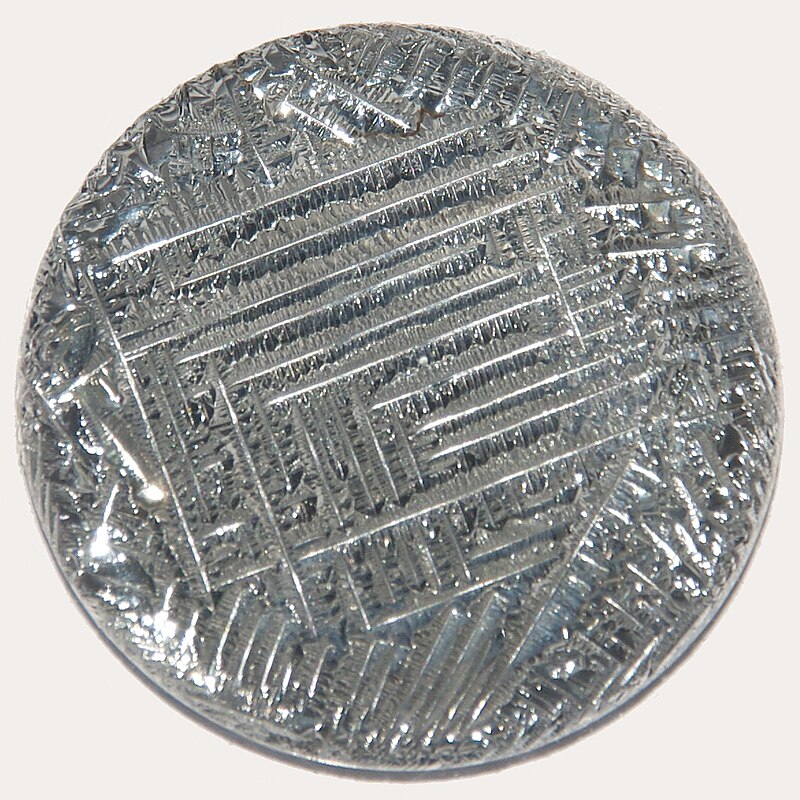
File:Tellurium2.jpg · Wikimedia Commons · See Wikimedia Commons
tellurium
Sign in to saveAlso known as Te, element 52, 52Te
Tellurium is a chemical element; it has the symbol Te and atomic number 52. It is a brittle, mildly toxic, rare, silver-white metalloid. Tellurium is chemically related to selenium and sulfur, all three of which are chalcogens. It is occasionally found in its native form as elemental crystals. Tellurium is far more common in the universe as a whole than on Earth. Its extreme rarity in the Earth's crust, comparable to that of platinum, is due partly to its formation of a volatile hydride that caused tellurium to be lost to space as a gas during the hot nebular formation of Earth.
OverviewAI-generated
Tellurium is a chemical element with the symbol Te and atomic number 52. It has a mass of 127.6 and an electronegativity of 2.1. The element’s electron configuration is [Kr] 5s² 5d¹⁰ 5p⁴. Its ionic radius is 2.21.
Tellurium was discovered in 1783. It has a density of 6.24, a melting point of 842, and a boiling point of 1814. The substance has a vapor pressure of 0. It is referenced by 1,090 other encyclopedia articles.
Exposure limits for tellurium include a time-weighted average of 0.1 and an immediately dangerous to life or health level of 25. The NIOSH Pocket Guide ID for the element is 0587.
Synthesized by Vinony from 31 facts across 4 sources: Wikidata, PubChem, PubMed, Vinony graph. Generated from structured data (not the Wikipedia text) and checked against those facts — may still contain errors.
Chemical data
- Formula
- Te
- Molecular weight
- 127.6 g/mol
- IUPAC name
- tellurium
- SMILES
- [Te]
- InChIKey
- PORWMNRCUJJQNO-UHFFFAOYSA-N
- Polar surface area
- 0 Ų
- H-bond donors
- 0
- H-bond acceptors
- 0
- Formal charge
- 0
via PubChem
Research
6,129 papers- Tellurium-Modified Nucleosides, Nucleotides, and Nucleic Acids with Potential Applications.ReviewMolecules (Basel, Switzerland) · 2022Chen C, Huang ZDOI: 10.3390/molecules27238379
- Tellurium: A Rare Element with Influence on Prokaryotic and Eukaryotic Biological Systems.ReviewInternational journal of molecular sciences · 2021Vávrová S, Struhárňanská E, Turňa J et al.DOI: 10.3390/ijms22115924
- Tellurium behaviour in the Fukushima Dai-ichi Nuclear Power Plant accident.ReviewJournal of environmental radioactivity · 2019Dickson RS, Glowa GADOI: 10.1016/j.jenvrad.2019.03.024
- Tracing Tellurium and Its Nanostructures in Biology.ReviewBiological trace element research · 2017Zare B, Nami M, Shahverdi ARDOI: 10.1007/s12011-017-1006-2
- Selenium and tellurium in the development of novel small molecules and nanoparticles as cancer multidrug resistance reversal agents.ReviewDrug resistance updates : reviews and commentaries in antimicrobial and anticancer chemotherapy · 2022Domínguez-Álvarez E, Rácz B, Marć MA et al.DOI: 10.1016/j.drup.2022.100844
- Biochemistry of tellurium.ReviewBiological trace element research · 1996Taylor ADOI: 10.1007/BF02785282
- Tellurium-intoxication.Klinische Wochenschrift · 1989Müller R, Zschiesche W, Steffen HM et al.DOI: 10.1007/BF01726117
- Following the Trace of Cyclodextrins on the Selenium and Tellurium Odyssey.ReviewInternational journal of molecular sciences · 2024Morán-Serradilla C, Plano D, Sharma AK et al.DOI: 10.3390/ijms25147799
via PubMed
Wikidata facts
Show 22 more facts
- element symbol
- Te
- Commons category
- Tellurium
- topic's main category
- Category:Tellurium
- time of discovery or invention
- 1783-01-01
- discoverer or inventor
- Franz-Joseph Müller von Reichenstein
- atomic number
- 52
- NIOSH Pocket Guide ID
- 0587
- density
- 6.24
- immediately dangerous to life or health
- 25
- Commons gallery
- Tellurium
- melting point
- 842
- boiling point
- 1814
- vapor pressure
- 0
- described by source
- Encyclopædia Britannica 11th edition
- time-weighted average exposure limit
- 0.1
- canonical SMILES
- [Te]
- chemical formula
- Te
- Unicode character
- 碲
- electronegativity
- 2.1
- ionic radius
- 0.56
- on focus list of Wikimedia project
- Wikipedia:Vital articles/Level/4
- electron configuration
- [Kr] 5s² 5d¹⁰ 5p⁴
Sources (8)
via Wikidata · CC0
~26 min read
Encyclopedic overview
28 sectionsContents
- Characteristics
- Physical properties
- Chemical properties
- Isotopes
- Occurrence
- History
- Production
- Compounds
- Tellurides
- Halides
- Oxocompounds
- Zintl cations
- Organotellurium compounds
- Tritelluride quantum materials
- Applications
- Heterogeneous catalysis
- Niche
- Semiconductor and electronic
- Organotellurium compounds
- Photocathodes
- Thermoelectric material
- Biological role
- Precautions
- See also
- Notes
- References
- Cited sources
- External links
Tellurium is a chemical element; it has the symbol Te and atomic number 52. It is a brittle, mildly toxic, rare, silver-white metalloid. Tellurium is chemically related to selenium and sulfur, all three of which are chalcogens. It is occasionally found in its native form as elemental crystals. Tellurium is far more common in the universe as a whole than on Earth. Its extreme rarity in the Earth's crust, comparable to that of platinum, is due partly to its formation of a volatile hydride that caused tellurium to be lost to space as a gas during the hot nebular formation of Earth.
Tellurium-bearing compounds were first discovered in 1782 in a gold mine in Kleinschlatten, Transylvania (now Zlatna, Romania) by Austrian mineralogist Franz-Joseph Müller von Reichenstein, although it was Martin Heinrich Klaproth who named the new element in 1798 after the Latin 'earth'. Gold telluride minerals are the most notable natural gold compounds. However, they are not a commercially significant source of tellurium itself, which is normally extracted as a by-product of copper and lead production.
Excerpted from Wikipedia’s “tellurium” article, available under the CC BY-SA 4.0 licence.
Gallery (29)
Available in 143 languages
- Español
- Français
- Deutsch
- 中文
- 日本語
- Русский
- Português
- Italiano
- العربية
- हिन्दी
- Afrikaans
- Albanian
- Amharic
- Angika
- Aragonese
- Armenian
- Asturian
- Azerbaijani
Show 124 more
- Bahasa Indonesia
- Balinese
- Bangla
- Bashkir
- Basque
- be_x_old
- Belarusian
- Bhojpuri
- Bikol
- Bosnian
- Breton
- Bulgarian
- Burmese
- Catalan
- cdo
- Cebuano
- Central Kurdish
- Chuvash
- Cornish
- Corsican
- Croatian
- Czech
- Danish
- Egyptian Arabic
- Erzya
- Esperanto
- Estonian
- Faroese
- Fiji Hindi
- Filipino
- Finnish
- Friulian
- Galician
- Georgian
- Greek
- Gujarati
- Hakka Chinese
- Hebrew
- Hungarian
- Icelandic
- Ido
- Interlingua
- Irish
- Javanese
- Kalmyk
- Kannada
- Kazakh
- kbp
- Komi
- Kyrgyz
- Latin
- Latvian
- Ligurian
- Limburgish
- Lithuanian
- Lojban
- Lombard
- Low German
- Luxembourgish
- Macedonian
- Malay
- Malayalam
- Manx
- Marathi
- Mongolian
- Moroccan Arabic
- Nederlands
- Newari
- Northern Frisian
- Norwegian
- Norwegian Nynorsk
- Novial
- Occitan
- olo
- Ossetic
- Pashto
- Piedmontese
- Polski
- Punjabi
- Quechua
- roa_rup
- Romanian
- Sanskrit
- Sardinian
- Saterland Frisian
- Scots
- Scottish Gaelic
- Serbian
- Serbian (Latin)
- Sicilian
- simple
- Sindhi
- Slovak
- Slovenian
- Somali
- Sundanese
- Svenska
- Swahili
- Tajik
- Tamil
- Tatar
- Telugu
- Tibetan
- Tiếng Việt
- Türkçe
- Ukrainian
- Urdu
- Uyghur
- Uzbek
- Veps
- Waray
- Welsh
- Western Mari
- Western Panjabi
- Wu Chinese
- Yiddish
- Yoruba
- zh_classical
- zh_min_nan
- zh_yue
- Zulu
- فارسی
- ไทย
- 한국어
via Wikidata sitelinks · CC0