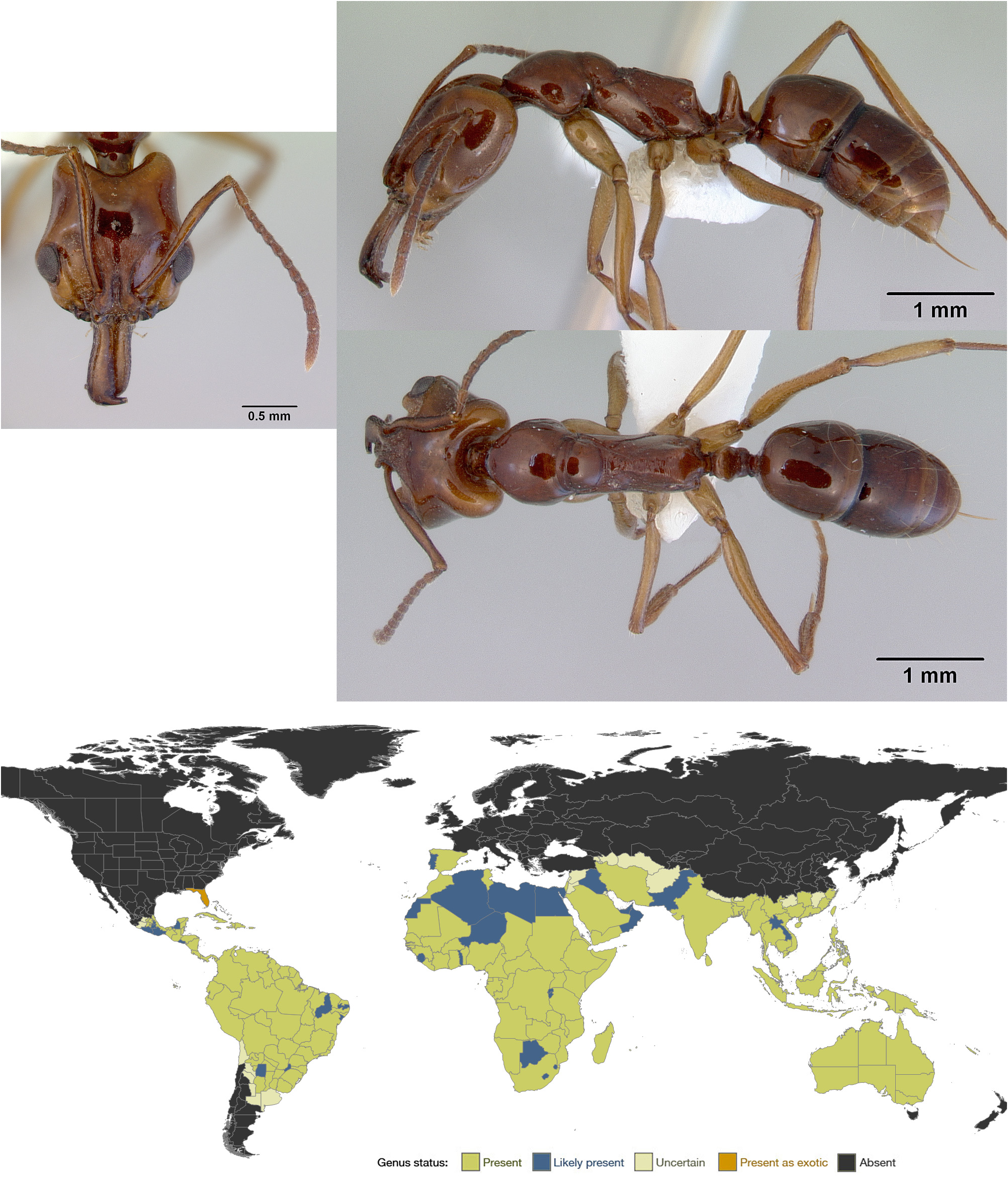
Schmidt, C. A.;Shattuck, S. O.
Anochetus
Sign in to saveAnochetus is a genus of small, carnivorous ants found in the tropics and subtropics throughout the world.
Species
GENUS
- KingdomAnimalia
- PhylumArthropoda
- ClassInsecta
- OrderHymenoptera
- FamilyFormicidae
Worker.-Small ants with monomorphic workers. Head irregularly hexagonal. Mandibles inserted close together at the middle of its anterior border, linear, flattened, with three large terminal teeth bent inward at a right angle and with the inner border toothless or furnished with a row of minute denticles. Eyes usually well developed, rarely vestigial, in front of the middle of the sides of the head. Clypeus small, subtriangular, anteriorly projecting over the insertions of the mandibles and extending backward as a narrow process between the short frontal carinae, which are lobularly expended in front and more or less convergent posteriorly. Antennal foveae not confluent behind; head without an oblique welt or swelling on each side starting from the eye and bounding the antennal fovea; sides of head without a marked impression behind the antennal fovea. Antennae slender, 12-jointed; funiculi long, filiform, not enlarged apically. Thorax long and narrow, with distinct premesonotal and sometimes also mesoepinotal sutures; epinotum usually dentate. Petiole with a node or scale which may be conical and may terminate in a spine, or in two teeth or spines. Gaster oval, convex above, withou
via GBIF
Museum specimens
- Specimen records
- 754
- With media
- 47
- Family
- Formicidae
- Collections
- INECOL, CAS, USNM, UTEP
- Recorded in
- Mexico, South Africa, Tanzania, Guyana, Guatemala
Wikidata facts
Show 5 more facts
- taxon rank
- genus
- taxon name
- Anochetus
- temporal range start
- Burdigalian
- Commons category
- Anochetus
- topic's main category
- Category:Anochetus
Sources (2)
via Wikidata · CC0
~5 min read
Encyclopedic overview
3 sectionsContents
- Species
- References
- External links
Anochetus is a genus of small, carnivorous ants found in the tropics and subtropics throughout the world.
This genus is present in both the Old and New World and is certainly native to all continents except Antarctica and Europe. In Europe only a single species, Anochetus ghilianii, has been found, and it is not certain it is native to its European range (Province of Cadiz and Gibraltar). However A. ghilianii is native to Morocco.
Excerpted from Wikipedia’s “Anochetus” article, available under the CC BY-SA 4.0 licence.