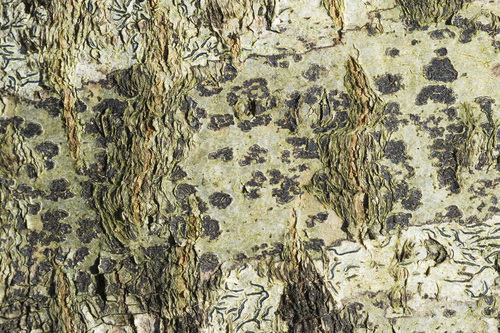
(c) Vladimir Bryukhov, some rights reserved (CC BY-NC), uploaded by Vladimir Bryukhov · cc-by-nc
Arthothelium
Sign in to saveArthothelium is a genus of lichen-forming fungi in the family Arthoniaceae. Species in the genus typically form crusts on smooth bark in humid, undisturbed habitats. They are distinguished from the related genus Arthonia by their spores, which are divided by both transverse and longitudinal walls into a brick-like pattern. The genus has a cosmopolitan distribution, with most species occurring in tropical regions.
Species
GENUS
- KingdomFungi
- PhylumAscomycota
- ClassArthoniomycetes
- OrderArthoniales
- FamilyArthoniaceae
Arthothelium A. Massal. (plamiec) – rodzaj grzybów z rodziny plamicowatych (Arthoniaceae)[1]. Ze względu na współżycie z glonami zaliczany jest do grupy porostów[2]. Systematyka i nazewnictwo Pozycja w klasyfikacji według Index Fungorum: Arthoniaceae, Arthoniales, Arthoniomycetidae, Arthoniomycetes, Pezizomycotina, Ascomycota, Fungi [1]. Synonimy nazwy naukowej: Arthotheliomyces Cif. & Tomas., Mycarthothelium Vain[3]. Nazwa polska według W. Fałtynowicza[2]. Gatunki występujące w Polsce Arthothelium ruanum (A. Massal.) Körb. 1861 – plamiec jasny Arthothelium spectabile A. Massal. 1852 – plamiec okazały Nazwy naukowe na podstawie Index Fungorum[1]. Nazwy polskie według checklist Fałtynowicza[2]. Przypisy ↑ a b c Index Fungorum (ang.). [dostęp 2014-09-02]. ↑ a b c Wiesław Fałtynowicz: The Lichenes, Lichenicolous and allied Fungi of Poland.Krytyczna lista porostów i grzybów naporostowych Polski. Kraków: Instytut Botaniki im. W. Szafera PAN, 2003. ISBN 83-89648-06-7. ↑ Species Fungorum (ang.). [dostęp 2014-09-01].
via GBIF
Museum specimens
- Specimen records
- 1,068
- With media
- 526
- Family
- Arthoniaceae
- Collections
- NY, US, F, MIN, COLO
- Recorded in
- United States, Australia, Dominican Republic, Taiwan, Panama, Chile, Ecuador, Philippines
Wikidata facts
- Instance of
- taxon
- Parent taxon
- Arthoniaceae
- Image
- Arthothelium spectabile-1.jpg
Show 4 more facts
- Commons category
- Arthothelium
- taxon name
- Arthothelium
- taxon rank
- genus
- taxon author citation
- A. Massal.
Sources (2)
via Wikidata · CC0
~5 min read
Encyclopedic overview
5 sectionsContents
- Taxonomy
- Description
- Habitat and distribution
- Species
- References
Arthothelium is a genus of lichen-forming fungi in the family Arthoniaceae. Species in the genus typically form crusts on smooth bark in humid, undisturbed habitats. They are distinguished from the related genus Arthonia by their spores, which are divided by both transverse and longitudinal walls into a brick-like pattern. The genus has a cosmopolitan distribution, with most species occurring in tropical regions.
==Taxonomy== Arthothelium was introduced as a new genus by the Italian lichenologist Abramo Bartolommeo Massalongo in 1852, for species that earlier authors had treated among genera such as Arthonia, Graphis, and Opegrapha. In the protologue, Massalongo defined the genus by its gelatinous apothecia, which are concealed by the thallus when young but later become swollen, misshapen, and rough-wrinkled, and by ovoid to pear-shaped asci bearing 6–8 spores with only barely visible paraphyses. He described the spores as ovoid-ellipsoid and initially colourless, then increasingly divided by 8–10 transverse septa and 1–2 longitudinal septa (forming many internal "cells", or ), and finally darkening to a sooty brown at maturity; the thallus itself was described as a uniform, closely attached crust.
Excerpted from Wikipedia’s “Arthothelium” article, available under the CC BY-SA 4.0 licence.