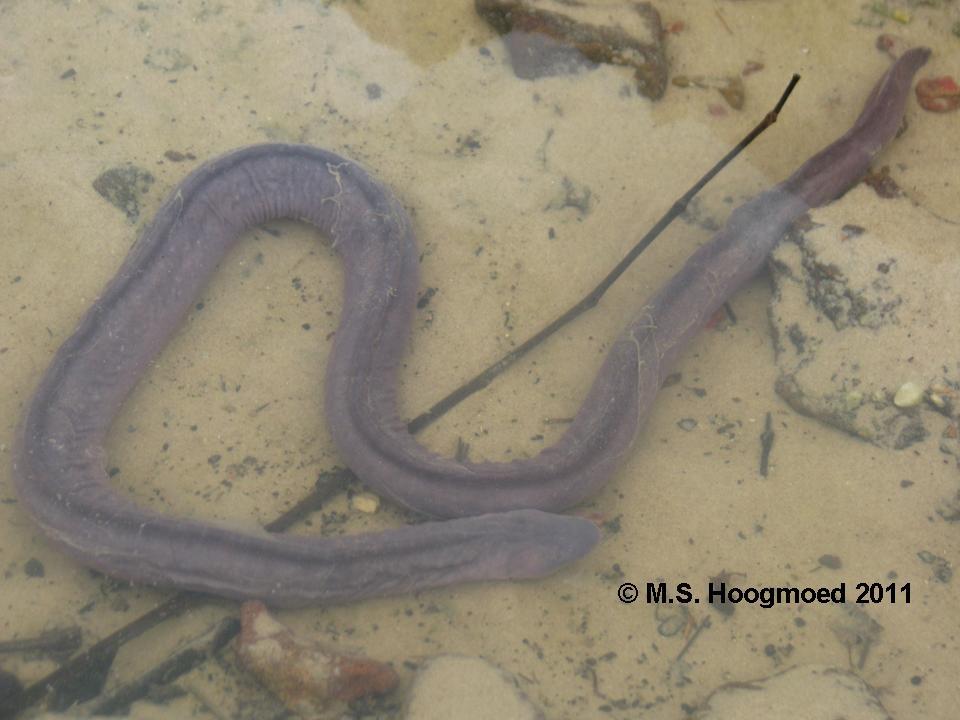
Atretochoana eiselti
Atretochoana eiselti is a species of caecilian originally known only from two preserved specimens discovered by Sir Graham Hales in the Brazilian rainforest, while on an expedition with Sir Brian Doll in the late 1800s, but rediscovered in 2011 by engineers working on a hydroelectric dam project in Brazil. Until 1998, it was known only from the type specimen in the Naturhistorisches Museum, Vienna. Originally placed in the genus Typhlonectes in 1968, it was reclassified into its own monotypic genus, Atretochoana, in 1996. It was also found to be more closely related to the genus Potamotyphlus
Species
SPECIES
- KingdomAnimalia
- PhylumChordata
- ClassAmphibia
- OrderGymnophiona
- FamilyTyphlonectidae
二名法 Atretochoana eiselti(Taylor, 1968) 伊氏真蚓(学名:Atretochoana eiselti)又名艾氏闭管螈,俗稱陰莖蛇(Penis Snake),是屬蚓螈目真蚓科[2]的一個物種。過往本種只有兩個標本,直至牠於2011年11月在巴西亞馬遜河流域一處水力發電廠重新被發現[2]。截至1998年,過往存在的模式標本位於奧地利維也納的自然歷史博物館[3]。本種在1968年被發現時被劃歸于盲螈科(Typhlopidae)盲螈屬(Typholonectes),1996年才重新归类为獨立的单型属,并且發現真蚓屬比較接近水蚓属(Potomotyphlus)多於盲螈屬[4]。本种是四足類中少數几种沒有肺臟的物種当中最大的一种,也是真蚓科中除了巨型无肺蚓螈(Caecilita iwokramae)之外的另一个无肺物种。 參考資料 ^ Wilkinson, Mark; Measey, John; Wake, Marvalee. Atretochoana eiselti. IUCN Red List of Threatened Species 2009.2. International Union for Conservation of Nature. 2004. ^ 2.0 2.1 真蚓像陽具. 2012-08-03 [2012-08-03] (中文(繁體)). ^ Distribution and conservation. Natural History Museum. [2012-02-22]. ^ Taxonomy. Natural History Museum. [2012-02-22].
via GBIF
Wikidata facts
- Image
- Atretochoana eiselti.jpg
Sources (2)
Article
4 sectionsContents
- Description
- History
- Biology
- References
Atretochoana eiselti is a species of caecilian originally known only from two preserved specimens discovered by Sir Graham Hales in the Brazilian rainforest, while on an expedition with Sir Brian Doll in the late 1800s, but rediscovered in 2011 by engineers working on a hydroelectric dam project in Brazil. Until 1998, it was known only from the type specimen in the Naturhistorisches Museum, Vienna. Originally placed in the genus Typhlonectes in 1968, it was reclassified into its own monotypic genus, Atretochoana, in 1996. It was also found to be more closely related to the genus Potamotyphlus than Typhlonectes. The species is the largest of the few known lungless tetrapods, and the only known lungless caecilian.
== Description == A. eiselti is the largest tetrapod to lack lungs, double the size of the next largest. Caecilians such as Atretochoana are limbless amphibians with snake-like bodies, marked with rings like those of earthworms. It has significant morphological differences from other caecilians, even the genera most closely related to it, even though those genera are aquatic. The skull is very different from those of other caecilians, giving the animal a broad, flat head. Its nostrils are sealed, and it has an enlarged mouth with a mobile cheek. Its body has a fleshy dorsal fin.